Corporate Team Building: A Postmodern Evolution at the Intersection of Sports and Human Resources Management
This article seeks to understand how team-building offerings are structured and what the main factors influencing them are. We first identified shifts in values associated with sports and their role in postmodern society. We conducted four semi-structured interviews with professionals from a company that provides team-building activities. The results of this qualitative study show that team building appears to follow trends associated with postmodern sports. Thus, the pursuit of enjoyment, playfulness, and well-being emerge as central concepts in team-building offerings. Changes in human resources management—particularly participatory management—also appear to contribute to the evolution of team building in terms of its forms and objectives. This reflects a desire to involve employees and foster connections among them through collaborative activities designed to bring them together.

Team building is a practice that revolves around several key components: the company, sports, and human resources management. It is therefore influenced by developments in these various areas and the interactions that take place among them.
To define it, according to Vernazobres (2012), team building is a practice similar to coaching: more specifically, it involves group support. It is based on the definition established by Syntec Conseil in 2006: “an intensive program conducted over a short period of time and used on an ad hoc basis […] to build a high-performing team dynamic.”
However, team building has undergone many changes since its inception and earliest forms. Initially, corporate sports became more widespread after World War II: they were primarily corporate in nature and driven by the involvement of works councils. Then, during the 1980s, corporate sports evolved into inter- and intra-company athletic competitions such as the Cross du Figaro, the Challenge du Lys, and the Cross des Violettes in Toulouse (Barbusse, 2009).
At the same time, sports activities that are practiced outside of competition began to emerge gradually: it was in this context that outdoor training camps emerged as the first form of corporate sports events and non-competitive activities. Combining the values of challenge, extreme sports, and adventure, these camps were quickly criticized in the 1990s and viewed as a devious means of evaluating and selecting employees while compromising their physical and psychological well-being (Julien Pierre and Tribou, 2013). This led to the emergence of new terms, widely used today and with a more promotional focus: “incentive” and “team-building” (Burlot and Pichot, 2004).
Furthermore, beyond sports participation and its place within the organization, the internal workings of companies have also changed. Indeed, looking back, the modern era placed the individual at the center of society and the workplace, particularly to meet performance requirements (division of labor, individual goals). However, individualism no longer seems to align with today’s new ways of doing business and new forms of human relationships (Lacan, 2016).
We are gradually seeing the emergence of new managerial practices based on a shift in hierarchical relationships and interpersonal dynamics among workers. The term “participatory” is thus used in reference to these new methods of management and the exercise of authority (Ehrenberg, 1999). From a postmodern perspective, management is equated with managers’ ability to adapt to their teams, improvising with their tools to improve a situation, satisfy everyone’s interests, and ensure the company’s performance (Lacan, 2016). Furthermore, managerial practices from the modern era are now obsolete due to the abandonment of the myth of progress in people’s consciousness (Ibid.). It is no longer a matter of succeeding in one’s career at any cost in order to succeed in life. The sacrifices and efforts demanded at work in order to advance within the company no longer seem sufficient for employees’ fulfillment. Thus, since the 2000s, a new concern has emerged for business leaders: well-being at work. Here we see the notion of hedonism—central to postmodernity—extending even into the professional sphere. This manifests, on the one hand, in changes to hierarchical relationships (moving toward more horizontal, peer-to-peer relationships) and, on the other hand, in the adoption of a managerial approach centered on kindness, active listening, and understanding of employees (Ibid.). Concern for quality of life at work will therefore prove fundamental in postmodernity, and team building—by fostering a shared emotional experience among a group of employees—could help improve collaboration among company members and foster a sense of belonging. Indeed, for a person to feel that they belong to a group or collective, the sense of community cannot arise on its own; it must be organized. Lacan (2016) therefore identifies the manager as responsible for facilitating their team. In the postmodern era, the manager-facilitator must personally create the conditions for cooperation among team members, for example, by leading a collaborative project carried out with everyone’s best interests in mind (Ibid.). Here, we might consider team-building and its collaborative activities, where each person’s involvement and skills are necessary to achieve a common goal.
For our study, we must also consider team building in light of current human resource management (HRM) practices, which are shaped by postmodern values. One such value is reflected in the pursuit of “self-actualization and personal fulfillment in the here and now, experienced in all [its] intensity” (Maffesoli, 2011, p. 14). Team building could be likened to a social group in which participants are connected by emotional bonds and shared experiences. From a postmodern perspective, the ephemeral fate to which people are collectively subjected matters more than the history one establishes contractually with others (Lacan, 2016). Here, we can draw a parallel with our subject of study, team building, since it takes the form of an activity chosen in advance by the manager, to which a group of employees is subjected for a set period of time—most often a few hours. The question here is whether these notions of shared experiences, lived experiences, and emotions are fully integrated into commercially available team-building programs.
Team building, as a management tool that brings people together to share experiences, could thus be influenced by postmodern values (collaboration, hedonism, emotion, experience). This therefore presents a real challenge for professionals in the sector who seek to offer programs whose format and content align with both current sports trends and the prevailing approaches to human resource management and leadership today.
This article seeks to explain how changes in sports practices and human resources management practices—which are moving toward postmodernity—contribute to shaping team-building offerings. On the one hand, we observe transformations in sports practices and a different, more postmodern integration of sports into team-building retreats. Next, we will examine how
Human resources management practices have evolved since the 1990s, and this evolution also influences the design of team-building programs.
Methodology
We adopted the perspective of team-building professionals and conducted four semi-structured interviews with four employees of a team-building service provider. Since the interviewees did not wish to remain anonymous, we will refer to them by their first names. The goal was to gather the perspectives of these employees, who all hold different positions within the company: sales representative (Maéva), project manager (Adrien), communications specialist (Sarah), and sales manager (Massimo). This allowed us to interview those who design, sell, facilitate, and promote the team-building programs offered by the company in question.
We chose to interview Maéva because she has been with the company the longest. As a result, she has a clear understanding of the changes that have occurred in the requests of the clients she regularly approaches. In addition, she’s also on the ground, leading the team-building events on the day they take place. This gives us a clear picture of how the activities unfold on the day of the event and what that actually entails: emotions, client feedback, and overall impressions. Adrien, a project manager, helped create several team-building programs that the company subsequently included in its catalog and marketed to clients. It is therefore important to speak with him to understand how he designs team-building activities and tailors them to his clients’ expectations. We then chose to speak with Sarah, the communications manager. She constantly monitors the competitive landscape to understand market demands and anticipated trends in team-building activities. We were able to understand what, in her view, helps attract clients, convince them to choose a particular team-building program, and what uses of team building and sports are expected in today’s corporate environment. Finally, Massimo, the sales manager, was an interesting subject because he deals with a more “high-end,” “luxury” clientele. We were curious to see whether the trends toward collaborative team-building programs—with a focus on fun and recreation—also applied to this type of clientele.
The interview method chosen for this study was the semi-structured interview. Indeed, it seemed important to structure the data collection process while providing respondents with a flexible framework, particularly through the use of the interview guide. Our goal was to guide the interviewees toward the major themes of our study using open-ended questions and to allow them to speak freely in order to gather the richest possible data.
The goal was to highlight the changes that have shaped the evolution of team building—in terms of its format, objectives, values, and, finally, its applications. Our interview guide covered three main themes: team building in general (definition, formats, objectives, values), client behavior (type of activity desired, concept of experience, feelings), and the team-building activities specifically offered by the service provider (the most successful ones, strengths, weaknesses, current trends). It should be noted that, having previously worked alongside all the interviewees, a relationship of trust with them had already been established before we made contact. The interviews took place either in person, at a location chosen by the interviewee, or via videoconference (for one of the participants). In terms of duration, the interviews lasted between 26 minutes and 1 hour, depending on how much time each person was able to set aside for us. Sarah was the busiest and granted us a Skype interview during her lunch break, which is why the conversation could not last longer than 26 minutes.
As part of our study, we chose to conduct a thematic analysis through data reduction. By recording each interview with a voice recorder, we were able to transcribe the collected data in its entirety. From the verbatim transcripts, we identified three themes that encapsulate the comments gathered: team-building programs and their specific characteristics, the postmodern values associated with them (emotions, experiences, collaboration), and the values of modern sports (competition, challenge). The qualitative data obtained provide a better understanding of the structure of team-building offerings and the changes that have taken place, according to our interviewees. Postmodern values, along with the evolution of management methods in companies, have allowed us to better grasp the challenges associated with this HRM tool.
Team Building Shaped by Changes in Sports Practices
Postmodern Sports: A Search for Emotions, Sensations, and Experiences
Sports in the workplace initially evolved in line with the shift from a modern society to so-called “postmodern” values. Thus, it is the hedonistic values of well-being, self-fulfillment, and a love of leisure that seem to be at the heart of our postmodern democratic society (Roederer and Filser, 2015). Sports are thus no longer a competitive activity but must, above all, satisfy a hedonistic pursuit that blends play and pleasure (Lacassagne et al., 2006 ).
The literature identifies “modern” sports—centered on the pursuit of performance, challenge, and victory—as being out of step with the concerns and expectations of the public in the late 1970s. The needs of the individual in the postmodern context are associated with notions of playfulness, emotions, and sensations (Corneloup, 2011). Today, team-building professionals are designing and marketing more programs that provide enjoyment and fun without constraints. Maéva adds: “We want to move toward something different—activities that are more fun and enjoyable.” “You have team-building events—and these days, they’re more focused on pleasure, fun, and playfulness—where we get participants to take part in a social experience they wouldn’t normally have,” explains Massimo, the sales manager. This reflects a key aspect of postmodern sports: quick access to thrills, a fully self-directed experience with minimal constraints—in contrast to the “federation-led” model (Gaubert, 2012) that predominates in modern society. Companies specializing in team building therefore seem to be following these trends by offering “original, playful, and fun” activities that guarantee employees will have a good time. All of our interviewees—whether they are responsible for designing team-building programs, marketing them, handling communications, or facilitating them during events—say they create programs based on enjoyment and playfulness. “It’s true that we’re also asked for activities without too many restrictions; with this approach, they want to have fun and enjoy themselves. In an ‘open’ format, it’s therefore open-access—always with a common theme, but open-access,” says Adrien, Project Manager.
“These days, we’re getting more and more requests for activities that aren’t competitive—ones designed to bring teams together, reward them, and simply share a moment of relaxation and fun,” added Sarah, the communications manager.
In postmodernity, sports are a means of experiencing a multitude of physical, spatio-temporal, and social experiences through “practices described as hedonistic, playful, aesthetic, and individual” (Lacassagne et al., 2004, p. 99). Our interviews show that these concepts are fundamental to team-building professionals, who therefore base their thinking and program design largely on the experience. “You come back from a team-building event, and you tell your kid: ‘Dad ate a scorpion,’ or they’re laughing their heads off playing giant foosball—typically […] they take pictures in front of it; it’s a massive thing—it’s 8 meters tall—those are the kinds of memorable moments,” explains Adrien, a project manager. But also, “Something out of the ordinary could, for example, be as simple as a seminar at an iconic location… The last time we organized an out-of-the-ordinary seminar for them, for example, you’d leave Marseille to go to Degbay Island because it’s a magical place that you have all to yourself, and that’s it—it’s the location itself that’s out of the ordinary” (Maéva, sales representative).
According to the literature on experiential consumption, consumers “seek immersive experiences in themed settings rather than simply encountering finished products” (Cova and Cova, 2004, p. 5). This characteristic recurred frequently in the comments of our interviewees, who emphasized the importance of the experience gained during a team-building event. This can be reflected, for example, in the location where the activity takes place: a natural environment, exceptional landscapes, or immersion in a specific world. The term “world” refers to the combination of settings, activities, and props used during a team-building activity to “immerse clients in a world,” through the use of strong themes. The skills of the facilitators on-site during team-building days also contribute to the creation of this “world.” In fact, one of the respondents emphasized the importance of the “human element” in bringing the experience to life for the client: the client will remember, above all, the person who made their team-building activity come alive and the moment they experienced thanks to that person.
Furthermore, it is important to examine the relationship to competition. According to the authors, recreational sports—although a source of well-being, pleasure, and excitement for individuals—are not necessarily detached from competition in French society, which then takes on a more hedonistic dimension. Thus, we can note that “in its postmodern aspect, sports incorporates training and competition as sources of pleasure and relaxation” (Lacassage et al., 2004 , p. 106). Similarly, as mentioned by our participants, those taking part in a team-building activity may themselves engage in competition in certain cases. We observe that when a group of salespeople from the same company is present, the competitive aspect takes precedence over the desire to have fun. Here, the goal is to win the challenge or earn the most points by the end of the day. With this particular audience, team-building programs will include an awards ceremony at the end of the activity, featuring a podium and a prize for the winning team.
We can thus observe that changes in team-building offerings—in terms of their formats and associated values—may mirror what has happened with sports themselves. These offerings are therefore primarily built around the postmodern values of pleasure, fun, and experience; however, it remains difficult to standardize them for all types of clients and all situations. Thus, changes in the way people practice sports alone are not enough to explain the breadth of what is available on the team-building market today.
The Use of Sports in the Workplace and Its Values
According to the literature, companies incorporate sports to achieve a variety of objectives. Through sports, companies primarily seek to help employees adapt to the competitive environment of the workplace, its pace, and its organization. In this way, through sports competition and the pursuit of performance, managers aim to prepare employees for “economic competition” (Barbusse, 2002, p. 20). For his part, Pierre (2011) highlights the values inspired by the competitive aspect of sports, namely: pushing one’s limits, dedication, self-sacrifice, and courage—all of which tend to motivate employees toward greater productivity and better performance. Thus, we can cite the remarks of a business executive that he quotes in one of his works: “In the month following [a team-building activity], the teams manage to exceed their goals by 50%” (Pierre, 2011, p. 49). There would therefore appear to be a clear link between the team-building experience and the productivity of employees upon their return to the workplace.
However, we have seen previously that a certain shift has taken place in the values associated with sports: victory, rankings, and hierarchy (Corneloup, 2011) are concepts associated with traditional modern sports. On the other hand, postmodern sports aim to be more closely aligned with the concepts of leisure and enjoyment. In light of our study, it is interesting to note that this shift also appears to apply to team building and how managers utilize it. Here, sports should be viewed as a tool for fostering cohesion: employees are thus said to become more engaged and more energized, both mentally and physically (Barbusse, 2002). According to the results of our survey and the comments of our respondents, most organizations today define team building as a means of uniting their employees, bringing them together, and fostering connections. We are therefore faced with new challenges that modern competitive sports had previously set aside. “What they expect from team building—and this is why it’s always the one word that comes up—is really to rebuild connections […] to bring teams together, to unite employees” (Maéva, sales representative). In fact, team-building providers sometimes play an active role in fostering this cohesion by “forming the teams themselves.” This, in particular, mixes up all the individuals and encourages sharing and interaction among all members.
Sports are recognized for their ability to motivate employees in their work by offering competitive sports activities as rewards (Pierre et al., 2010). During our survey, while the participants did discuss these reward-based activities as a means of motivating employees, they all described activities that lacked any element of challenge or competition. They referred to recreational activities intended to be enjoyable and to reward deserving employees. Sports are seen as a source of motivation that is also utilized in team-building activities, though in different forms, reflecting the pursuit of pleasure and fun characteristic of postmodernity. Consider, for example, the comments of one of our interviewees: “As for the incentive aspect, we offer employees catamaran trips or kayaking excursions, but it’s more about providing activities where there’s absolutely no sense of challenge,” according to Maéva, a sales representative. A second respondent confirmed this idea when discussing a reward activity for a company’s top salespeople. Adrien, a project manager, explained:
“In this case, it’s more about incentives, so we might organize a catamaran tour along the coast with a small barbecue on board and an open bar .” Here again, while these activities are intended to further motivate the sales representatives, they seem to be based solely on relaxation and leisure.
Our survey thus showed that team-building programs are based on collaborative activity models in which every individual is encouraged to participate. Providers design programs that do not focus on earning points or one team of employees dominating another, but rather on reflective, constructive activities where everyone must contribute to achieve a common goal together with their entire team. According to Massimo, a sales manager, “[…] a team-building event for about 100 people, where everyone works on a different part of the program, and at the end we tie all the workshops together—it creates a participatory event that builds connections among everyone. This notion of team-based challenges is becoming less and less common, in favor of collaborative work on a part of a shared project. ” But also, “we’re seeing more and more briefings that emphasize collaboration over competition […] we’re increasingly being asked not to structure activities as head-to-head competitions, but as collaborative efforts […] The whole point is for them to work toward a common goal” (Adrien, project manager).
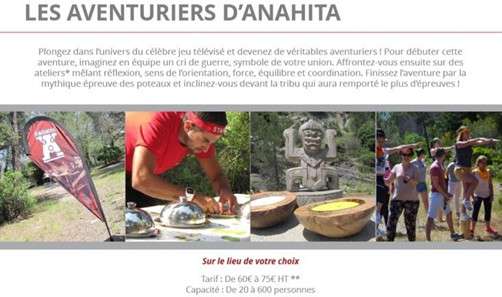
To better understand the differences between a team-building program based on team competition and one with a more collaborative focus, we can examine two product descriptions from the provider’s sales brochure . The first program, “The Adventurers of Anahita” (see Figure 1), lasts half a day and falls under the sports and adventure category. Employees are divided into teams and compete against each other in various games (testing skill, strength, speed, and strategy) to earn the most points. The team-building event concludes with a final round pitting the top three teams against each other, and the winning team is awarded a medal and a prize. Thus, this program embodies the values associated with modern sports: challenge and competition.
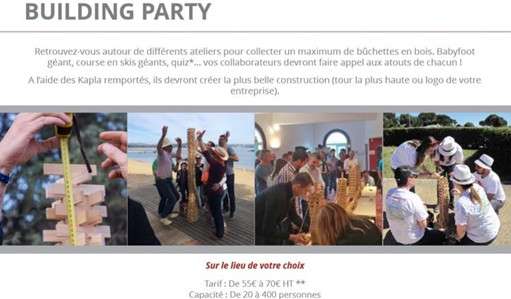
The second program—the “Building Party” (see Figure 2)—is organized around several activity stations, which teams of employees choose to visit based on their skills. There are also various types of games, but the goal is to collect as many Kapla blocks as possible (rather than points) to build the tallest tower by the end of the activity. Everyone is therefore responsible for achieving the common goal, and the teams do not compete directly against one another. All participants receive a medal or a prize chosen by the company at the end of the team-building event. The idea is not to impose anything on the participants: they choose which activities they want to take part in and must make the most of each person’s strengths to achieve the goal.
In addition to the values associated with sports and the expected benefits of participating in them, other findings have contributed to our study and helped improve our understanding of team building.
Human Resources Management and Team Building Practices
A more participatory management style
Sports programs in the workplace were initially used to achieve managerial objectives in response to emerging economic, social, and psychological challenges. One example is the widespread adoption of teamwork in companies since the 1990s (Egley et al., 2005 ). All the individuals who make up a team have different ages, professional cultures, and values, and are required to interact within a very specific setting: the workplace. There is therefore a significant risk that conflicts will arise (Brunet, 2006).
Here we see the need to rethink traditional management methods. This marks the emergence of participatory management and the gradual move away from discipline as the primary means of directing employees and leading them toward efficiency (Ehrenberg, 1999). The idea is to “transform workers into entrepreneurs of their own tasks” (Ehrenberg, 1999, p. 224) in favor of engagement and greater autonomy. “Participative management, as a management method and a way of exercising authority, is the area on which managers’ concerns are currently focused” (Ibid., p. 223). Team-building programs can be viewed as a manifestation of this form of participative management. Indeed, they offer a different source of motivation for employees by making them active participants in the activity. For example, the study examines the case of a group of sales representatives participating in a ride in an electric Mehari or on a catamaran. These are activities that the company in question incorporates into its commercial offerings aimed at its business clientele. Here, the goal of these activities is to motivate the company’s top salespeople by rewarding them without incorporating any element of competition. They will experience an activity based entirely on relaxation and leisure, but this time away from their daily work routine can help motivate the employees who have been offered the activity in question. In this context, team building and sports are viewed as ways to foster acceptance of unpredictability in recreational activities and as a response to the pursuit of economic efficiency and employee motivation (Ibid.). According to one of the industry professionals interviewed (Adrien), the motivation derived from a team-building experience remains linked to performance goals: “If we can combine relaxation with concepts of group performance, it’s always a win-win for managers.”
Participatory management—which introduces the concept of responsibility while setting aside the emphasis on obedience found in earlier management models—is facilitated by sports and the values they embody (Barbusse, 2002). Team-building activities could therefore be designed to foster shared values between the company and its employees, as well as to create a shared experience and sense of community for them. Moreover, sports themselves foster values such as cohesion, collectivity, team spirit, solidarity, and integration (Pierre, 2011). The use of sports therefore appears to be an effective way to manage individuals in a new society and to instill in them the values the company wants them to internalize deeply. In this regard, we mentioned earlier the creation of bonds among employees, the unifying aspect of team building, and its ability to improve cohesion among individuals—aspects that were raised by all of our interviewees. Team building thus appears to be an effective way to foster a sense of belonging to the company.
New management approaches—particularly the introduction of participatory management—are influencing the team-building market and the services it offers. Team-building programs must incorporate these new challenges by offering relaxing and enjoyable activities that can motivate employees, help them buy into a vision, and, more broadly, foster a sense of belonging to the company culture. As employees feel closer to their managers and their organization, they will be more engaged and motivated in their work.
A Focus on Employee Well-Being
Ever since Mayo’s Human Relations theory (1939), it has been widely accepted that an employee who feels valued by their company and who feels emotionally connected to it will be more effective on the job because they are more satisfied. Employees therefore now appear to be more receptive to an approach based on emotions than to one focused solely on ever-increasing economic profitability, which pays no heed to their satisfaction or motivation.
Our postmodern society is known to take a toll on physical health (musculoskeletal disorders, cardiovascular diseases) and mental health, such as feelings of stress and anxiety and the risk of “burnout” (Barbusse, 2002).
The issue of well-being has also been brought to the forefront by postmodern society, in which people seek physical and mental balance through sports (Lacassagne et al., 2006 ). This concept also allows companies to demonstrate their concern for their employees and their well-being.
Massimo, the sales manager, will note, “I’ve noticed a trend toward workplace well-being—organizing yoga sessions, gentle morning stretches, and perhaps even massages. In my view, these values are actually becoming more popular.” Sarah, the communications manager, will emphasize, “Shared values and relationships among employees are key factors in their well-being and their commitment to the company.”
For the company, it is also an effective way to minimize absenteeism and employee fatigue—which can be counterproductive (Barbusse, 2002) and may result from these conditions. The changes society has undergone and new management methods—particularly participatory management, which emphasizes employees’ feelings and satisfaction, as well as the benefits of sports (as a vehicle for values, commitment, and well-being)—make team-building management a powerful new tool that is becoming increasingly widespread among HRM practices. These new concerns play a major role in shaping the range of team-building offerings.
Conclusion
Our survey has shed light on certain trends in team building. These trends appear to be driven by shifts in the values associated with sports. We’ve observed a rise in recreational activities and a pursuit of playful enjoyment that seems to be reflected in our study area. The concepts of experience and emotion are also important in team-building activities, as they allow employees to create shared experiences and forge bonds that will endure once they return to the workplace. In the postmodern era, team building thus appears to be undergoing the same changes as sports, shifting away from a focus on performance and competition toward playful activities centered on enjoyment. Furthermore, emotions experienced together—in the present moment and in a specific place (for example, during a team-building day)—play a predominant role in postmodernity.
In addition to a shift in the use of sports and its values, postmodernity has thus seen the emergence of new management methods. We now speak of the “facilitator-manager,” who is responsible for fostering cooperation among team members—for example, through the accomplishment of a shared project (Lacan, 2016). The term “collaboration” has, in fact, come up several times in the comments of professionals who note that client requests for team-building activities often involve activities that allow participants to get involved in order to work toward a “shared project” (Massimo) or “a common goal” (Adrien). Corporate management is also influenced by the emphasis placed on well-being. It appears that companies are beginning to understand that employees want to take care of themselves and wish to contribute, through their own practices, to their professional fulfillment (Lacan, 2016).
When it comes to today’s forms of team building, our study suggests a shift toward more “collaborative” activities that allow participants to share experiences and emotions—much like the evolution of sports toward more hedonistic values centered on pleasure and well-being. In this vein, we envision activities that foster interaction among individuals and encourage discussion, where everyone’s skills are essential to achieving a common goal. Based on our study, creative and hands-on programs—featuring open-access multi-activity workshops—appear to align with postmodern trends. In this form, team building could address a key concern for managers: bringing employees together and improving their relationships within the company.
Finally, based on this survey, we could explore a new line of research. Regarding today’s forms of team building, our study suggests a focus on more “collaborative” activities that allow participants to share experiences and emotions—much like the shift in sports toward more hedonistic values, such as pleasure and well-being. In this vein, we envision activities that foster interaction among individuals and encourage discussion, where everyone’s skills are essential to achieving a common goal. Based on our study, creative and hands-on programs—featuring open-access multi-activity workshops—appear to align with postmodern trends. In this form, team building could address a key concern for managers: bringing employees together and improving their relationships within the company.
Bibliography
BARBUSSE, B. (2002). “Sports and Business: Converging Logics?” *L’Année sociologique*, Vol. 52(2), 391–415.
BARBUSSE, B. (2009). Between Sports and Business: A Mutual Attraction. L’Expansion Management Review, 134(3), 10–19.
BRUNET, L. (2006). Resolving Interpersonal Conflicts in the Workplace, by Solange Cormier, Quebec City: Presses de l’Université du Québec, 2004, 188 pp.
CORNELOUP, J. (2011). The Transmodern Form of Nature-Based Recreational Practices. Sustainable Development and Territories: Economics, Geography, Politics, Law, Sociology, Vol. 2, No. 3 [Online] http://journals.openedition.org/developpementdurable/9107
COVA, B., & COVA, V. (2004). The Consumer Experience: From Manipulation to Compromise. Proceedings of the Third Normandy Consumer Conference.
EGLEY, R., PARK, S., & HENKIN, A. B. (2005). Teacher team commitment, teamwork, and trust: Exploring associations. Journal of Educational Administration, 43(5), 462–479.
EHRENBERG, A. (1999). The Cult of Performance. Hachette Littératures.
GAUBERT, V. (2012). Toward the Gamification of Sports Practices…. When Playing Soccer (Re)Becomes Fun. *Géographie et cultures*, 84, 43–61.
LACAN, A. (2016). Postmodernity in the Workplace: What Kind of Manager Is Needed to Meet the Challenge?
Management Avenir, No. 90(8), 195–217.
LACASSAGNE, M.-F., BOUCHET, P., WEISS, K., & JEBRANE, A. (2004). Analysis
A Comparative Study of Social Perceptions of Sports in France and Morocco: Modern and Postmodern Values Among Sports Science Students. *STAPS*, no. 65(3), 97–109.
LACASSAGNE, M.-F., PIZZIO, L., & JEBRANE, A. (2006). The Social Representation of Sport: Perspectives of Student Athletes and Non-Athletes. Mouvement Sport Sciences, No. 58(2), 117–134.
MAFFESOLI, M. (2011). Postmodern Tribalism. Sociétés, No. 112(2), 7–16.
PIERRE, J. (2011). The Portrayal(s) of Sports in Management Journals. Science & Motricité, 72, 47–51.
PIERRE, JULIEN, PICHOT, L., & BURLOT, F. (2010). Corporate Sports as a Tool for Management Practices. Communication, Vol. 28/1, 133–160.
PIERRE, JULIEN, & TRIBOU, G. (2013). Sports events as a tool for internal corporate communication. Gestion 2000, 30(3), 113–128.
ROEDERER, C., & FILSER, M. (2015). Experiential Marketing: Toward Co-Creation Marketing. Vuibert.
* Human Resources Management.