Naturism and Aesthetics: Values Laid Bare
Originating in Germany in the late 18th century, naturism advocates a way of life based on a healthy, authentic, and genuine relationship with nature. This philosophy emphasizes moral values that are being challenged by the body image standards imposed by today’s society. Our work focused on analyzing the concepts of this “way of life” and the impact of society on the erosion of its core values. Following a theoretical section focused on the principles of naturism and the societal ideal of bodily aesthetics, the field study highlights the diverse representations of the body across different generations and the significant impact of new media on body norms.

From the creation of Adam and Eve to ancient Greece, from ancient Rome to the Renaissance, from the Enlightenment to the mid-18th century, the various periods that mark the history of humanity have always sparked a particular interest in nudity. The term “naturism” first appeared in the late 18th century (Barthe-Deloizy, 1992). It combines the ideas of health and nature and is not affiliated with any political party, nation, or ideology, yet it has given rise to a body of discourse, an organization, principles, and an attitude toward society. Norbert Elias’s (2004) work interprets naturism as “a leisure activity, practiced within a geographically and chronologically defined framework, appearing as an experience of temporary relief from social constraints.” According to the definition provided by the French Naturist Federation, it “is a way of life in harmony with nature, characterized by the communal practice of nudity, with the aim of fostering self-respect, respect for others, and respect for the environment; this movement advocates closeness to nature and a return to a natural state…”. Naturism emerged primarily in the 1950s and 1960s, becoming part of “infrastructure-based” tourism in Yugoslavia and the south of France, and then in Spain in the 1980s. Through the narcissistic display of bodies on beaches, this movement forged a deep-seated identity among naturists (Jaurand, 2008). However, in our society, the body occupies an important place yet is also a potential source of insecurities. According to Jean Maisonneuve (1999), history reveals a cult of appearance and a preoccupation with bodily norms reinforced by the media’s recurring themes. It appears that the media play a decisive role in disseminating societal norms (Rodgers, 2009). The media highlight aesthetic models that reflect the standards society seeks to impose, with the goal of inducing widespread adherence to these new archetypes in order to subject people to a capitalist system where beauty is a consumer product. Thus, these body standards are conveyed through magazines, advertisements, and films, which transcend national borders. Furthermore, this phenomenon may be reinforced by the media frenzy and, in particular, by the new social media platforms used by Generation Y—those born between 1981 and 1999. This so-called “connected” generation is more adept at using new technologies and displaying their bodies through social media, which results in exposing individuals to the gaze of others and eliciting either admiration or rejection from them. In the face of society’s aesthetic dictates, we may wonder whether the values of naturism—including the desire to return to a natural state, freedom, and tolerance—are being compromised. The study we will conduct on naturist beaches will allow us to determine whether this way of life liberates people from imposed body standards, and whether people accept the body as it truly is, despite the rise of media and social media that constantly promote standardized body types. In other words, we might ask to what extent the aesthetic standards imposed by society are amplified by social media and how they challenge the values championed by naturism.
We will assume that the aesthetic standards imposed by society alter nudists’ relationship to their bodies, while also taking generational factors into account.
An Investigation at ESpiguette
The method used to collect data was the semi-structured interview. This approach combines a non-directive stance—to encourage the exploration of ideas in a climate of trust—with a directive approach—to obtain information on predefined topics (Berthier, 2010, p. 78). In order to analyze the qualitative data from naturists encountered on Espiguette Beach and through naturist community websites, an interview guide was developed in advance with questions grouped into four themes:
- Topic 1: The feeling, the experience of being a naturist;
- Topic 2: The Values and Representation of Naturism;
- Topic 3: Generational Aesthetic Influence;
- Topic 4: Aesthetic standards imposed by the media and social media.
The plan was to ask the questions in order, but the wording was adjusted based on what the respondent had said previously. To ensure a more fluid and natural interaction, it was necessary to memorize the interview guide in advance.
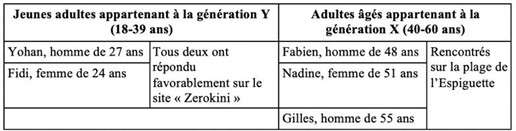
In order to assemble our sample group, we had to do some research to find out where the naturist beaches in our region were located. We settled on Espiguette Beach in Le Grau-du-Roi, a 45-minute drive from Montpellier. We checked in advance to make sure the beach was open so we could go there directly. Choosing what to wear is no trivial matter when meeting naturists. We wanted to be perceived as members of the “community,” not as “intruders” arriving “clothed,” which is why we chose to disrobe—to fully adapt to the environment and the people we were interviewing. The boundary between the nudist beach and the “clothed” section was marked by a simple symbolic sign. Before crossing that line, it took us quite a while to work up the courage to “take the plunge.” Our first experience in this completely unfamiliar place put us in an uncomfortable position, and it was interesting to observe this and take it into account as the study progressed. It took a long time to adjust before we felt ready to meet the naturists.
In order to obtain a larger sample and thus reach different generations and a greater diversity of genders, we also signed up for a naturist platform called “Zerokini.” This platform is a social network specializing in naturism that has more than 4,000 members on its website, 80% of whom are in France. Our approach to contacting naturists online involved creating a profile and posting a classified ad on the naturist website. Our ad included: our name, student status, the research topic “relationship to the body and nudity,” the purpose of the survey—namely, to understand naturists’ subjective perceptions of their own bodies—the types of questions we would ask, the confidentiality of the interview, its duration, and the researcher’s contact information to facilitate faster and more efficient communication.
To address our research question, we drew on the perspectives of naturists we met at Espiguette Beach (n=3) and on the “Zerokini” website (n=2). A total of five interviews were conducted. Overall, the age range of the interviewees was between 24 and 55 years old. We therefore categorized this sample by age group and generation.
Convergence and Divergence in Generational Perceptions
The Experience and Perception of Naturism
Among the sample studied, there is a convergence in how different generations surveyed perceive naturism. According to Bolton et al. (2013), generations can be categorized as follows: the Silent Generation (1925–45), the Baby Boomers (1946–60), Generation X (1961–81), and Generation Y (born between 1981 and 1999). Among the respondents, we noted the sentiments of 27-year-old Yohan— “we were experiencing a certain freedom…”— and those of 56-year-old Michel— “it’s a return to our roots,to a state of well-being; we feel a little free.” This perception remains consistent across the generations in question and aligns with the values of naturism described by Barthe-Deloizy (2003). Indeed, the author associates the term “naturism” with the concepts of health and nature and describes a quality of life based on respect for others and the protection of nature through the practice of daily, collective nudity. He adds that naturism combines feelings of freedom, leisure time—during which the body rejoices—and a sense of oneness with nature. According to the author, this freedom expanded in the 1960s with the sexual revolution and the liberation of social mores. Consequently, symbolic acts emerged during this period.
The “No Bra Day” proclaimed by Americans, along with the hippie protests, which, according to Michel Bernard (2015), became “a means of returning to nature, of rediscovering bodily innocence, which is trampled upon daily by the obscenity of war and exploitation.” This demonstration reflects an escape through the act of baring one’s body in order to restore bodily values “as a subversion of an institutional order corrupted by money and the appetite for wealth” (Ibid.).
Exposure & Aesthetics
For both generations, the first instances of baring their bodies occurred at roughly the same age—on average, around 22. However, it is clear that these experiences were met with different feelings within the two generations. Generation Y felt a sense of embarrassment due to a fear of being judged physically: “ I was afraid people would judge me outright based on my appearance” ( Fidi, age 24). As studies in the 2000s have amply demonstrated, a key element of the idealized female beauty in Western societies is a slim body, a curvy figure, an attractive physique, and an unrealistic thinness (Perloff, 2014). The internalization of the ideal of thinness for women is rooted in a multitude of social and cultural forces, including pressures to conform to socially defined ideals of physical attractiveness, peer influence, media representations, and symbolic, cultural, and even ideological representations of female beauty (Ibid.). Another important phenomenon is self-objectification, the process by which girls and women come to view their bodies as objects to be looked at, much as an observer would (Ibid.). This psychological internalization of the observer’s perspective on one’s own body can lead to obsessive body monitoring, which in turn can induce subjective distortions of one’s own body image—a common experience that Perloff (2014) has termed “normative dissatisfaction.” It is worth noting that toward the end of the 1970s, the aestheticized nude body began to appear almost everywhere. Indeed, according to Barthe-Deloisy (2003), the nude was on display in cities and in the mass media. Both the press and television made the nude familiar to the general public. Slogans such as “Today I’m taking off my top… then my bottom” and “Better naked than in fur” have gone down in history, featuring actresses and supermodels who were animal rights activists (Barthe-Deloisy, 2003). It is worth noting that these early depictions of the body—which the media powerfully highlighted at the time—portray flawless figures. “Slim, perfect young women—they impose aesthetic standards that naturist ethics reject” (Ibid.) and which do not seem to have had an effect on Generation X: “No, no, I didn’t feel judged” (Gilles, age 55), “No, honestly, everything happened naturally, like I said; I didn’t feel like people were looking at me or judging me” ( Nadine, age 51). However, insidiously, the beginnings of an internalized aesthetic norm would take root among future generations through new media.
The Ubiquity of Aestheticized Images
We are currently seeing a significant intensification of the aesthetic standards that society seeks to impose on Generation Y. “In the society we live in, we’re constantly being judged, so if you’re not a little muscular, or if you gain weight, you risk being singled out” ( Yohan, 27). According to Eglem (2003), Generation Y is subjected to the body image standards reflected back to them by the media and, to an even greater extent, by social media. Indeed, social media amplify the ability to expose the individual and their body and facilitate endless opportunities to gaze at it, thereby triggering admiration, desire, disgust, and the standardization of individuals’ identities so they can belong to the same group. According to the author, these are practical examples that provide access to the desired body and, consequently, to a certain aesthetic associated with that body. Generation X, on the other hand, did not feel affected by society’s body norms or by the gaze of others : “People look without necessarily judging you, just because you’re moving” ( Fabien, 48). The normative pressure associated with the act of undressing seems to be downplayed by Generation X.
Media and Social Media
Nous percevons donc que les normes esthétiques émanant des médias et certains réseaux sociaux ne se conjuguent pas de la même façon selon la génération X ou Y étudiée. « Je trouve qu’on est un peu obligé entre guillemets parce qu’avec l’arrivée de tous les réseaux sociaux comme Snapchat, Insta, Facebook c’est vrai je fais très attention à l’image que je peux renvoyer » (Yohan, 27 ans). Selon Lionel Dany et Michel Morin (2010), ces problématiques liées à l’image corporelle, au corps et à l’apparence sont prégnantes à l’adolescence. Cette période se retrouve être une « une période importante pour l’élaboration de points de vue sur soi-même et le monde, [..], du fait que la puberté entraîne tout un ensemble d’évènements et de changements relatifs au corps » (Dany et Morin, 2010, p.322). L’image corporelle est alors essentielle pour la définition personnelle des adolescents et des jeunes adultes, elle porte à croire par le biais de la socialisation digitale que leur apparence constitue « la base quasi- essentielle de leur évaluation personnelle et de celle opérée par autrui ». Ainsi elle entraînerait une insatisfaction corporelle qui pourrait se traduire par un mécontentement normatif (Ibid.). Cette image corporelle se trouve être omniprésente sur les réseaux sociaux, par rapport aux médias de masse amplifiant alors une pression esthétique auprès de la génération Y « On vit dans une société en effet, où on a tous des réseaux sociaux, donc heu… l’image est très très importante » (Fidi, 24 ans). Perloff (2014), met en exergue une différence entre les médias dits conventionnels (télévisions, magazines, radio…), et les réseaux sociaux (Twitter, Facebook, Instagram…). Selon lui les réseaux sociaux ont la possibilité d’être remplis de photos et d’une multitude d’images peu réalistes qu’une adolescente ou une jeune femme peut avoir repéré et relayé sur sa page. En outre ces plateformes sont disponibles pour la visualisation, la création de contenu et l’édition 24 heures sur 24, 7 jours sur 7, sur des appareils mobiles, partout et à chaque instant, ce qui permet d’offrir un nombre exponentiel de possibilités de comparaison sociale et de surveillance dysfonctionnelle de son propre corps, mieux que ne le permettaient les médias de masse conventionnels. De plus, selon Eglem (2003), les réseaux sociaux diffusent différentes tendances esthétiques et valeurs dans lesquelles les individus cherchent à s’insérer par goût ou pour faire partie d’un groupe considéré comme attractif. Selon les travaux de l’auteur, les types esthétiques du corps sont ainsi décrits comme « standardisés » et suivent des directives prédéfinies et diffusées par les médias (notamment les réseaux sociaux) et identifiables par certains signes extérieurs : forme du corps, marques utilisées, alimentation, type de loisirs, expression de langage etc. L’observation réalisée par l’auteur sur le réseau social Instagram conduit à distinguer plusieurs types d’esthétique classés par catégories. Les catégories qui apparaissent le plus clairement sont celles qui mettent en valeur le corps ou les parties du corps faisant l’objet d’une attention particulière auprès de la génération Y, et Millénium (née à partir de l’an 2000) et que l’on cherche à développer (par exemple faire augmenter le volume de la masse musculaire). De nombreuses photographies postées sur Instagram montrent ainsi des plats ou des aliments visant à conserver ou augmenter la masse musculaire ou développer une alimentation saine (Eglem, 2003). Selon l’auteur il s’agit de cas pratiques qui permettent l’accès au corps souhaité et donc à une certaine esthétique de ce corps. De plus, de nombreux slogans présents sur Instagram sont relayés par des influenceurs qui selon Audigie (2004) sont définis comme des leaders d’opinions. Ils ont pour objectifs de changer le comportement de leur auditoire appelés followers dans l’optique de leur faire consommer le produit, le service ou de faire adopter un comportement souhaité. Ce marketing d’influence est utilisé par les entreprises pour élargir leur clientèle et dynamiser la vente de produits et le service (Darel, Nico & al. 2017). Ainsi, les influenceurs, par le biais de slogans, incitent à la persévérance dans la quête de ce corps et ou dans l’adoption des valeurs qui l’accompagnent. Selon Darel (2017), « Le développement des réseaux sociaux a pu, petit à petit, rendre naturelle la diffusion de photos qui sont autant d’images de la vie parfaite, dans une tentative plus ou moins consciente de provoquer l’admiration ». Selon Eglem (2003) le quotidien est ainsi théâtralisé par une démarche d’esthétisation de chaque instant, à partir d’une conscience préexistante des scènes les plus à même d’avoir une répercussion positive en termes de réception par les autres utilisateurs. L’auteur décrit notre temps par la généralisation des technologies de diffusion et de partage, et la possession massive de smartphones qui mettent en question la capacité à être pleinement attentif et concentré sur le moment présent.
The dominance of new media—particularly social media—exerts a strong influence on individuals, especially among Generation Y. This early and frequent exposure to technology and idealized images on these platforms has both advantages and disadvantages in terms of cognitive, emotional, and social outcomes (Bolton et al., 2013). For example, they rely heavily on technology for entertainment and to interact with others. Social media platforms such as Instagram, Snapchat, and Facebook can enhance young people’s social capital because their identity is shaped by what they share about themselves and, in turn, by what others share and say about them; the idealized body thus becomes the center of attention. The use of social media can have additional beneficial effects on the psychological and emotional well-being of Generation Y. For example, it can strengthen family ties and foster other supportive social relationships that improve Generation Y’s self-esteem. However, it can also lead to dependence on these means of communication and information. Bolton et al. (2013) point out that adolescents and students compulsively check profiles and news feeds on social media, thereby witnessing a constant display of aesthetically enhanced bodies.
In contrast, Generation X seems indifferent to these body standards and takes a step back from these new forms of communication. They don’t feel the need to join social media and are not immersed in that world.
“When we were teenagers, we didn’t have all these resources, all these social media platforms… we felt good” ( Nadine, 51). There were fewer media outlets and social networks were virtually nonexistent during their youth. This aesthetic pressure has evolved over time through the rise of social media, and as Maisonneuve & Bruchon-Schweitzer (1999) point out, this aesthetic standardization transcends time. If we take the example of the female body, we see that between 1900 and 1925, “curvy” women—or those described as “full-figured”—were coveted by men, even as a “boyish” fashion trend characterized by a preference for slimmer silhouettes was also prevalent. Marking a transition between these two ideals, the 1950s revealed two distinct feminine archetypes: the voluptuous “vamp” embodied by Marilyn Monroe and the more slender, childlike figure of Grace Kelly. The 1960s established a cult of the body, promoted by a “slim, slender” physique popularized by women’s magazines and publicized by haute couture; this ideal of beauty became the norm. We can see that this body standard is present throughout the media and is beginning to intensify through reality TV shows : “I used to look up to a former contestant on ‘Kholanta’; when I compared his body to mine, well, it gave me a little motivation,” (Yohan, 27), but this standard wasn’t as pervasive back then as it is today, as Michel, 56, points out : “I have an 18-year-old daughter, and she told me, ‘I wish I could have lived in your era when I was your age.’” Furthermore, it’s clear that Generation X places greater importance on health than on the aesthetic appearance of their bodies. “For me personally, the body is important for health” ( Nadine, 51). This observation echoes the values associated with naturism regarding health (Barthe-Deloisy, 2003).
Toward Lasting Values
We can see that the interviewees’ perceptions converge on the representation of naturist values—namely, well-being, freedom, and a return to nature—as mentioned by Descamps (2002). However, it is interesting to note that there is a generational difference in perspective when we discuss perceptions of the first experience with naturism. Views diverge notably depending on the interviewees’ respective eras. Indeed, for Fidi and Yohan, aged 24 and 27 respectively, we observe a feeling of discomfort during their first time being naked, stemming from a fear of being judged, whereas the slightly older generations do not seem to be affected by this. Despite the generational differences, most of them began practicing naturism around the age of 20, which echoes what Maisonneuve & Bruchon-Schweitzer (1999) said about “a temporal ideology that can be altered over time.” However, it is interesting to note that their subjective perceptions of their bodies differed across eras (Ibid.); norms can evolve differently, and the aesthetic standards promoted by the rise of the media have a significant impact on younger generations.
As a result, we observe a greater generational disparity regarding the importance placed on physical appearance. Our interviews clearly show that the aesthetic appearance of the body does not carry the same weight across generations and eras. For example, Fidi, 24, explained to us that it would be very difficult for her to go out if she were overweight; she would hide herself, hence her fear of being judged. She would then be a victim of exclusion because she would not conform to the norms and codes that society seeks to impose (Goffman, 1975). Yohan also points out that the emergence of new social media platforms adds additional pressure regarding physical appearance—which he considers of paramount importance—and that the media, and more specifically social media, constantly reinforce aesthetic standards that people are expected to conform to. We can therefore conclude that younger generations are more affected by this aesthetic pressure.
In contrast, older people like Gilles, 55, Michel, 56, and Nadine, 51, don’t care much about the image their bodies might project. From the first time they bared their bodies at age 20 to the present day, their ideal has remained unchanged, prioritizing health over physical aesthetics: the media had less influence (print, broadcast), and social media did not exist (Instagram, Snapchat, Facebook, Twitter). As Maisonneuve & Bruchon-Schweitzer (1999) note, this pseudo-narcissism was already present… but was not fueled with such intensity. We can add that certain reality TV shows have shaped the body ideal that young naturists hold for themselves, as illustrated by Yohan, who refers to a reality TV contestant. Our transcripts reflect greater indifference among Generation X, who did not experience the ubiquity of today’s media and do not use social media, seeing no point in it. In conclusion, they place greater importance on their health and well-being than on their physical appearance. In contrast, Nadine and Michel’s 18-year-old daughter, who is also a naturist, is bearing the full brunt of this media pressure: she thinks it was more comfortable to be 18 back in her parents’ day… Thus, we could interpret this analysis as an amplification of aesthetic norms by the media and social media. We can therefore conclude that the generational difference highlights the prominence of body image among younger people, whereas it downplays its impact among older naturists.
Conclusion
This research project, which explores both naturism and the impact of aesthetic norms on naturists, was conducted on the beaches of Espiguette and through the naturist website Zerokini. We were able to analyze and compare the perspectives of naturists of various ages. It is interesting to note that younger generations of naturists, unlike their older counterparts, are significantly more influenced by the media than previous generations. Recurring messages from the media and new social networks greatly increase access to images of idealized bodies, which reflect current beauty standards. The easy access to and ubiquity of this new mode of communication insidiously shapes and influences the relationship these young naturists have with their bodies. As a result, the values championed by naturism—freedom, tolerance, equality among individuals according to Descamps (2002), and a relaxation of social constraints (Jaurand, 2008) —are being undermined by constant media pressure that emphasizes a conformist aesthetic ideal, thereby subjecting young naturists to a new paradigm.
Bibliography
Agam, D. N. (2017). The Instagram follower ratio affects a product’s brand awareness. Australian Journal of Accounting, Economics, and Finance, 3(2), 85–89.
Audigier, N. (2014). Using Social Media to Strengthen Customer Relationships. *Gestion*, vol. 39(1), 71–78.
Barthe-Deloisy, F. (2003). Naturism: From Atmospheric Cures to Sustainable Tourism. *Bienfaisante nature*, 49–97.
Bernard, M. (2015). *The Body*. Edition du Seuil.
Berthier, N. (2010). Research Methods in the Social Sciences: Methods and Answered Exercises, 4th ed. Paris: Armand Colin.
Bolton, R. N., Hoefnagels, A., Kabadayi, S., Migchels, N., & Parasuraman, A. (2013). Understanding Generation Y and Their Use of Social Media: A Review and Research Agenda. Journal of Service Management, 24(3), 245–267.
Cluet, M. (1999). “Free Culture.” The Nudist Movement in Germany from Its Origins at the Dawn of the 20th Century to Hitler’s Rise to Power (1905–1933). Assumptions, Developments, and Historical Issues, unpublished doctoral dissertation, University of Paris IV–Sorbonne.
Dany, L., & Morin, M. (2010). Body image and self-esteem: A study of French high school students. Bulletin de psychologie, 509, 321–33.
Descamps, M-L. (1991). Living Naked: The Psychology of Naturism. Editions Trimegiste. Descamps, M-L. (2002). Naturism: Paradise Regained? Urbanisme, 325, 46–48. ELIAS, N. (1973). The Civilization of Manners, Paris, Calmann-Lévy.
Goffman, E. (1973). The Presentation of Self, Paris, Minuit.
Jaurand, E. (2008). “Nudist Beaches: A Western Exception?” *Geography and Culture*, 1–16.
Maisonneuve, J., and Schweitzer, M. (1999). The Body and Beauty. Que sais-je.
Perloff, R. M. (2014). Social Media Effects on Young Women’s Body Image Concerns: Theoretical Perspectives and an Agenda for Research. Sex Roles, 71, 1–16.
Rodgers, R., & Chabrol, H. (2009). The impact of exposure to images of idealized thinness on body dissatisfaction among young French and Italian women. L’Encéphale, 262–268.
Tiggemann, M. (2011). Sociocultural perspectives on human appearance and body image. In T. F. Cash & L. Smolak (Eds.).