Sustainable Development in the Operational Approaches of Outdoor Sports Providers in Southern Aveyron
Millau, the capital of outdoor sports located in southern Aveyron, is an iconic destination for practicing certain outdoor sports. In this study, we will seek to understand how service providers in the Millau region align their professional practices with the principles of sustainable development. To this end, we conducted a qualitative study using semi-structured interviews. Our results show that the practices of the respondents are evolving toward a new form of professional culture that is more environmentally friendly: the transmodern form of nature-based recreational activities.
Over the past three decades, we have seen a surge in popularity for outdoor sports (Mounet, 2007), and we now know that these activities can have a real impact on our environment: trampling, habitat alteration, and the loss of nesting sites for raptors—there is no shortage of examples. However, the professional landscape in this sector appears to be shifting toward new practices that take current sustainable development challenges into account. It is worth noting that this has not always been the case, and the work of Corneloup and Bourdeau (2002) illustrates the evolution of professional cultures within the sector.
According to these authors, the first generation of professionals (modern culture, 1930–1960)—shaped by mountain culture—emphasized technical training and highlighted the athletic aspect of these activities. The second generation (postmodern culture), which emerged in the 1980s, opened up new avenues for professionalization in mountain sports: university programs, entrepreneurship training, and so on. Professions are thus evolving to respond to a new dynamic in the consumption of mountain sports: more recreational, more accessible, and thereby opening up participation to a mass audience.
We are currently witnessing the emergence of a third generation rooted in “trans-modern” culture (Corneloup, 2011, p. 4): the generation of “recreational eco-developers” (Perrin-Malterre, 2014, p. 3). These outdoor sports providers seem to be orienting their professional practices “toward the creation of an ecological lifestyle” (Corneloup, 2011, p. 6). This trend is directly linked to the evolving demand from tourists. Indeed, today’s clientele is more concerned with environmental issues and demands an ever-higher-quality experience (Marsac et al., 2012).
Our work therefore examines the actions taken by professionals in the sector to protect the environment and, more broadly, their involvement in sustainable development issues.
However, “The concept of sustainable development (SD) is often perceived as an empty phrase, or as a lofty promise touted in public communications” (Marsac et al., 2012, p. 144). It is difficult to apply across various scientific disciplines because it involves complex and interdisciplinary concepts across its three key dimensions: social, economic, and ecological. Furthermore, the work of Bon et al. (2012) shows that small businesses struggle to come to terms with this complex concept of SD and do not always grasp the benefits to be gained from it. However, the outdoor sports sector is predominantly led by managers at the helm of small businesses (SB: fewer than 50 employees) and very small businesses (VSB: fewer than 10 employees) (Bouhaouala, 2008), and our study area is no exception.
Nestled between the Causses and the gorges through which crystal-clear rivers flow, the town of Millau is located in the southern part of the Aveyron department. Recognized nationwide as the “Capital” of outdoor sports, this small town is a major hub in this field. Thanks to its layout, landscapes, geological foundation, and topography, the Millau region (Millau and its surroundings) enables industry professionals to offer their customers a wide range of outdoor activities: caving, paragliding, canoeing, kayaking, rock climbing, trail running, ATV riding, mountain biking…
It is in this region, which has historically been associated with outdoor sports, that our study will take place and seek to answer our two-part question: To what extent do service providers in this region incorporate sustainable development into their work, and what meaning do they ascribe to this concept?
Theoretical Framework
To answer this initial question, we applied the sociology of action logics in a manner quite similar to the work of Perrin-Malterre (2014). The concept of “action logic” (Amblard H. et al., 2005, p. 1) proposes analyzing the actor within their situational context to identify the logics at work behind their actions. Amblard et al. summarize the concept using the equation: “actor + situational context = logic of action” (Amblard et al., 2005, p. 204). According to the authors, the actor consists of four components, including a psychological dimension that we will set aside here, as it is highly complex and falls outside the scope of our sociological study. We will therefore focus on the last three dimensions of the actor to analyze the logics of their actions: their strategic behavior, their socio-historical positioning, and their group integration.
The actor’s strategic behavior: This is understood as the application of conscious choices linked to the achievement of the actor’s objectives and to the actor’s rationality. It is difficult to perceive in advance; the actor’s strategy is generally discernible only after the action has been carried out, “in hindsight” (Guyot and Vandewattyne, 2008, p. 45).
The actor’s socio-historical positioning: The actor does not simply apply a strategy in his or her choices; he or she is inevitably and unconsciously influenced by his or her culture, worldview, and attachment to the local area—all factors that must be taken into account to understand his or her behavior. According to Amblard et al. (2005), this concept is closely related to P. Bourdieu’s (1987) notion of “habitus,” though it is not necessary to obtain all the information about the actor’s life and past. This socio-historical positioning becomes quite evident when examining the actor’s life story (Amblard et al., 2005).
The actor’s integration into groups: The actor never appears as a “lone wolf”; it is important to take into account the various groups into which he or she integrates and with which he or she interacts in order to understand the influence these groups have on the actor’s decision-making processes (Guyot and Vandewattyne, 2008). These groups can be of various types, ranging from those inherent to a company and integrated into the actor’s professional sphere to those in a more private context: his social circle or his “nuclear family” (Guyot and Vandewattyne, 2008, p. 50).
The final element of the equation in which our actor operates: the situational context. In our work, this refers to the professional environment in which the actor operates.
Ultimately, the concept of “logic of action” proposed by Amblard et al. (2005) appears to be a useful tool for addressing our research question, as it allows us to understand not only the various SD practices implemented by the actors, but also the motivations underlying their commitment to SD by analyzing the various conscious processes (the actor’s strategic dimension) and unconscious processes linked to lived experience (the socio-historical dimension) and social influences (group integration), all of which are defined by the context of action—which we equate in our study with the framework of their professions.
Various sociological studies (Perrin-Malterre, 2014; Labelle and St-Pierre, 2010; Paradas, 2007) provide insights into the involvement of outdoor sports organizations in sustainable development initiatives. Today, this is referred to as Corporate Social Responsibility (CSR). “CSR is most often defined as the set of voluntary initiatives aimed at simultaneously improving a company’s social, environmental, and economic performance” (Chanteau, 2009, p. 2).
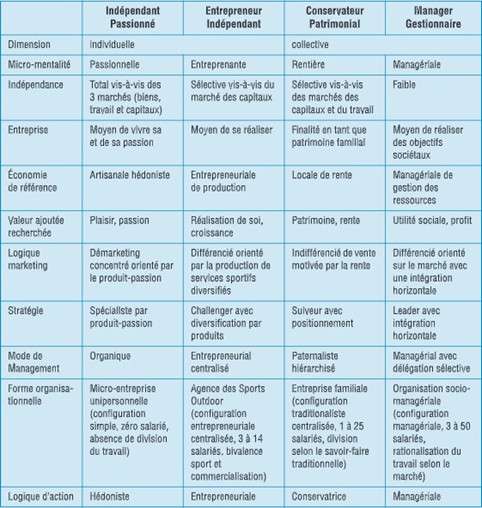
Paradas’s (2007) research shows, for example, that “the leader’s very strong presence” (p. 45) is what determines whether or not very small businesses engage in CSR. Bouahouala’s (2008) work takes a similar approach by examining the micro-mentalities of leaders, thereby establishing a typology that identifies four main categories of business leaders (see Appendix 1). For their part, Labelle and St-Pierre (2010) study the organizational and institutional factors influencing companies’ commitment to sustainable development. Finally, our study draws upon and is inspired by the work of Perrin-Malterre (2014), who examined sustainable development practices within the action frameworks of recreational eco-developers in the Vercors region.
Methodology
Drawing on the sociology of action logics (Amblard et al., 2005), our study aims to understand and describe the professional practices implemented by service providers in the Pays Millavois region with regard to sustainable development. To collect our data, we conducted a qualitative study using semi-structured interviews (Blanchet and Gotman, 2005).
Eight interviews, each lasting approximately 45 minutes, were conducted with seven managers of small outdoor sports businesses in southern Aveyron and one independent paragliding instructor (see Appendix 2). All interviews were recorded and then transcribed as faithfully as possible, in order to minimize the potential for overinterpretation (de Sardan, 1996) of the participants’ statements.
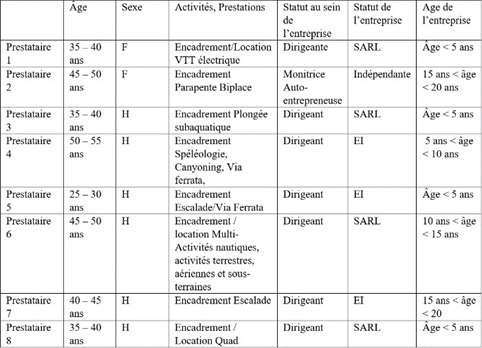
Although identifying a representative sample of a given region is not the priority of a qualitative survey, we nevertheless sought to incorporate a range of criteria relevant from this perspective. Indeed, outdoor sports are defined as “all aerial, aquatic, terrestrial, or underground activities—whether supervised or unsupervised—that take place in a natural environment” (Desvigne and Thomine, 2004, p. 14), and all of our respondents participated in at least one of these activities.
Dubois and Terral (2011) discuss an ongoing trend toward feminization in outdoor sports; furthermore, according to Labelle and Saint-Pierre (2010), women place greater importance on sustainable development issues than their male counterparts in the corporate world. We therefore included a female executive and an independent paragliding instructor in our sample to gather their perspectives, even though our hypotheses do not focus on gender-related issues regarding commitment to sustainable development. According to Labelle and Saint-Pierre (2010), sustainable development is a relatively recent concept that suggests greater awareness among young companies and, consequently, among young executives. Our sample includes at least one recently established company (less than 5 years old) led by a manager under the age of 30. Finally, Mounet et al. (2000) distinguish between “non-motorized outdoor sports, on the one hand, and, on the other hand, those that use motorized vehicles or extract resources from the natural environment” (p. 2). Outdoor sports providers using motorized vehicles are an integral part of the Millau region; with this in mind, we interviewed a manager offering a motorized activity.
Our interviews were conducted using a framework based on three themes that reflect the three components of the actor in the sociology of action logics proposed by Amblard et al. (2005): We first explored the actor’s background (his arrival in the region, his athletic career, and his professional career) to identify his socio-historical positioning. We then examined the actor’s strategic behavior using open-ended questions about the nature of their professional activity and their knowledge of sustainable development. Finally, we concluded our interviews by asking our participants about their integration into the group (the role of family in the company, involvement in community organizations, support from outside individuals, etc.). Once our data was collected, we conducted a thematic analysis to systematically organize our findings.
While we were able to analyze the socio-historical dimension and the actors’ integration into groups using an analytical framework specific to our study, we took a different approach to analyzing its strategic dimension. To do so, we used the framework for professional action proposed by Vachée et al. (2004), as Perrin-Malterre had done in her 2014 work.
This framework highlights “4 structural pillars” (p. 163) that describe the practices of service providers in the outdoor sports sector, which we will summarize below:
- “Practical logic” (p. 164): encompasses the various behaviors adopted by the service provider in his or her interactions with clients during the coaching process (Vachée et al., 2004).
- “The logic of sports” (p. 164): identifies the ways in which sports are practiced, the type of activity, the purpose for which the natural environment is used, and the choice of playing field.
- “Organizational logic” (p. 165): encompasses all behaviors related to the management of the service provider’s operations, including management, marketing, human resources, and so on…
- “Social Logic” (p. 165): Discuss the connections between private/social life and professional life.
We link each of these areas to sustainable development to identify the various practices implemented by the stakeholders. This adapted framework for professional action served as a guiding principle for analyzing the strategic dimension of each stakeholder.
Our presentation of the results will follow the sequence of our survey, covering each of the three topics addressed in our interviews before focusing on a key finding that emerged from our survey: a lack of understanding of sustainable development.
Results
Socio-historical dimension of the stakeholders: commitment to sports and ties to the local community
An analysis of the service providers’ backgrounds revealed several differences, but also striking similarities. First, through their ties to the Aveyron region. In fact, five were born or raised there, while the other three moved there for the quality of life and to pursue their passion as a hobby before developing their businesses near Millau. Despite this diversity, they are all deeply attached to the region today:
“That’s what brought me to the region—I was drawn to the area because of its wide-open spaces; you can really breathe in the Aveyron! It’s not… it’s not crowded… I mean, there aren’t any big cities, and there’s a great climbing area—in any case, a fantastic climbing area that’s well-known both nationally and international reputation, and it still has enormous potential , right!”
Similar to the service providers in the Vercors studied by Perrin-Malterre (2014), it appears that for our eight service providers in Aveyron, “the region is viewed as a place to live with a superior quality of life. It is at once a space for sports and a space for connecting with nature” (Perrin-Malterre, 2014, citing Bouahouala, 2001, p. 236).
Their career paths are just as varied: some of them have always known they were meant for outdoor sports, while others are changing careers and find in their new profession a way to “start over”:
“I spent 15 years in the industry, where I was advancing fairly quickly and ended up in charge of production…. Um, and then since I took the job a bit like a challenge—kind of like in sports—I took on on so many tasks—so many, in fact, that I ended up burning out—and that’s when I returned to my first passions.”
The service providers interviewed thus turned their initial passion into a career by choosing to become professionals in outdoor sports instruction. Each of them has earned at least one state-recognized certification in the discipline or disciplines of their choice. This “vocational mindset” (Perrin-Malterre, 2014, p. 5) had already been identified among recreational eco-developers in the Vercors region in the context of outdoor sports instruction in the mountains. Furthermore, the comments from our respondents converge on their passion for their professions. For most, the primary goal is not financial gain, but rather personal fulfillment within a hedonistic framework: “So, yeah, it’s a lot of work and takes a lot of time, but these are jobs you’re passionate about—you’re never going to get rich doing them anyway. The idea is to make it sustainable and just have a blast!” This mindset is found among the “passionate independents” in the typology of small business owners proposed by Bouahouala (2008).
Summary of the multi-criteria typology of small businesses and entrepreneurs (Bouhaouala, 2008).
Only one service provider—who has long been involved in outdoor sports—has significantly reduced the time he spends leading activities to focus on management tasks within his organization in order to preserve his passion:
“Well, I’m more on the administrative side, but that doesn’t stop me from being also out in the field […] educationally speaking, I’d reached—I’d say—the limit of what I wanted to give, and that was it. I didn’t want to get fed up with the activities I love, because I think working too much in those areas can turn you off.”
Strategic Dimension of the Organization: Educational activities open to all to ensure long-term sustainability.
By adopting the methodology used by Perrin Malterre (2014), we were able to identify certain practices implemented by our service providers as part of a sustainable development approach.
The use of the professional practice analysis framework proposed by Vachée et al. (2004) in our analysis allowed us to obtain results very similar to those of Perrin Malterre (2014), despite the differences between our respondents. Indeed, in our approach, our sample was not intended to consist exclusively of “recreational eco-developers ” (Perrin Malterre 2014, p. 11)—unlike the sample used by Perrin Malterre (2014), who selected only those service providers embodying transmodern culture and already engaged in sustainable development initiatives—which allowed us to provide a more general overview of the situation in southern Aveyron.
Thus, an analysis of the practical approach taken by our service providers demonstrates their commitment to educating their audience about the environment. All service providers mention raising public awareness, particularly through verbal explanations during supervision and briefings. These explanations can take various forms; they may involve conveying rules related to sports activities, but can also be demonstrative: “Look, if I pick up a piece of paper—well, they’re watching me—maybe they’ll think about it next time…” This commitment to education among our service providers, however, appears less profound than that demonstrated by the recreational eco-developers in the Vercors, some of whom offer long-term programs in the form of workshops, with the aim of fostering richer human relationships that are therefore more likely to bring about behavioral change (Perrin-Materre, 2014).
An analysis of the logic behind these sports activities shows that the programs offered by these organizations are rooted in the pursuit of enjoyment and exploration of the environment, setting aside the purely physical aspect of the activity. In his work, Perrin-Malterre (2014) refers to “low-impact activities focused on exploring the local environment” (p. 6). Thus, each of these providers offers an accessible way to explore nature, to counteract this decline in the appreciation of physical exertion, which was once the very essence of modern culture. Examples include the use of electric-assist mountain bikes, the creation of easy trails for ATVs, and the development of via ferrata routes accessible to children as well as to people with disabilities: “[…] people are less and less interested in the athletic aspect… so it’s going to take a lot of logistical effort to get them out into nature…”. Thus, through their commitment to expanding their offerings to a less athletic audience, our service providers are acting in direct alignment with the social pillar of sustainable development, specifically in terms of ensuring inclusion for all segments of the public.
An analysis of the organizational logic reveals stakeholders who are committed to distinguishing their offerings from mass tourism in order to create exceptional, artisanal products that minimize their environmental footprint. On the other hand, the technical equipment used by some of our service providers in their activities seems, at first glance, to contradict this approach: For example, the electric mountain bikes they use are highly technical products derived from the industrial sector, and their use opens up preserved areas—previously reserved for purists—to the general public and thus potentially to mass tourism. But it’s not about “overdoing it,” one of our service providers who offers ATV tours tells us, adding that he does not wish to sell more tours despite high demand, for fear of compromising the authenticity of his “products.” In the same vein, seven of our service providers affirm their commitment to ensuring the long-term viability of their businesses by growing them in a responsible, human-scale manner and fostering healthy competition with other organizations:
“[Service Provider 1] The community here—even though we’re competitors—well, most of us are friends. That’s motivating; I’d say it’s a relatively healthy.”
“[Service Provider 2] Yeah, we get along well with our coworkers—we help each other out. In the Alps… the guys practically fight over who gets to leave on time… but in Millau, we just all pile into the same car to get to the starting line. When we get there, we race together!”
This desire to keep businesses small and on a human scale, along with this spirit of camaraderie among competitors, can be seen to some extent as a safeguard against mass tourism. Indeed, it is conceivable that a new business owner seeking to launch a venture with a development strategy that diverges from the local dynamic would be rejected by his “peers” and would ultimately have to adapt.
An analysis of the social dynamics, meanwhile, highlights the commitment of all stakeholders in the local community, as evidenced by their desire to integrate their activities into the Millau region so that they benefit everyone:
"We've set up a project called 'One Village, One Challenge: A Week Without My Car' in Saint Beauzély, and so if you want, the park lends out bikes, and if more bikes are needed, I'll lend some of mine to make sure everything goes smoothly.”
This approach also involves the collaborative development of our service providers’ tourism projects in harmony with the Grands Causses Regional Nature Park (PNR) and the National Forest Service (ONF), which are viewed as beneficial stewards by the majority of our survey respondents.
In the same vein, one of the service providers we interviewed integrates its professional activities with sustainable development by creating jobs in the region through the expansion of its organization, which has been established there for more than 20 years.
“The big part of sustainable development that I’m proud of is also—well, let’s just say it—providing jobs for people here in… well, let’s just say it… we are, after all, a region, the Aveyron, that’s pretty hard-hit when it comes to jobs, and so, I’m… even if some of the jobs are seasonal, I’m proud to provide work for about twenty people. That’s my take on sustainable development.”
Based on the previous findings and by cross-referencing the narratives collected with the typology of entrepreneurs proposed by Bouhaouala (2008), we can conclude that 7 of our respondents are “passionate independent entrepreneurs” (see Appendix 1), although two of them also exhibit characteristics specific to “independent entrepreneurs.” Their implementation of strategies to differentiate their sports products is a good example of this:
"All my colleagues around here have mostly hardtails, but I only have full-suspension bikes full-suspension bikes, and the idea is to have big bikes—we’re in the world of enduro here, after all.”
Only one of the service providers—who is also passionate about outdoor sports—could be identified as a “Managing Director.” He has been growing his business for many years and is a product of postmodern culture. Unlike our passionate freelancers, his tone was very down-to-earth.
“We’re anything but sustainable! I’m, um, I’d say a logistics specialist. Canoeing involves shuttles, all activities involve shuttles, paragliding involves shuttles, going into a canyon involves shuttles—it’s all about transportation. We’re all transporters in a way. We all use gear—I love gear, I’m superbly equipped—we all use gear… canoeing involves plastic; it can’t be more plastic.”
But even though “the underlying logic of the tourism sector and the requirements of sustainable development appear, in many respects, to be contradictory” (Parra, 2010, p. 1), the relationship between tourism and sustainable development remains complex and open to debate.
The Actor’s Integration into a Group: A Community of Service Providers in Millau
As we have begun to observe in the context of social dynamics, service providers are eager to integrate their activities into the local community’s dynamics and, as a result, become part of numerous networks. These are primarily nonprofit and professional networks:
“I like the people I work with, and the fact that I’ve joined a group like [name] is also extremely motivating.”
Our analysis also highlights a strong sense of belonging to a community of outdoor sports professionals who blur the lines between friendships and professional relationships: “So, generally speaking, it happens pretty naturally—it’s all kind of mixed together. All my coworkers are, so to speak, people I could invite over for dinner.”
This sense of belonging seems to foster, among the service providers who speak of it, shared values, practices, passions, and ideas linked to their sports culture, which is primarily oriented toward an “eco-friendly” lifestyle. Their desire to distance themselves from practices of overconsumption in their discourse and to move toward a simpler lifestyle is a striking example of this.
It seems that these ideas, passed down from one service provider to another, are reflected in their professional practice. Corneloup et al., in their 2014 study, develop the concept of “recreational livability,” in which “sports enculturation reinforces a sense of belonging to the region, especially when combined with knowledge of the plateau’s sports history and current events, which allows people to feel like they are part of the inner circle.” Through participation in this sports community, residents shed their status as outsiders and become members of a broader collective where everyone is, to a greater or lesser extent, a friend of a friend or someone one has already seen here and there.” (p. 53).
Several of our stakeholders are also involved with the various institutions present in the region, such as the Regional Nature Park (PNR), UNESCO, and Natura 2000. In the Millau area, the collaboration between service providers and these institutions appears to be long-standing and significant in the eyes of our respondents: “When you’re leading a project, these are typically the people you need to meet.” ” This relationship, although mandated by law, has led to the standardization of certain practices, particularly those related to environmental protection.
As we saw earlier, the participants also get involved on a personal basis in sports clubs and organizations and volunteer in their local communities: “So every year I go there to help them, to serve on the judging panel, to deliberate, to do a little bit of everything… I go as a volunteer, of course!”
Maintaining these connections within the nonprofit sector makes it easier for some service providers to make their services available to these networks. This can ultimately help them achieve long-term sustainability for their operations more quickly.
"So that's the point of investing in this—to attract big diving clubs that come here and help us get the season off to a decent start. Professional activities for associations and clubs.”
Most of the service providers surveyed also have children and a family life, which appears to be a crucial factor not only in their integration into the local community but also in the long-term viability of their businesses:
“We built our house all by ourselves. Here, with the family’s help, it was possible; we couldn’t have done it anywhere else […]. I never would have built this space if I hadn’t had family to helped me…”
The family factor can therefore be interpreted not only as an important economic resource in the development of sustainable tourism infrastructure, but also as a motivating factor for environmental conservation:
“We won’t have much left to leave for others, really. Especially in the underground world: these are environments… that are very fragile and that… don’t really belong to us, so we should try to leave them as they are for future generations to come so they can see a little of what we’re able to see , you know?”
The Democratization of Sustainable Development
The lack of knowledge about sustainable development is the most striking finding in our study. Marsac et al. (2012) point out that “The concept of sustainable development is often perceived as an empty phrase, or as a lofty promise touted in public communications” (p. 144). And this was confirmed: none of the service providers mentioned any well-known definitions, nor even the social-environmental-economic triad, let alone the concept of CSR. The question “What does ‘sustainable development’ mean to you?” went unanswered on several occasions; for the vast majority of service providers, the term has no precise definition:
“It’s a broad topic. It’s a pretty crazy topic”; “Sustainable development—it seems to me like a topic that’s… more… political, something for politicians—I’m not really sure.”
In the comments of several of our respondents, the concept also seems more directly linked to personal life than to professional activity: “Sustainable development??… I think it’s already about buying local… local and, let’s say, clean agriculture… Not necessarily organic, but more sustainable.”
Nevertheless, for all service providers, the term is related to environmental protection, and 5 of the service providers mentioned the concept of long-term sustainability for their businesses.
It is only by compiling the statements from our eight service providers that we can identify most of the institutionalized aspects of sustainable development. This lack of awareness highlights the need to strengthen support for these small organizations in their professional endeavors, in order to help them fully grasp the social and economic challenges that seem to be overshadowed by the environmental pillar as they develop their operations.
Conclusion
The striking similarities between service providers in the Aveyron region and those in the Vercors region, as examined in Perrin-Malterre’s (2014) work, support the idea of a transition in the professional cultures of outdoor sports toward transmodernity. The Millau region is no exception. Although a handful of large organizations, established for many years, still seem deeply rooted in postmodern culture, an increasing number of “neo-ruralists” are launching their own businesses with the goal of making a living from their passion and seeking an alternative to the professional life offered by the industrial world. A lack of understanding of sustainable development, meanwhile, could be reduced through training initiatives implemented by public policies in the sector. In his article, Van Der Yeught (2015) identifies four key competencies for “sustainable development management” (p. 91). Incorporating these key competencies into the numerous networks in which service providers operate would enable them to acquire new skills in the area of sustainable development.
Ultimately, the use of nature—at the cost of inevitable damage linked to our recreational activities—remains undeniably at odds with the principles of sustainable development. On the other hand, outdoor sports appear to be a valuable tool and platform for fostering collective awareness by harnessing “the educational power of outdoor sports in environmental protection ” (Bouhaouala and Bouchet, 2007, p. 153). Thus, with the growing interest in these activities, environmental education and awareness are becoming increasingly essential components of the tourism experiences offered by providers of transmodern culture.
Bibliography
Amblard, H., Bernoux, P., Herreros, G., Livian, Y-F. (2005). New Sociological Approaches to Organizations. Paris: Seuil.
Blanchet, A., Gotman, A. (2005), The Survey and Its Methods: The Interview. Armand
Bon, V., Lacroux, A., Teller, P., Van Der Yeught, C. (2012). “Sustainable Development and CSR Practices in the PACA Region: Examining the Unique Characteristics of Small Businesses,” *Recherches en Sciences de Gestion*, No. 96, pp. 179–197.
Bouhaouala, M. (2001). Inter-firm Relationships in a Local Market: The Case of Small and Very Small Enterprises in the Sports Tourism Sector in Vercors, *Espaces et Sociétés*, No. 105–106, pp. 229–251.
Bouhaouala, M. (2007). Micro-mentalities and Decision-Making Logics of Entrepreneurs Who Manage Small
"Companies," International Journal of SMEs, 20 (2), pp. 123–149.
Bouhaouala, M., and Bouchet, P. (2007). “Sector-Specific Certification and Sustainable Regional Development: A Theoretical and Operational Approach in the Nature-Based Sports Tourism Sector,” *Revue Gestion 2000*, No. 2, pp. 127–160.
Bouhaouala, M. (2008). Management of Small Sports and Recreation Businesses: A Socioeconomic Approach. Louvain-la-Neuve , Belgium: De Boeck Supérieur.
Bourdieu, P. (1987) *Choses dites*, Paris, Éditions de Minuit.
Chanteau, J.-P. (2009). “Corporate Social Responsibility”: Some Issues in International Political Economy. International Symposium on “International Political Economy and New Regulations on Globalization,” Center for Research on Economic and Financial Integration, University of Poitiers, Poitiers, France.
Corneloup, J. (2011). The Transmodern Form of Nature-Based Recreational Activities. Sustainable Development and Territories. [Online], Vol. 2, No. 3
Corneloup, J., Bourdeau, P. (2002). Professional Culture and Careers in Mountain Sports Tourism.
Téoros, Presses de l’Université du Québec, 20 (3), pp. 32–44.
Corneloup, J., Bourdeau, P., Bachimon, P., & Bessy, O. (2014). Peri-urban Recreational Livability.
Sociétés, 125(3), pp. 47–58.
Desvigne, C. Thomine, J. (2004). Outdoor Sports: Trends in Supply and Demand. Les Cahiers espace. Paris.
Dubois, F., Terral, P. (2011). From Sports Enthusiast to Small Business Owner. Sports Tourism in
In the Great Outdoors. Work and Employment, (126), pp. 35–44.
Guyot, J., Vandewattyne, J. (2008). The Concept of Action Logic: A Reference Framework. In, The Logics of Entrepreneurial Action: The Case of First-Time Entrepreneurs in the Walloon Region. de Boeck Supérieur, Louvain-la-Neuve, Belgium, pp. 41–59.
Labelle, F., St-Pierre, J. (2010). Institutional, Organizational, and Individual Determinants of SMEs’ Sensitivity to Sustainable Development, 10th International Francophone Conference on Entrepreneurship and SMEs, Oct. 27–29, 2010, Bordeaux, Montesquieu University.
Marsac, A., Lebrun, A., Bouchet, P. (2012). Sustainable Tourism and Tourist Experiences: A Dilemma. Proposal for an Analytical Framework Applied to Tourism in Rural Areas. Management et Avenir ( No. 56), pp. 134–153.
Mounet, J.-P. (2007). Outdoor Sports, Sustainable Development, and Environmental Controversy, *Natures Sciences Sociétés*, (vol. 15), pp. 162–166.
Mounet, J.-P., Nicollet, J.-P., Rocheblave, M. (2000). The Impact of Outdoor Sports Activities on the Natural Environment. Montagnes Méditerranéennes ( No. 11), Sports Tourism and Regions.
Paradas, A. (2007). The Manager as a Catalyst for CSR in Very Small Businesses: An Exploratory Approach Based on
the use of narratives and cognitive mapping. Revue internationale P.M.E. ( No. 20), (3–4), pp. 43–67.
Parra, C. (2010). Chapter 30. Tourism and Sustainable Development. In Zuindeau, B. (DS.), Sustainable Development and Territory: New Original Edition. Villeneuve d’Ascq: Presses universitaires du Septentrion.
Perrin-Malterre, C. (2014). The Integration of Sustainable Development into the Professional Practices of Sports and Tourism Service Providers. Sustainable Development and Territories [ Online], Vol. 5, No. 3.
(From) Sardan, J.-P. O. (1996) “Violence Against Data, ” *Enquête*, (No. 3), pp. 31–59.
Vachée, C., Corneloup, J., Soulé, B. (2004). Professional Logics and Cultural Referents in Mountain Sports Professions. In Sobry, C. (ed.), Sports Tourism, Villeneuve d’Ascq, Presses universitaires du Septentrion, pp. 161–189.
Van Der Yeught, C. (2015). What Skills Are Needed for Managing Organizational Sustainability? The Case of Small Tourism Organizations. Management & Avenir ( No. 78).
.