Street Workout: A Strength-Training Sport with Potential for Urban Tourism
The purpose of this article is to understand how Street Workout has established itself as an urban-tourism activity by evolving within the urban landscape. This activity, which aligns with the cult of the body prevalent in our contemporary societies, was the subject of a qualitative study conducted through interviews with five practitioners, supplemented by immersive observations during Street Workout sessions . The research aimed to capture how these practitioners engaged in the activity and thereby identify the factors that make it appealing. The results allowed us to highlight the recreational appeal of Street Workout for participants, which fosters a sense of freedom and, more specifically, this pursuit of recreational and athletic thrills involving self-presentation, where the participants’ bodies become an acrobatic spectacle on display in public spaces.
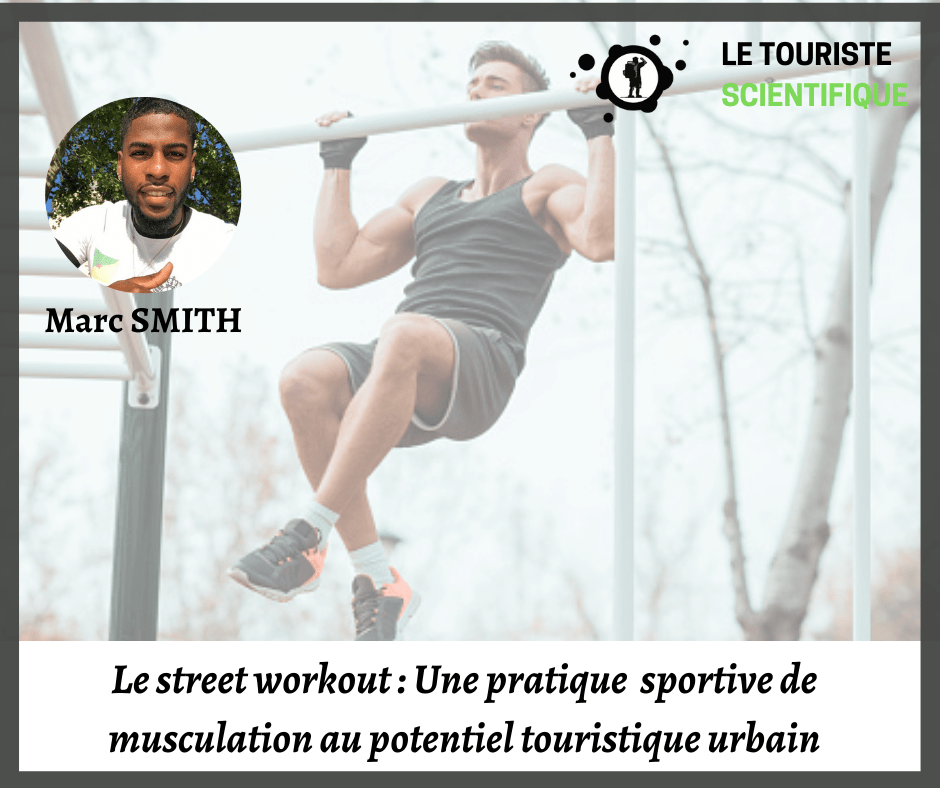
In parks, at the beach, and on street corners, we’re seeing more and more bodybuilders performing moves worthy of gymnasts, turning this practice—known as Street Workout(SW)—into a spectacular discipline. It’s truly spectacular to watch athletes with bulging, defined muscles perform a wide variety of moves on street workout equipment. However, despite its growth and institutionalization in France in recent years (the creation of a federation, the construction of SW parks, etc.), this practice has not always been viewed favorably by society, which has generally regarded it as a popular activity reserved for people from disadvantaged backgrounds. According to an article in *L’OBS* published in June 2013, SW is said to have originated in prison settings; consequently, many people have associated this sport with an activity reserved for inmates. To illustrate this point, we can consider the commentary by Mark Reifkind, Master Instructor of the RFC (Russian Kettlebell Challenge), regarding Paul Wade’s book, *The Prisoner’s Workout*. In this book, Mark Reifkind states,“I didn’t want to like this book. In fact, I didn’t even want to read it because of the title” ( 2016, p. 8). This reflects a negative perception that tends to devalue the practice of SW. Indeed, for many people, SW is an activity reserved for a working-class social group due to its origins and its adoption by African American communities, which are often associated with poverty, delinquency, or other forms of social exclusion. Sociologists such as Mauss (1935), Metoudi, and Pociello (1981, 1995) have examined the relationship between sports and social classes and have subsequently highlighted that “poor” populations are often more represented in popular sports—generally strength-based sports—while, conversely, the affluent social classes are often represented in so-called “noble” activities (tennis, golf…), which are often more technical.
It is generally believed that this practice helps young people from low-income neighborhoods or “ghettos” avoid falling into a life of crime, which is why it is sometimes referred to as the “ghetto workout.” Indeed, in an interview with the website étudiants.ch[1], Allan Muller, a postdoctoral researcher on the topic of SW, explained that during his research, he often encountered a common perception that associated the practice with a disadvantaged urban context“and which earned street workout its nickname ‘ghetto workout.’”This negative association is defended by certain pioneers such as Hannibal For King[2], an icon of the practice according to the website litobox[3]. He is a public figure who has helped popularize SW through his numerous videos of spectacular performances posted on Instagram, Facebook, and other social media platforms. Posted since 2008, these videos have fueled the practice’s explosive growth.
Certainly, it’s worth noting that the number of participants is growing steadily (no official figures are available), along with the construction of street workout parks, the organization of competitions, and the creation of federations such as the World Street Workout & Calisthenics Federation (2011)—not to mention the numerous video posts on social media.
This new, very trendy street sport is now, according to the Calisthenics Parks website[4] (which is regularly updated), there are now 1,287 SW practice sites in France (up from 1,017 in 2020) and 15,699 worldwide (up from 13,193 in 2020). According to SBL School Workout[5], a French SW school based in Nice, SW—also known as calisthenics—is a discipline that falls halfway between gymnastics and weight training, combining strength, flexibility, balance, and agility in a new style focused on aerial freestyle. More specifically, it is often practiced outdoors (hence the name “Street Workout, ” whichmeans street training) and without equipment. The origin of this bodyweight-based strength training technique remains difficult to pinpoint, as it has developed rapidly in various parts of the world over a short period of time.
According to the French SW Federation, this practice emerged in Russia in the 1990s and was later popularized by a few pioneers in the United States—such as Hannibal for King, who came from working-class neighborhoods in New York and trained in the streets. For SBL School Workouk, this discipline is rooted in traditional calisthenics. Calisthenics, derived from two Greek words—kallos (beauty) and sthenos (strength)—was already practiced in Ancient Greece and was later supplemented with bodyweight techniques. According to this school of thought, SW originated on the streets of New York, and the Russians subsequently added a gymnastic element to the practice. SW is therefore, according to SBL School Workout,[6] “an alchemy of these different athletic disciplines from several continents.”
Today, SW is undergoing a major transformation that is taking place far removed from disadvantaged neighborhoods and involves participants from all social classes. These participants are drawn to SW by a“fun”approach to weight training—one that allows them to combine aesthetic goals with enjoyment—but also, and above all, by an outdoor practice that asserts a certain freedom to be part of the urban landscape. The question here, then, is to what extent does SW qualify as urban sports tourism? We will see that this activity requires few resources and that, by being situated in strategic locations—high-traffic areas close to nature—it offers an active display of the participants’ bodies through spectacular gymnastic moves, which attract the general public and foster new interactions that promote a new form of tourism.
Methodology
The research aimed to understand how SW practitioners engage with urban space. In a way, by emphasizing outdoor strength training and an artistic form, this practice makes urban space more attractive. We therefore sought to understand the place of this new practice on the streets by conducting qualitative research. To this end, we conducted five semi-structured interviews and observed three SW sessions between February and March 2020. Our sample consisted of five SW practitioners of different genders, ages, and levels of experience.
For the interviews, our sample consisted of a diverse range of profiles. The purpose of this diversity was to reflect as closely as possible the reality of the SW scene, where we find people with completely different backgrounds (in terms of gender, social status, and age). Among the practitioners interviewed, two are longtime friends, and the others are people I met at various spots and with whom I was able to build relationships while practicing with them. The interviews took place at a later stage, once relationships had been established. Research interviews are part of the methodological framework of a scientific approach (G. Imbert, 2010, p. 23). There are three types of interviews: structured, semi-structured, and unstructured. For our study, we opted for the semi-structured interview to address specific topics while allowing the interviewee a certain degree of freedom. In 1995, Lincoln defined the semi-structured interview as a data-collection technique that contributes to the development of knowledge, promoting qualitative and interpretive approaches, particularly those within constructivist paradigms.
| First Name | Status | SW Experience | Location |
| Karine (23) | Student | 6 years | French Guiana |
| Darlan (18 years old) | Salesperson | 4 years | French Guiana/Brazil |
| Gregory (26) | Student and fitness coach | 3 years | Montpellier |
| Endrick (23) | Student | 3 years | French Guiana |
| Loïc (32) | Fitness Coach; Vice President of Body Art Lyon; President of Body Art Guyana; Vice President of the Caribbean Street Workout and Calisthenics Federation | 8 years | Lyon / French Guiana |
The five interviews were conducted between April 20, 2020, and May 10, 2020, and each lasted between 27 and 47 minutes. Given the health situation related to COVID-19, the interviews were primarily conducted by phone (n=4) or via Skype (n=1). The latter medium offers an alternative that allows for eye contact and helps establish a trusting rapport during the conversation. Furthermore, “it is a common tool that respondents have been accustomed to using since its development in the 1990s, making it indispensable for conducting a great many social science surveys ” (Béliard and Brossard, 2012, p. 114). The aim of these interviews was to determine how practitioners engage in SW and, ultimately, to understand the appeal of this practice in different parts of the world: Montpellier, Lyon, and French Guiana.
These interviews were supplemented by participant observation during three sessions, each lasting approximately 2 hours and 30 minutes, and took place exclusively in the heavily frequented SW park within the Hibiscus Joint Development Zone (ZAC) on Cayenne Island in French Guiana. “Observation focuses on a group that one attempts to approach directly through slow and continuous immersion” (Laplantine, 2001, p. 17). There are several types of observation: floating, distanced, and participant observation. The latter, which we chose, involves fully immersing oneself in the study environment in order to observe a phenomenon. As a practitioner for over four years, my immersion was made easier by being in a familiar setting, and my technical skills allowed me to blend into the circle of practitioners and get a feel for the rhythm of the sessions. Thus, to conduct my observation sessions, I would go to the practice locations as if I were going to my own training session. This allowed me to be seen as a practitioner participating in training rather than as an observer; as such, I relied on my memory to record my observations once the session was over. Consequently, by combining the data collected in French Guiana with the interviewees’ accounts, we can understand the practice of SW as a new urban-tourism activity.
The Self-Organizing Principles of Software: Building Strength in a Different Way
SW, a practice centered on body weight
Among the people we interviewed, several of them currently do—or have done in the past—gym-based weight training alongside SW. Quite often during our interviews, a comparison between these two activities comes up:
"The problem with the gym is that it's way too crowded; I couldn't see myself working out there and having to wait five minutes just to use a machine."
(Grégory, 26).
According to them, the fact that they can work out using only their body weight eliminates the waiting time they might otherwise experience when using the various machines available in the weight room.
"Here, you don't have to wait to use a machine like you do at the gym; if the bar isn't free, you do push-ups, squats, and so on."
(Endrick, 23)
Furthermore, even though this wasn’t mentioned during our interviews, we did notice during our observation sessions that participants preferred this activity because it providesa “full-body” workout(that is, it engages the entire body). In fact, the exercises performed in SW aren’t specifically targeted at a single muscle but rather at an entire muscle chain. For example, pull-ups engage the biceps, triceps, and pectoral muscles simultaneously. Beyond the time efficiency and multifunctional nature of the exercises, SW has a unique feature related to equipment. While most physical and sports activities require specific equipment, body weight is the primary focus in SW. In this sense, all that is needed is a simple pull-up bar and two parallel bars—which can be substituted with everyday objects or public fixtures. SW can therefore be practiced in a wide variety of locations, and like many other sports, these locations “have evolved over time, beginning with the construction of specialized facilities and later extending to the adaptation of urban spaces originally intended for other uses ” (Augustin Bourdeau et al., 2008). The lack of specialized equipment is already a major draw for practitioners, as it allows them to train whenever and wherever they choose.
"Besides, I'm also drawn to how easy it is to do them—you do them whenever you can, whenever you want; all you need is a bar, and that's it."
(Karine, 23)
The "fun" spirit of SW
Since the rise of new sports activities in the 1970s, self-organized sports have attracted many athletes, who have sometimes turned away from traditional sports organizations. While sports organizations are responsible for ensuring that the rules of the game are followed (techniques, fouls, etc.), providing venues, and assigning roles (coaches, referees, etc.), the model of free play often dispenses with the need for specific venues and roles (Haumont, 1987). This is what seems to appeal to many participants. Practicing a sport outside the institutional and regulated framework allows athletes to foster a spirit of play.
"I started this sport so I could build muscle while having fun. I was drawn to 'freestyle,' but also to the physical fitness you get from doing street skateboarding."
(Endrick, 23)
According to Bessy and Hillaire (2002), the needs of athletes are evolving, thereby challenging the institutional system and its inherent regulations. In their view, we are shifting from organized, regulated, time-bound, and location-specific sports participation to “self-organized” activities that are multi-temporal and multi-spatial. Institutional frameworks are fading away, giving way to new perspectives and questions about “participating in sports” within a broader context that encompasses sports and wellness cultures. People are now focused on engaging in activities that offer them a greater degree of freedom, where they can have fun and unwind. Here, then, there is a break with the performance-oriented sports culture that imposes rules, established norms, a defined framework for practice, and specific timeframes for participation. The cult of effort has given way to the cult of pleasure (Dienot and Theiller, 1999), which is strikingly evident in the SW. Indeed, one of our interviewees made this telling remark:
“I wasn’t athletic at all before. I’d just done a little judo, swimming, dance, and track and field, but I didn’t like being ordered around, told what to do by others, or yelled at. And what I also appreciated was that you have a bit of freedom to develop on your own, to take the time to reflect on what you’ve learned so you can keep improving.”
(Karine, 23)
We thus see this pursuit of a recreational-athletic approach to sports, in which enjoyment must be an integral part of the sport for these participants. As a result, the pursuit of performance—which might be imposed in an institutional setting—gives way to this desire to enjoy oneself and have fun.
Certainly, the needs of athletes are not static over time and are subject to change. For example, the most conventional and common method for building muscle remains working out in a gym. However, many people are choosing alternative and emerging activities such as CrossFit or SW, which are fun forms of exercise. Today, athletes are seeking enjoyment more than performance, in a spirit of hedonism (Bessy and Hillaire, 2006, p. 14). Our results thus support this view and show that the fun culture of SW—particularly through the many acrobatic moves known as “freestyle”—also reflects the spirit sought by these practitioners.
"When I first started, it was the whole freestyle aspect that drew me in, and it still does! It's amazing! When I saw the 360, I was blown away and wanted to try it."
(Darlan, age 18)
The overall trend in France over the past twenty years or so has been toward the development of recreational activities—often informal and more or less fun—that break with traditional sports culture (Loret, 2004).
Practice SW with complete freedom
During our research, we also found that practicing outdoors was a major factor that could explain one of the reasons these athletes are involved in SW. Freedom is the ability for a person to act without constraints or dependence. Indeed, the desire to exercise outdoors, to feel the fresh air, to be in contact with nature (exercise can take place in a wooded park, on the beach, etc.), and to not be surrounded by walls—as one might be in a gym, for example—was frequently mentioned. Gregory says on this subject:
“There was the advantage of practicing outdoors—there was no pressure from being indoors, and not many people around you.”
(Grégory, 26)
Darlan also emphasizes the sense of freedom in the SW when he says:
“What has always appealed to me and has always convinced me to share this sport is that, for one thing, it’s a free sport that anyone can do outdoors.”
(Darlan, age 18)
For Endrick, not feeling“cooped up in a gym” and being able to breathe the fresh air are some of the benefits of SW.Karine also praises outdoor exercise, which she considers important:
"In my opinion, doing Street Workout indoors takes away some of its charm. It starts with the name itself—'Street Workout'—which means working outdoors, on the street, and that’s actually what makes it so appealing: working with nature."
(Karine, 23)
Another advantage of practicing outdoors is that it makes the activity completely free. This allows practitioners to practice as they please—whenever and wherever they want—without having to pay. This point was raised by some of our interviewees:
“For those who want to build muscle quickly, without going to the gym and without necessarily paying for a gym membership. That was also a factor—back then, I couldn’t really afford a gym membership.”
(Grégory)
"I love the freedom this sport offers—it's free."
(Darlan)
This free access thus allows for unrestricted participation and attracts people from all walks of life, thereby eliminating any social connotations associated with this practice. This point can be illustrated by Loïc’s comment, in which he observes:
“When I first arrived at the park in Lyon, there were people of all nationalities: people from the Caribbean, Africans, Arabs, people from mainland France, Guyanese, Russians, Turks… and also from different social classes. In fact, there were business owners, a mechanic, and a mover who came to train with us, just like the unemployed, the student, and the retiree.”
(Karine)
She also explains that she has practiced SW with “managers, students, and business leaders.”
This aspect of freedom associated with outdoor practice—which attracts these practitioners—is also examined from another perspective. In addition to the sense of freedom offered by practicing SW outdoors, the interviewees highlighted the freedom to practice as they please and progress at their own pace, all without pressure to achieve specific results. This observation was confirmed during oursecond participant observation session, when, during an endurance exercise (such as core strengthening), participants were free to stop whenever they wished[7], while others continued until they reached their own limits. Karine explains this when she says:
"What I liked about Street Workout is that you have a bit of freedom to develop on your own, to take the time to build on what you've learned so you can improve as much as possible."
(Karine)
We have observed that one of the factors contributing to the appeal of SW is this outdoor activity, which provides a sense of freedom. It seems that the exercise of freedom—the expression of power through the ability to set one’s own rules, choose one’s own styles, times, and spaces for practice, as well as one’s partners—is fundamental to these new forms of athletic expression (Dienot and Theiller, 1999). Nowadays, people express a need to reconnect with nature and reestablish a relationship with it. There is a desire to venture off the beaten path and break away from routine—as exemplified by the choice to prefer SW over the gym. This desire to escape everyday life can be likened to the phenomenon of urban exodus—that is, fleeing cities to move closer to the countryside in order to connect with nature. The format offered by the gym no longer meets the needs of these SW practitioners. Thus, SW prioritizes enjoyment far more than the competitive aspect of traditional sports. Free or self-organized sports practices like SW reflect a significant shift in the perception of physical activity, moving away from a competitive focus toward social interaction and a healthy lifestyle (Adamkievicz, 1998). In this sense, it is about building muscle in a different way—without specific gear or equipment, outdoors, at one’s own pace, for the sake of one’s body, and by expressing oneself through acrobatic moves—which provides the sense of freedom sought by SW practitioners. However, outdoor SW must take place at specific locations that increasingly meet these athletes’ desire to be seen.
A Staging of the Body as an Urban Spectacle
Urban Space as a Setting for SW Practice
We have observed that SW is an urban practice that tends to repurpose public objects as workout spots. This is the case, for example, in Montpellier, where street workers use the benches and stairs along the banks of the Lez River to do push-ups and dips, for instance[8] etc. This repurposing of objects is common to all other urban activities, such as rollerblading, skateboarding, and BMX, because in street sports, “the quest is part of the fun” (Calogirou and Touché, 1997, p. 75). We observed, for example, that practitioners of these sliding sports in Montpellier often gather in small squares such as the Espace JacquesIer in Aragon or along Boulevard Henri IV. “These various sliding sports all share the characteristic of appropriating landscapes, exploring new ones, and marking these new territories by gliding through them” (Lefebvre and Roult, 2009, p. 57).
Some authors have also highlighted this new way of using public space: “Sports have moved beyond the venues where physical performance was once confined […] joggers are taking over parks and streets, while skateboarders and inline skaters are taking over squares and esplanades” (Dorvillé & Sobry 2006, p. 14). Thus, by reinventing the physical uses of the city, these participants—who challenge traditional representations of public space—maintain interactive relationships with the urban environment through “an original and playful reappropriation of the city” (Ibid., p. 15). It is therefore this reappropriation that leads us to examine SW as a practice that organizes urban sports tourism. “Geographically, this refers to the confining of sports tourism to the urban setting, which excludes winter sports resorts […] the term encompasses two meanings: the use of sports facilities dedicated to spectator sports and the use of non-sports urban spaces for recreational and sporting purposes ” (Ibid., 2006, p. 16). All in all, there is a form of appropriation of urban space by these athletes because today, “the environment has become the frame of reference for hedonistic practices” (V. Siau, 2007, p. 23). The appropriation and repurposing of public urban spaces (Chantelat et al., 1996) seem to be essential for participants. Participants exercise in spaces where they can be seen (Vieille-Marchiset, 2010). This exposure of the body—which is certainly sought after by participants who often train in full view of the public—generates interactions with spectators. Thus, in the following chapter, we will examine the effects of this exposure on both participants and passersby.
Freestyle routines , a public performance
If we look at how these Street Workers present their bodies—which takes place in urban spaces—the participants are visible to everyone. This visibility, sought after by SW practitioners who put on a “show,” thus becomes a spectacle for passersby. In addition to performing acrobatic moves of varying degrees of impressiveness in public spaces, these athletes are often known for their prominent, visible muscles, reflecting a body image that aligns with the ideals of our contemporary society. The atmosphere and the spectacle on display attract the attention of passersby, who don’t hesitate to stop, comment, film, and sometimes even give it a try themselves. During our first observation session, several young passersby approached us, drawn by the various stunts, and tried them out for themselves. During that same observation session, passersby made several comments:“Congratulations, kids”;“Good job, guys!”;“Wow, that guy’s strong! Did you buy those Nike socks?”;“Wow! Mom, I’m going to try doing that too! .” When this little boy came over to try the“Human Flag” move that had amazed him, we noticed that the entire group of street workers present that day was cheering him on, while some helped him hold the position so he could pull off the move. We also observed that there is ultimately a collective way of using these spaces, a sense of kindness and respect for one another. As a result, for example, when it comes to taking turns on the pull-up bars, there are never any arguments; participants follow an order they can signal with a simple hand or head gesture, as if to say, “It’s your turn.” This was also observed with beginners who are just starting out and are generally guided through their first exercise. Our interviewees also noted the following:
“Plus, in this sport, everyone cheers you on and helps you. If you can’t do something, people guide you, and I really loved that sense of solidarity among the participants. Because whether it’s a stranger, someone from another culture, who speaks a different language, or whatever—we all communicate the same way on the street; there’s always encouragement, and it knows no boundaries.”
(Darlan)
The more experienced members don't hesitate to come over and help, encourage, and offer advice to beginners. During my third observation session, I remember trying a "front lever" move[9] ” that I hadn’t quite mastered yet, when two other practitioners came over to me and said:
"To start mastering this move, I began by extending just one leg! And little by little, you'll get the hang of it. It's a little more complicated for you because you're tall, but if you work hard at it, you'll get there!"
This supportive and advice-filled approach toward beginners extends just as much to the general public. It is the act of participating—of trying things out in this space—that encourages self-expression but, above all, fosters interactions (discussions, guidance, comments), which is what makes SW such a welcoming experience.
This interaction and self-presentation are not limited to those present at the practice sites; they also extend to the internet. The figures—often filmed by practitioners and passersby—are posted on various social media platforms such as Instagram[10], Snapchat[11] , and sometimes even on YouTube channels, following a specific visual language. When Endrick successfully performs the“front lever”for thefirst time and is about to post his video on Instagram, Darlan steps in and tells him
"No, when you post your video, you have to include the unlocked padlock emoji—that means you now know how to do that trick."
So, just as in all other urban practices, there is a common language among practitioners that, in a way, strengthens their bond and their sense of belonging to a group. These numerous video posts—just as one of the pioneers, Hannibal For King, had done—will thus create ways to interact with the public without geographical boundaries, thereby contributing to the development of SW.
There is also another phenomenon that further accentuates these practitioners’ exposure of their bodies and self-presentation. During our various observation sessions, we noted that the dress code seemed fairly relaxed and that most participants were often shirtless. There’s a kind of exhibitionism that happens quite naturally—it’s a chain reaction; all it takes is for one participant to take off their T-shirt for the rest of the group to follow suit. During one session, we overheard two female joggers remarking that all the participants were shirtless and exclaiming,“Oh, here, the dress code is shirtless.”There is, therefore, a desire among participants to show off the muscular bodies that SW builds; they proudly display them in public.
“Actually, there’s a bit of an exhibitionist side to this sport. Why? Well, for one thing, it’s ultimately a physical sport where you work out your body, and people are just happy to be able to show off the results they’ve achieved. And just like in most physical sports, you’re happy to get compliments on your body: ‘You’re muscular,’ ‘You have a great physique.’ Just like in weightlifting, there’s that side to it—a bit self-centered—where you’re focused on yourself, and when you get positive feedback, you’re even more satisfied with your work, and that pushes you to want to do even better to maintain that sense of a job well done.”
(Loïc, 32)
In our contemporary societies, there is a particular relationship with the body that places great importance on personal appearance. The body is displayed and staged; we have witnessed a true liberation of the body since the 1960s. It corresponds to idealized images of youth, health, fitness, and beauty (…) Maintaining an “athletic” body has become the most popular and important leisure activity (Perera and Gleyse, 2018, p. 7). In ancient Greece, a strong man was one who was muscular and possessed great strength. This approach to physical fitness—with the goal of displaying a muscular self—is evident in all of our interviews:
"For me, it just comes naturally; I don't even realize when I take off my T-shirt. Maybe it's because we need to show off—to show our results and our muscle definition."
(Endrick, 23)
There is a desire among participants to show off their muscular physiques to the public, as these are seen as synonymous with health and beauty. Behind this behavior lies a desire to gain social acceptance by conforming to the dominant standards promoted by our society. It is important to understand that while many “street sports” carry negative connotations—thereby undermining the image of these sports—a shift occurs when participants display their bodies in full view of the public in accordance with dominant aesthetic norms. Streetwear (SW) shapes behaviors that are strikingly rooted in current recreational, athletic, and physical expectations, all of which contribute to this sense of social acceptance. Here, the image of the body appears, above all, as a mediator of social bonds by conforming to dominant aesthetic norms. “We concern ourselves with it either from an instrumental perspective of success and social integration; or to meet social norms of presentation; or with the intention of winning the affection of others.” (Jodelet, 2005, p. 34).
Like rollerblading, skateboarding, BMX, and other urban activities, SW thus leads to “a dual form of spectacularization: the city is a spectacle for the performer, and the performer is a spectacle for the passerby” (Dorvillé & Sobry, 2006, p. 17). The practice of SW becomes an “urban spectacle,” and this “spectacularizable” activity involves passersby as witnesses and spectators, while the street worker becomes “a spectacle for the passerby” (Dorvillé & Sobry, 2006, p. 15).
In conclusion, we have observed that SW is a relatively new practice and that its practitioners are drawn to the simplicity of the activity, particularly in terms of the minimal—or easily replaceable—sports equipment required. In fact, only simple static bars are needed, and these can be easily substituted. Beyond the fact that SW requires very little equipment, this discipline is practiced outdoors. This is what characterizes SW, as it encourages people to escape confined spaces and feel free, according to our respondents. We also noted that the codes of conduct and methods are the same from one city to another, and that “we communicate the same way on the ‘street,’ and it knows no borders”(Darlan).
As a result, the various training spots are located outdoors—typically in parks, on the outskirts of neighborhoods, or at the beach—which provides an ideal training environment for these athletes. Our findings also show that these athletes are reclaiming public spaces by, for example, using objects intended for rest or staircases, and by training in places where they can be seen, thereby putting on a show for passersby. The performance aspect is also sought after by these athletes, who, as we have seen, are drawn to the fun and spectacular nature ofStreet Workout: acrobatic moves worthy of gymnasts, combining technique, flexibility, and strength, which require a physique that is on display because it aligns with prevailing aesthetic standards.
This use of urban space for sports, combined with the spectacle it offers, is in itself sufficient to justify the SW’s classification under the category of urban sports tourism, which thus follows two approaches: one centered on the participants and one focused on the spectators.
On the other hand, the growing success of this activity is leading to its institutionalization through the creation of federations, major competitions, and so on. Public sports organizations also seem to be beginning to grasp the scale of the phenomenon and are providing dedicated spaces for the activity. Although these spots are located within the urban landscape (parks, beaches, etc.), these facilities—which are taking their rightful place in the city—will, in a way, curb the phenomenon of appropriation as well as the use of public space. Just as we’ve seen with BMX, inline skating, and skateboarding, we might wonder if streetwear isn’t in the process of being co-opted by the institutional world?
Bibliography
Adamkiewicz, E. “Street Sports Performances: Spectacular Independent Sports Practices in Lyon,” *Les Annales de la Recherche Urbaine*, no. 79, pp. 50–57, 1998.
Béliard, A-S., Brossard, B., “The Internet and the Ethnographic Method: The Use of Instant Messaging in a Field Study,” *Genèses*, No. 88, pp. 114–131, 2012
Calogirou, C., and Touché, M. 1997, “Youth and the Street: Skateboarders’ Physical and Acoustic Interactions with Urban Spaces,” *Espaces et sociétés*, no. 2, pp. 69–88.
Campillo, P., Porrovecchio, A., “The Concept of Physical Beauty in *La Culture Physique*: The Quest for the Ancient Ideal,” *Staps*, vol. 119, no. 1, pp. 11–25, March 2018.
Dorvillé, C., Sobry, C., “The City Reimagined by Athletes… ?”, Territ. En Mouv. Rev. Géographie Aménage. Territ. Mov. J. Geogr. Plan.,no. 3, pp. 14–20, Dec. 2006, doi: 10.4000/tem.295.
Dienot, J., Theiler, D. (1999), “Outdoor Sports Activities in the Mountains,” in *New Sports and Leisure Activities in the Mountains*. Pessac : Maison des Sciences de l’Homme d’Aquitaine. Chapter 1
Gibout, C., Lebreton, F., “Youth Cultures and Street Sports: An Approach Through Public Space,” Agora Debatsjeunesses, vol. 68,no. 3, pp. 71–84, Oct. 2014.
Haumont, A., 1987, “Sports Practices,” in Thomas Raymond (ed.), Sociology of
sport, Paris, PUF, pp. 65–150.
Imbert, G. “The Semi-Structured Interview: At the Intersection of Public Health and Anthropology,” Rech. Soins Infirm., vol. 102, no. 3, pp. 23–34, 2010.
Laplantine, F. 2001, *Anthropology*, Paris: Bibliothèque Payot.
Lefebvre, S., and Roult, R. 2009, “The New Territories of Surfing in the City,” Téoros, vol. 28, no. 2, pp. 55–62.
Lemoine, L., “New Sports Activities, New Urban Territories: The Example of Roller Skating in Rouen,” Conference, University of Rouen, 2004
Loret, A., in *Le sport de la République*, March 2008.
Moussaoui, A., “Observation in Anthropology: Immersion and Distance,” Contraste, vol. 36, no. 1, pp. 29–46, 2012.
Mueller, A. “Building Street Workout, Doing: Ethnographic Snapshots of Identity-Building Engaged in by ‘Street Fitness’ Practitioners,” *Social Sciences and Sport*, vol. 1, no. 9, 2016, pp. 47–82
Perera, E., Gleyse, J. “Introduction: Bodybuilding and the Transformation of the Body in Our Modern Societies,” *Staps*, vol. 119, no. 1, pp. 7–10, March 2018.
Piraudeau, B. “A Geographic Analysis of Beach Sports in Light of Current Changes and Trends: An Attempt at a Synthesis,” *Staps*, vol. No. 124, pp. 23–42, 2019
Riffaud, T. “Skating Through the City to Explore It: Street Sports and Urban Tourism,” *Sports Tourism and Health*, vol. 40, no. 1, 2021.
Siau, V. “Outdoor Sports and Recreation: A Field in Need of Recognition,” in *Pour*, vol. 193, pp. 23–27, 2007.
Vieille-Marchiset, G. “From Urban Margins to Institutionalization: Self-Organized Sports Practices in the City of Besançon,” in ethnographiques.org, No. 20,
[1] https://www.etudiants.ch/cms/etumag/064/le-street-workout
[2] "Hannibal for King," born on February 4, 1978, in the United States, is the go-to figure for all "Street Workout" fans.
[3]https://www.litobox.com/street-workout-calisthenics
[4] This is a website that lists all SW spots around the world
[5] https://www.sbl-workout.com/historique/
[6] www.sbl-workout.com
[7] SW exercises are sometimes done in groups, which helps foster commitment to the effort
[8]Dips are an arm-bending exercise performed on two parallel bars that primarily targets the triceps.
[9] Front lever: involves holding yourself on the pull-up bar with arms straight and parallel to the ground in a plank position.
[10] Instagram: A social media platform for posting videos, photos, etc.
[11] Snapchat: A social media platform that allows users to post videos, photos, and more.