Motorcycle Accessibility for People with Paraplegia: The Essential Role of Peer Support
Motorcycling is more than just a mode of transportation; it’s a true way of life, a passion (Scol, 2017). It’s a passion that isn’t without risk—accidents can happen at any moment and may mark the breaking point between a rider and his passion. Five men who became paraplegic following a motorcycle accident shared their life stories with us and described how they were eventually able to get back in the saddle despite their limitations. We therefore followed the Planète Handisport association to understand how they use their experiences and expertise to enable people with reduced mobility (PRM) to once again enjoy the experience of riding a motorcycle on a racetrack under “handi-capable” conditions. Thanks to their determination and mutual support, they are now successfully returning to the racetracks, with some even competing alongside “able-bodied” riders.
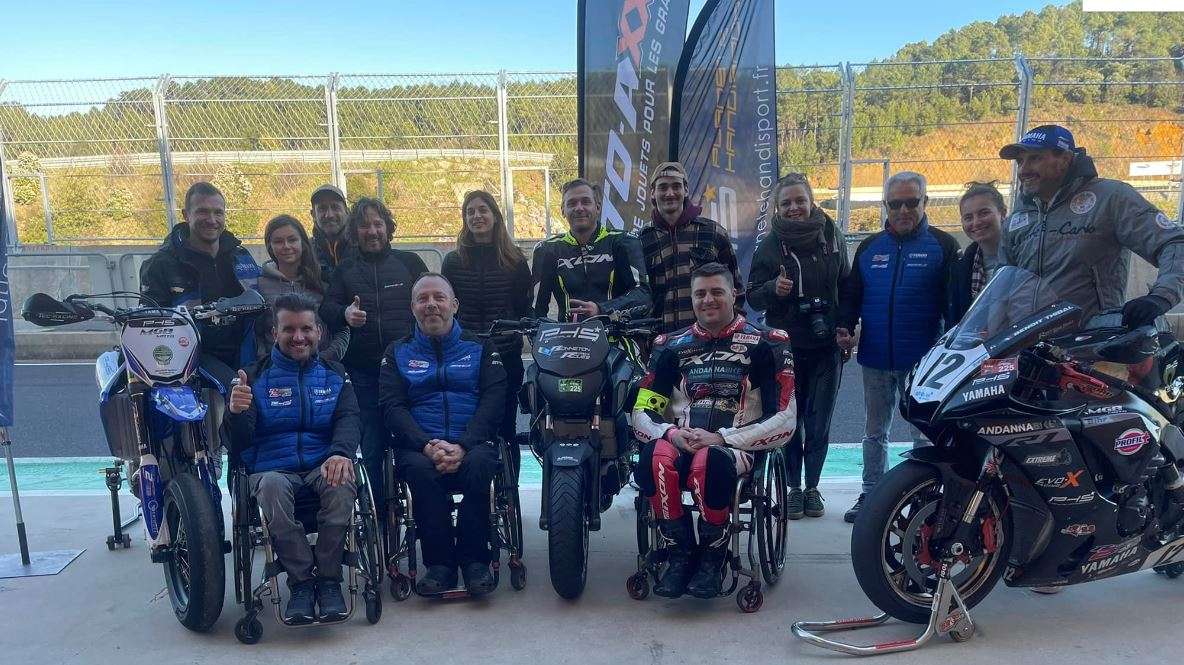
@PHS Association
"Exactly six years to the day after his motorcycle accident, Emmanuel SENIN (President of the Planète Handisport – PHS association) is back on a motorcycle."[2].
Following a motorcycle accident that left him paraplegic, Emmanuel Senin decided to get back in the saddle on August 8, 2020, at the Alès racetrack. A month later, he founded Planète Handisport (PHS), France’s first disabled sports mechanics center, in Alès. For two years now, hundreds of people with limited mobility—including those with upper or lower limb amputations, paraplegics, and hemiplegics—have been getting back on motorcycles thanks to this organization. This achievement challenges the stigma surrounding disability and demonstrates that nothing is impossible when the right adaptations and personalized support are in place.
“For a long time, it was taken for granted that certain ‘dangerous’ spaces should remain off-limits to them and that ‘people with disabilities’ should confine their physical activities to places that were prepared, adapted, and ‘sterilized’” (De Léséleuc, 2017, p. 4). Motorcycle tracks, in particular, were among these so-called “dangerous” spaces, where access for people with disabilities seemed unimaginable. “The environment thus becomes a factor to be taken into account in the production of disability” (Reichhart, Lomo Myazhiom, 2020, p. 83). Reichhart clarifies the term “environment” by stating that it “should be understood in a broad sense, encompassing—in a combined and complementary manner—human assistance and intervention, as well as equipment and technological innovation” (Reichhart, 2020, p. 8). This line of thinking was already developed by Fougeyrollas in 1998 through his MDH-PPH model[3] which introduced the idea that “environmental factors present in a person’s or a population’s setting can act as facilitators or barriers”[4].
In this sense, people with disabilities must address both human and technological factors in order to navigate a society based on an “able-bodied-centered” model, where the norm is an able-bodied person (Probst et al., 2016). This raises the question: How has it been possible to make motorcycling accessible to people with limited mobility (PLM)?
First and foremost, this is the story of a man, Stéphane Paulus, who became paraplegic following a motorcycle accident in 2003 and decided to reconnect with his passion for riding. To do so, he developed an entire technological system to adapt his motorcycle to his disability. But this is just one example among many that came before it. In fact, many have drawn on their own technical knowledge to adapt equipment to their abilities. These men took on the role of true “tinkerers,” making modifications to their equipment themselves. The early days of para-motorbiking were thus characterized by “resourcefulness ” (Perera, Beldame, Soulé, 2020, p. 150). More broadly, in the history of the para-sports movement, technical innovation in sports equipment generally involves adaptations “based on a spirit of mutual aid and adaptation through DIY” (Perera, Beldame, Soulé, 2020, p. 151). For example, in the early days of all-terrain wheelchairs in France, pioneers “initially designed and built a cross-country ski sled ‘using pieces of pipe to weld together.’ The equipment was then tested—‘sometimes with failures’—on the peaks of Tignes. ” (Le Roux, Galy, Perera, 2018).
Through trial and error, “technical developments seem essential to gradually move toward a more universalist perspective—‘for everyone’” (Issanchou, Perera, 2020, p. 10). The environment is a complex and evolving system that therefore requires the use of technology as a tool to promote accessibility. It enables people to “get back in the saddle” safely, despite their disability. But this requires proficiency with adaptive equipment, and more specifically, with riding a motorcycle.
Before their accidents, some individuals had already incorporated technology through a motor sport described as “highly technological,” such as motorcycle racing: “Becoming one with a machine to be the fastest is part of their biker habitus” (Issanchou, Perera, 2020, p. 57). By embodying the dynamics of the motorcycle, they open up “new possibilities for engagement, for pushing beyond one’s limits, and for perceiving disability” (Perera, Villoing, Galy, 2020, p. 12). These individuals are then described as “differently capable,” according to Nuss (2008, p. 64). “Indeed, the disabled body conveys a fragility that creates power dynamics in its care, requiring multiple resources to make it ‘handi-capable’” (Perera, Villoing, Galy, 2020, p. 12). Their experiences riding motorcycles prior to the accident now facilitate their transition to “handi-capable” status, allowing them to leave their limitations behind (Andrieu, 2017). They serve as proof to all people with reduced mobility that it is possible to get back on a motorcycle.
In addition to the purely technical aspects, human facilitators step in where technology reaches its limits. Beyond people without disabilities, a mechanism of mutual aid and solidarity among peers is created—what is known as “peer support.” In the field of mental health, Bernard Durand defines this term as a way to “restore hope to those still suffering from the illness and help them regain the capacity to take action (empowerment) so they can engage in a recovery process” (2020, p. 8). In our context, this “peer support” involves accompanying the individual through the process of getting back on a motorcycle following the accident.
Thus, it is the synergy between human and technological aids that makes it possible today for people with limited mobility to ride motorcycles on a racetrack. Nevertheless, according to Hamonet (2016, p. 61), drawing on Pierre Minaire’s statement that “Disability is not a constant, but a variable,” we must recognize that “to move the ‘slider’ in the right direction, we must first address the situations themselves to make them less ‘disabling .” Thus, these human and technological facilitators can also turn out to be obstacles. The nature of these facilitators/obstacles and the way they are used still need to be defined. That is why we decided to follow the PHS association and the development of its mechanical division in order to understand: How does the PHS association enable people with reduced mobility to get back on a motorcycle in a tailored setting involving an adapted motorcycle and ongoing peer support?
Methodology
To address our research question, we analyzed the various experiences of people with paraplegia who decided to get back on a motorcycle in a setting organized by the association “Planète handisport” (PHS). Our research was based primarily on semi-structured interviews, which were guided and supplemented by participant observation conducted at a motorcycle track in Alès.
Our qualitative approach began with a meeting with the PHS association at the Alès racetrack on February 25, 2022. During the event, we were able to observe and participate in the first return to racing for Jean-Pierre Roux (a paraplegic who has been living with his injury for 11 years), a member of the association, as well as in the training session of professional driver Benoit Thibal (a paraplegic who has been living with his injury for 14 years). About ten volunteers were present, along with the mechanic, Laurent Tronnet (a paraplegic for 26 years), and the association’s president and founder, Emmanuel Senin (a paraplegic for 28 years). This initial fieldwork phase, conducted as participant observation, serves a dual purpose. It not only allows us to make contact with potential interview subjects but also to build rapport with them, which will undoubtedly facilitate future interactions. Our participation in various tasks—such as transferring the rider from the wheelchair to the motorcycle, or keeping the motorcycle balanced as the rider with a physical disability mounted and dismounted—immersed us in the process of getting back on the motorcycle. This engaging experience, consisting of observations and verbal interactions, was drawn upon extensively during the semi-structured interviews to contextualize our remarks.
These interviews were conducted with five men with paraplegia, all of whom were motorcyclists who had been in accidents and had decided to get back on a motorcycle at least once with the team from the PHS association: Emmanuel Senin, Laurent Tronnet, Jean-Pierre Roux, Benoît Thibal, and Thomas Vergnet (who has been paraplegic for 13 years), who is in charge of wakeboarding and water skiing activities. All interviews, which lasted an average of 45 minutes, were conducted via videoconference, except for those with Thomas Vergnet and Emmanuel Senin, who were interviewed in person at their homes. The decision to use videoconferencing for four of them, due to their geographic location, introduced certain biases, such as potential inaudible segments, pauses, and the inability to read body language, etc. (Seitz, 2016). Nevertheless, the initial contact we made during our visit on February 25, 2022, facilitated our understanding of the discussions. The interviews followed a guideline based on general themes centered on: the encounter, the motorcycle, the accident, and the process of getting back on the bike. The goal was to understand the journey that led them to choose to ride a motorcycle again.
Technology as a Facilitator in the Motorcycle Recovery Process
When we brought up the topic of accessibility, all of our interviewees agreed that real changes have been implemented since their accidents. For Thomas V. (a paraplegic who has been living with his disability for 13 years), the environment around us “is not designed for people with disabilities.” According to him, these adaptations are the result of both technological and human progress: “Passionate people who have devoted their time and energy to ensuring that, thanks to assistive technology, living with a disability is as manageable and as easy as possible.” He goes on to acknowledge the major role played by technology: “So yes, accessibility and assistive technology go hand in hand. So technology does play a role.” “In this context, technology is designed with regard to a body it seeks to ‘repair,’ compensating for the consequences of a disability resulting from an impairment” (Reichhart, 2020, p. 8). Upon closer examination of adapted motorcycles, technology emerged as a central element in their evolution. In the early days of adapted motorcycles, Stéphane Paulus, a pioneer of the movement in France, developed “a system featuring an electrically retractable center stand controlled from the handlebars”[5]. Laurent T., a mechanic at the PHS mechanics department, drew inspiration from these modifications and adapted the first motorcycle belonging to Stéphane Paulus, a professional rider with a physical disability and a motorsports instructor at PHS: “I took a look at how the motorcycles were modified, and then, for Benoît’s motorcycle, I designed a setup that would work for Benoît.” He thus places a high priority on the “reliability” and accessibility of all his modifications: “For the association, these are adaptations that must work for everyone.” As De Fonclare and Bonnin (2007, p. 43) so aptly put it: “There are as many disabilities as there are people with disabilities.” Technical and technological development must therefore meet a wide range of needs (Reichhart, 2020, p. 8). That is why there is “a motorcycle adapted for people with paraplegia and a motorcycle better suited for amputees,” explains Emmanuel S., president and founder of the PHS association. These adaptations are tailored to the needs and specific circumstances of each individual.
It began as a solidarity movement made up primarily of athletes with disabilities. The era of “resourcefulness” had begun. These were true “tinkerers” who adapted equipment to make it accessible to as many people as possible. Technological and equipment advancements thus made it possible, at first, to adapt the motorcycle to the individual. Benoît T. talks about modifications: “There are mountain bike clipless pedals to hold your feet in place, a strap to keep your knees against the fuel tank, an electric shifter with buttons to change gears, and a thumb-operated rear brake, along with a few adjustments to the fuel tank to make the riding position more comfortable.”
Nevertheless, these modifications require technical skill on the part of the rider. Benoît T., a professional rider with a physical disability and a motorsports instructor at PHS, explains that “you have to feel comfortable on the motorcycle and become one with it if you want to perform well and enjoy yourself.” Vannier (2020, p. 11) identifies in this idea the process of embodiment that links the rider to the dynamics of the “motorcycle” as an object. In this sense, “technology can be a facilitator—that is, a condition that facilitates accessibility” (Reichhart, 2020, p. 10)—but only if the technical skills required for riding have been acquired.
But technology alone cannot overcome all the obstacles society imposes on it. According to Laurent T., making motorcycles accessible to people with disabilities could have been possible much earlier: “Technology is one thing, but I think it’s more people’s mindset that has evolved rather than the technology itself. Ten years ago, the equipment already existed, and, for example, the FFM didn’t want to hear anything about people with disabilities. […] Because I think that psychologically, people weren’t ready to put someone with a disability on a motorcycle on a track. […] They weren’t ready to face the fear or the risk of letting people with disabilities ride on the track.” This raises the question: How were these barriers overcome, and how did this lead to the growth of motorcycling among people with disabilities?
Educating and Proving Oneself to Address Disability: A Race Toward “Able-Bodied” Competition
Since 2013, when Stéphane Paulus’s application for a license from the FFM (French Motorcycling Federation) was denied, a real struggle has begun in the face of a society’s reluctance to move beyond a “able-bodied-centric” perspective. Limited by his disability, Benoît T. says he has to “prove twice as hard that we belong among able-bodied riders.” Through his achievements in competition, he has elevated the status of riders with reduced mobility and lent credibility to their ability to compete on the track. He embraces the status of “handi-capable” (Andrieu, 2017) and reignites hope among all people with reduced mobility that they might one day get back on a motorcycle. But he doesn’t stop there; he goes even further by educating “able-bodied” people so they can better understand disability. During introductory motorcycle track sessions, he serves as an instructor for all riders, whether they are “able-bodied” or “disabled.”
As far as he’s concerned, there’s no difference between a “disabled” rider and an “able-bodied” rider: “I don’t make any distinction—once you’re on the motorcycle, you’re a rider.” “This is the case, for example, with the standardization of assistive devices for competition, which—by presenting a sporting result as if it were produced solely by physical differences—overlooks all the work of adjustment and adaptation (Winance, 2010) that is nevertheless necessary for achieving athletic performance with assistive devices” (Issanchou, Perera, 2020, p. 20). Only the use of the legs distinguishes an “able-bodied” rider from a “disabled” rider. And Laurent T. affirms this when speaking of Benoît T.: “He has his bike, he mounts it differently, he has a different riding position, but he’s a rider. Drivers with physical disabilities are seen as drivers with performance records, lap times, and so on…”.
On July 9, 2016, the revival of motorcycle racing reached a historic milestone. This date marks the launch of the PMR Cup, the first motorcycle speed race on a track exclusively for riders with limited mobility. It was a pivotal and defining event for the world of motorcycling and its evolution. In fact, it took three years for Stéphane Paulus to finally receive approval from the FFM. A genuine desire to expand motorcycle racing for riders with reduced mobility is evident in the comments of those we interviewed, a sentiment echoed by Laurent T., who states, “The more riders there are, the more they’ll be recognized, and the more it will become a legitimate category. In the French championships, there are at most 15 riders; if there were twice as many, it would be a more exciting spectacle.” In France, there are about fifteen of us, and internationally, about thirty. We’re a bit short on competitors to make it eye-catching for spectators and for ‘disabled’ riders to be recognized as riders.” That’s why some riders, such as Benoît T., aspire to one day compete alongside “able-bodied” riders. An ambition that seems to be coming to fruition, as the driver tells us: “I’ve wanted to race with able-bodied drivers for years, but I’ve always been told no. Now, this is the first year I should normally be allowed to do so.” Then, on August 6, 2022, Benoît T. became the first paraplegic rider to compete in a round of the French Endurance Championship, the Ultimate Cup Moto[6], alongside “able-bodied” riders. An achievement that challenges the stigmas associated with disability. “The para-sports movement is rooted in a binary logic of ‘able-bodied’ versus ‘disabled’ that has almost ontological implications, making the ableist model a reference standard (Probst et al., 2016) that cannot be transcended” (Issanchou, Perera, 2020, p. 23). Yet today, moving beyond this framework is more than just conceivable. Had he not fallen during the final laps, Benoît T. would have been third in the overall standings after two hours of fierce competition. He narrowly missed the podium, but his performance left a lasting impression. Through his feats, this extraordinary rider proves to us all that “no matter the situation, it’s skill that defines performance.”
Getting Back on a Motorcycle as a Person with a Disability: A Difficult Journey to Overcome Without the Support and Guidance of Peers
When examining the process leading up to getting back on the bike, what first emerges from the various accounts is a sense of “fear,” “stress,” and “apprehension.” Through his metaphor, Emmanuel S. illustrates the challenge a paraplegic motorcyclist must overcome: “You see, they put that beam on the ground, and you have to ride across it for 5 meters. Easy! Well, when the beam is on the ground, it’s easy. But if you put that same beam 20 meters up in the air, it’s just as difficult—except you can’t afford to make a mistake. That’s what makes it complicated.” Unable to put a foot down, the rider is faced with the fear of falling or getting injured. This is what makes the process of getting back in the saddle so complex. All of our interviewees were motorcyclists before their accidents and had achieved complete mastery of the bike. So riding a motorcycle is child’s play for them, but without the use of their legs, Emmanuel S. notes that “mentally, it’s still a tough one. “You can’t afford to fall.” Priolo and Milhabet describe this psychological process as follows: “Engaging in unsafe behavior inhibits the persuasive effects of fear appeals, whereas engaging in safe behavior enhances them” (2008, p. 207).
There is therefore a clear need for support, which seems essential when getting back on a motorcycle after an accident. According to Emmanuel S.: “Either you’re lucky—and let’s face it, not everyone has a strong support system—or you’re mentally tough, or both—that’s the best-case scenario!” That’s why the PHS association offers personalized, specialized support to help individuals “get back into shape.” A relationship of trust is built over time. Having experienced this support firsthand, Jean-Pierre R. shares his thoughts: “They explain things to you, they put you at ease […] it gives you confidence.” Every member of the PHS mechanics team has a role. Laurent T., a mechanic on the team, emphasizes the safety aspects of the activity and customizes the motorcycles according to each person’s needs and specific circumstances. Benoît T. acts as an instructor and shares his experience as a professional rider. He is living proof that it’s possible to get back on a motorcycle. For his part, Emmanuel S. takes on the role of mentor and mentally prepares the beginner by building their confidence: “That’s kind of my strong suit […] when we’re doing introductory sessions, that’s where I like to step in; that’s where I usually manage to find the right words with people. Because I put myself in their shoes and I’m able to understand them… .” There are also “able-bodied” volunteers who assist with transferring the participant from their wheelchair to the motorcycle and who help when the rider sets off and upon their return. At the same time, family and friends are also present throughout this journey. They can have a beneficial influence, but also a detrimental one, on the individual. In fact, some loved ones are against the idea of getting back on a motorcycle and adopt an attitude that undermines the participant’s confidence. Meanwhile, others encourage the individual in their decision-making, even going so far as to participate in the introductory session with them: “The day I got back on, he rode with me—we rode together” (Thomas V., speaking of his best friend). Thus, the team at the PHS mechanics center fosters a climate of trust to ensure the participant’s psychological comfort during their initiation. Human support, in the form of multifaceted peer support, therefore complements the technological aids to make the experience of getting back on a motorcycle as positive as possible. Above all, it is a “peer support” relationship that develops between the experienced rider and the novice (Durant, 2020, p. 8), taking the form of peer mentors with diverse and complementary experiences.
Conclusion
By examining the stories of six paraplegic men who were able to ride motorcycles again thanks to the PHS association, the accident appears to be the breaking point between a man and his passion: motorcycling. It marks the beginning of a personal ordeal that Benoît T. experiences as “a struggle and a challenge.” For most of them, the idea of ever riding a motorcycle again was inconceivable, as Emmanuel S. tells us: “[…] your brain senses what’s possible and what isn’t. […] Because it was something that was absolutely impossible—no question about it. It was simply impossible.” However, Thomas V. held onto hope and couldn’t bring himself to give up on his passion: “[…] I used to tell myself that thanks to technology, advances in equipment, and everything else, I always had it in the back of my mind that one day it would be possible.” In 2011, Stéphane Paulus, a pioneer of stunt riding in France, took his first laps on the track 13 years after his accident. He thus became the first paraplegic man to ride a motorcycle again in France. An iconic figure in the sport, he gives hope to all people with limited mobility, showing them that it’s possible to reconnect with the passion that has lain dormant within them since their accident.
First and foremost, it was the use of technology that made it possible to adapt and make technical adjustments to the motorcycle. These are all former motorcyclists—who became paraplegic following an accident—who draw on their experience and creativity to customize the motorcycle to each individual’s specific needs. Technology thus acts as a facilitator, making motorcycle tracks accessible to people with reduced mobility. However, this facilitation still requires learning and technical mastery of the two-wheeled vehicle. Once the individual has acquired the skills required by the activity, we speak of “incorporation.” By incorporating the motorcycle’s dynamics, “the rider delegates the technical aspects of riding to their bodily reflexes and the proprioception of the body-motorcycle-environment system […] Consequently, by becoming one with their motorcycle, the rider is able to delegate the technical aspects of riding to their subconscious, allowing them to detach slightly from the action and open themselves up to the sensations offered by the surrounding environment” (Vannier, 2020, p. 11). Nevertheless, getting back on a motorcycle is not that simple; it is a complex process that requires support.
Having had the opportunity to get back on their motorcycles, the team from the PHS mechanics division has gained track experience that they wish to share with fellow enthusiasts. The complementary skills of Emmanuel S., Benoît T., and Laurent T. make the experience of getting back on a motorcycle unique. A relationship of “peer support”—in this case, multifaceted—is forged between the participant and the PHS team. In this way, the organization fosters a genuine atmosphere of trust in which the individual feels mentally ready to get back on a motorcycle.
It is also the story of riders who fought to carve out a place for themselves in their sport. Many of them have pushed the limits of bodies that were restricted by motorcycle racing following their accidents. Benoît Thibal and Stéphane Paulus are proof of this. They have made a name for themselves with the general public by achieving extraordinary feats. Their accomplishments are a source of inspiration, challenge perceptions of disability, and, above all, prove that the unthinkable is possible. We refer to them as “handi-capable” riders, leaving behind the limitations imposed by their disabilities.
Since 2016, when the PMR Cup was created, the sport of motorcycle racing has continued to grow. A small group of professional riders with disabilities—including Benoît T. and Stéphane Paulus—have had one goal in mind for the past few years: to compete alongside able-bodied riders. Their determination and their performance have proven their ambitions right, as on August 6, 2022, Benoît T. will compete in the Ultimate Cup Moto alongside able-bodied riders. This achievement marks a turning point for the worlds of motorcycling and disability. There seems to be no limit to how the sport can evolve. Thus, it’s legitimate to ask: in what directions can the sport of motorcycling still develop?
All of the introductory courses offered by the PHS association are primarily intended for people with disabilities (those with upper or lower limb amputations, paraplegics, hemiplegics, etc.) who had experience riding motorcycles before their accident. Thanks in part to the achievements of Benoît T., who has completely challenged society’s ableist paradigm, and to technological advancements, the world of motorcycling is embracing a more inclusive perspective. The PHS team is constantly expanding the reach of these initiatives and publicizing them on their social media channels and website. This raises their profile among the general public, which significantly contributes to making motorcycling more accessible to all and to changing perceptions of disability.
Bibliography
ANDRIEU, B. (2017). The Capacitary Body: The Performativity of the “Handicapable.” *Recherches & éducations*, (Special Issue), 9–20.
DE LÉSÉLEUC, E. (2017). Outdoor Activities and Disabilities: The Limits of Accessibility Are Not Only Physical. Nature and Recreation, (4), 7–13.
DURAND, B. (2021). The Origins of Peer Support. Pratiques En Santé Mentale, Vol. 66, No. 3, 6–13.
HAMONET, C. (2016). People with Disabilities. Paris cedex 14: Presses Universitaires de France.
ISSANCHOU, D., PERERA, E., REICHHART, F., DUCROS, P. (2020). Body, Sport, Disabilities, Volume 3: Technology Experiments and Experiences (Passage aux actes).
LE ROUX, N., GALY, A., PERERA, E. (2018), “The Emergence of the All-Terrain Wheelchair in France: Between DIY Projects and Innovations—The Role of the Pioneers in the Field,” *Les carnets du Labex ITEM*, Innovation and Mountain Regions.
NUSS, M. (2008). Being Present for Others: Supporting People with High Levels of Dependency (2nd ed. DS., Social Work: Aging and Disability). Paris: Dunod.
PERERA, E., VILLOING, G., & GALY, A. (2020). The ingenuity of off-road wheelchair mountaineers: the use of technology to promote independence and highlight the contrast between people with and without disabilities. Nature & Recreation.
PRIOLO, D., & MILHABET, I. (2008). When Engagement Precedes the Appeal to Fear: A Form of Engaging Communication. L’année Psychologique, 108(2), 207–241.
PROBST, I., TABIN, J.-P., PIECEK-RIONDEL, M., & PERRIN, C., “Disability: A Subordinate Position,” *Revue française des affaires sociales*, No. 4, 2016, pp. 89–102.
REICHHART, F., & LOMO MYAZHIOM, A. (2013). What Kind of Tourism for People with Disabilities? Téoros, 32(2), 81.
SEITZ, S. (2016). “Pixilated partnerships, overcoming obstacles in qualitative interviews via Skype: A research note,” Qualitative Research, 16, 2, 229–235.
SCOL, J. (2016). Motorcycle Tourism: The Evolving Geographies of a Marginal Phenomenon. *Via*, 9, *Via*, 2016, Vol. 9.
[1] The Planète Handisport association, also known as PHS, is dedicated to introducing people with disabilities to adrenaline-pumping sports. It also organizes trips and unique activities to offer original experiences tailored to people with limited mobility. Each section is led by experienced instructors who enjoy sharing their passion in a relaxed atmosphere. Their activities are open to both able-bodied athletes and athletes with disabilities, and participants can join the programs alone or with family and friends.
[2] www.pole-mecanique.fr
[3] The Human Development Model – Process of Disability Formation (HDM-PDF) is a conceptual model that aims to document and explain the causes and consequences of diseases, traumas, and other impairments to a person’s integrity or development. The model applies to all people with disabilities, regardless of the cause, nature, and severity of their impairments and disabilities.
[4] The International Network on the Process of Disability Production (RIPPH) is an internationally recognized nonprofit organization based in Quebec, Canada. (History of the Model – RIPPH)
[5] Portrait of Stéphane Paulus (2016) published on the website: le repaire des motards.com. Stéphane Paulus: A Head Full of Projects (lerepairedesmotards.com).
[6] The Ultimate Cup Moto is a championship that combines speed and endurance races on exceptional circuits throughout France.