WALKING TOURS: The Relationship to Place That Shapes the Tourist Experience
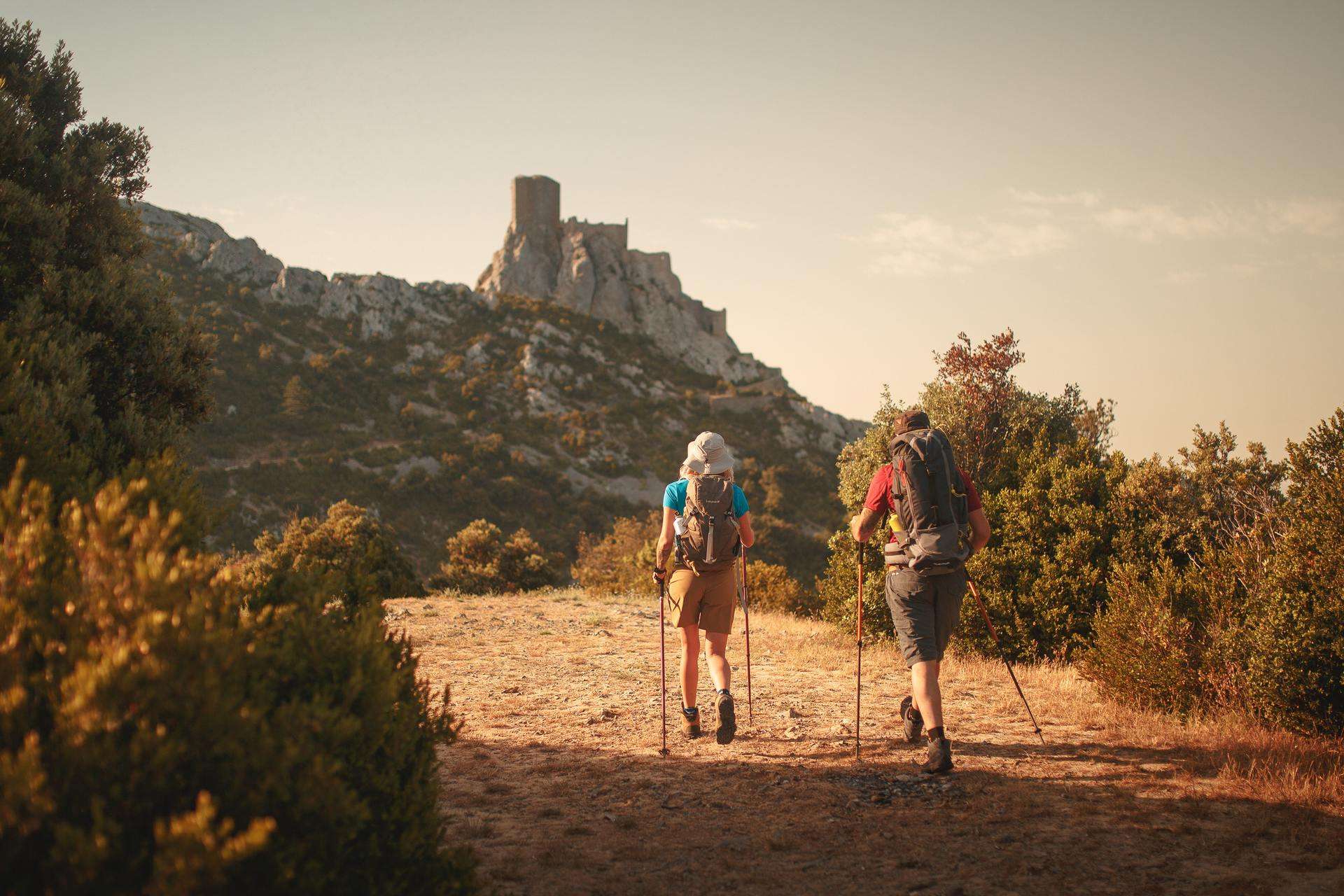
Hiking has become a highly sought-after activity in the world of outdoor sports and recreation. It has emerged as a solution to the hypermobility that characterizes our society, offering an immersive experience that leaves a lasting impression throughout our lives. In this article, we explore how this experience is perceived and the elements that make it so unique to each individual. As part of this research, we sought to understand how moving through a space influences this experience. To this end, we conducted on-site, group-based semi-structured interviews along the Cathar Trail, a symbolic route in the Pyrénées-Orientales. Blending history with wild landscapes, this hike is seen as a truly timeless immersion.
By Kenaël MORDINI
I am passionate about outdoor activities, especially hiking. My keen interest in adventure stories and exploring new places has led me to take a deeper interest in long-distance hiking. I wanted to understand how the experiences described in these stories actually unfold.
Introduction
Hypermobility is now deeply ingrained in our society, where every day is meticulously orchestrated and driven by the desire for profitability. This alienation from speed and the pursuit of time savings is gradually distancing people from the most fundamental form of movement: walking. This phenomenon can be observed in everyday life: work draws more on mental resources than on physical ones (Le Breton, 2001, p. 6). Consequently, the body is neglected, and walking becomes more of an activity than a form of movement in the strict sense. It offers a different relationship with time, in which one devotes oneself to understanding oneself and one’s environment, as Le Breton (2001, p. 10) asserts: “walking is a tranquil method of re-enchanting time and space.” This is particularly true of wandering, a meaningful practice that prioritizes the act of moving itself, sometimes at the expense of the importance placed on the final destination (Marsac et al., 2012). It is not limited to a mere physical journey but seeks to redefine the walker’s relationship with their surroundings by imbuing places with personal meaning (Berthelot and Corneloup, 2008). These definitions converge in one respect and encourage us to view wandering not as a tourist product to be consumed, but as an experience that unfolds along the way. This approach to walking echoes emerging trends in tourist mobility. It responds to the desire to preserve the sense of discovery while promoting nearby and local destinations. As Kaufmann (2008, p. 115) points out, “going faster and farther no longer guarantees a change of scenery.” It thus offers an inexhaustible opportunity to rediscover territories, as the landscape constantly unveils new revelations. Although this practice is booming and attracting new enthusiasts of outdoor activities every day, it remains difficult to define the elements that make up a travel experience. This article aims to explore this issue by examining the various factors that shape this experience, as well as the influence of movement through space on it.
Experiencing the Place While Traveling
What are the representations of homelessness?
Every environment is rich in representations, which shape the practitioner’s experience. They are described as “the translation of the way a subject conceives of and structures itself in its relationships with the objects that affect it” (Leroux & Rigamonti, 2017, p. 8). A second definition provided by Di Méo (1990, p. 360) suggests that representation originates in space and is “constructed in the human brain, where the object is distorted, or its meaning takes on collective significance, becoming associated with mental images, ideas, and correspondences specific to the individual, to the subject….” Every space traversed becomes imbued with meaning, both through its aesthetic dimension (form, verticality, volume…) and through the social relationships it elicits. Using the example of mountainous landscapes, Depau and Ramadier (2011) demonstrate the construction of the “mountain spirit.” To illustrate this, let us consider the Alps compared to the Pyrenees. Effort, pushing one’s limits, and accomplishment are all concepts used to describe an ascent into the heart of the Alpine massif (Corneloup, 2012). Consequently, the Alps are often perceived as a place of grandeur and challenge, where the hiker is confronted with an imposing natural environment that they attempt to master. This firmly entrenched perception has been shaped in part by the physical characteristics of the Alpine mountains, particularly their high altitude. In the Pyrenees, it is the “wild nature of the environment” and the “apparent lack of human influence” (Barna, 2020, p. 7) that seem to define the landscape. In this sense, the quest for adventure manifests itself more through immersion in this wilderness than through the accomplishment of athletic feats. However, as Barna (2020, p. 1) points out, since information about the Pyrenean region and its representations is limited, this may suggest a similarity to those of the Alps. Frolova’s work (2001, p. 4) also expresses the idea that applying the “Alpine landscape model” to other mountainous regions, particularly the Pyrenees, leads to a certain form of neglect or downplaying of their unique characteristics. Consequently, our study—which focuses on the Cathar Trail, an iconic trail in the Pyrenees—will provide a deeper understanding of the representations associated with this area. As demonstrated by the “mountain spirit” concept developed by Barna (2020), the imagined nature of an environment and the values associated with it influence the hiker’s behavior and perception of the experience. This process unfolds in three stages: the hiker will first adapt to their environment, then become accustomed to it. They will subsequently enter a phase of relaxation, during which they will become integrated into their surroundings. Finally, they will enter into symbiosis with the environment, adopting the “spirit of the place,” which will give them a different perspective on the space.
These mental representations are initially formed during the planning of the hiking trip and are sustained by “memories of past experiences” (Barna, 2020, p. 10). They partially shape the experience and are shaped by the events encountered as well as by the aesthetic character of the landscape traversed.
The Aesthetic Experience of Space
The landscape experience is defined here as the way in which individuals perceive, interpret, and interact with their visual and spatial environment. Marpot et al. (2021, p. 2) address this notion through the concept of “landscape engagement,” defined as “each person’s ability to experience a landscape through a particular activity ” (Marpot et al., 2021, p. 2). Landscape experiences are therefore deeply individual, blending intrinsic aspects of the landscape with subjective dimensions such as emotions and mental representations. In this sense, the practice of wandering would respond to the “desire to experience space with one’s whole body and not to be content with a spectatorial attitude ” (Corbin, 2002, pp. 180–181). It places the practitioner at the heart of an unstable landscape, shaped by the seasons, the weather, and the passage of time… As mentioned earlier, part of the landscape experience is explored through the lens of emotion. In this sense, it is plausible that these environmental factors play a role in shaping and intensifying this experience. While wandering, the participant is exposed to their environment over a relatively long period, which allows them to become more attuned to it or even to make it their own. However, as Olivier Sirost suggests, exposure alone is not enough. The concept of progression is necessary to appreciate one’s surroundings. It is this interplay between progression along the route and the duration of exposure to the environment that connects the participant to their surroundings—“the athlete then develops a special relationship with it” (Niel & Sirost, 2008, p. 191). The dimension of effort also appears to be linked to the appreciation of the environment. The body’s role in the landscape experience oscillates between activity and the environment. It is through effort and engagement that the environment is experienced: “the body’s dynamic engagement with space gives rise to new perceptions of the landscape ” (Niel & Sirost, 2008, p. 197). Alongside this dimension of effort, wandering is subject to the constraints of the environment and risk. It is therefore interesting to examine the role that risk plays in the practice and how this factor influences the experience.
The landscape experience, through its physical dimension (engagement, sensations) and its sensory dimension (emotions, interpretation), plays a crucial role in shaping the wanderer’s lived experience. However, beyond these aspects, it is also important to consider the symbolic dimension of wandering, which lends a deeper meaning to the walker’s experience.
The Symbolic Dimension of the Practice
Wandering is primarily characterized as an authentic experience in which practitioners share common interests: “the need to exist in a space of freedom, free from the constraints of modern life, and the search for spirituality in a society gripped by a crisis of values and reference points” (Rayssac & Pénari, 2017, p. 27). In this sense, the practice resembles an introspective quest, offering a “time and space conducive to confronting these situations,” while allowing for a rediscovery of the self (Lagarde and Rayssac, 2021, p. 5). Walking thus becomes meaningful: “It is by no means necessary to have a destination to walk… What matters in walking is not the destination, but what unfolds within it at every moment” (Le Breton, 2012, pp. 30–31). Some routes base their identity on one of these symbolic dimensions, thematizing the experience to contribute to its uniqueness. This is the case with Santiago de Compostela, which has successfully built a powerful narrative around spirituality and religion, one that is now firmly rooted in the landscape of hiking and tourism. (Lagarde & Rayssac, 2021, p. 5). Research on Santiago de Compostela and long-distance hikes highlights another fundamental dimension of the practice: interaction (Lagarde & Rayssac, 2021, p. 11). At first glance, one might think that pilgrimage, with its symbolic dimensions of introspection and rebirth, is a purely individual practice. However, all accounts of hiking experiences reach the same conclusion: interaction lies at the very heart of the practice. These interactions occur both with fellow hikers and with all the people encountered along the way and at the stopover points that punctuate their routes (Lagarde & Rayssac, 2021, p. 11). We will therefore seek to understand how these interactions are essential to the construction of the experience and how they manifest themselves.
The theoretical framework has allowed us to define hiking, identify its key issues, and propose hypotheses about how the experience is lived. However, it may be interesting to understand precisely to what extent the relationship to place shapes the experience during a hiking trip. The goal is to understand the mechanisms that tend to make a lived experience unique in the eyes of each individual.
Methodology
Choosing Methods
To shed light on this issue, we conducted a qualitative study. This involves a “normal, spontaneous, natural, almost instinctive way of approaching the world, questioning it, and understanding it” (Paillé, 2007, p. 409). This research method was chosen because it allows us to “grasp the meaning of a complex phenomenon as perceived by the participants” (Imbert, 2010, p. 25). In this sense, it aligns with our research question, which aims to understand the underlying mechanisms at work in the hiker. Our study will focus on the Cathar Trail, an iconic route through the Pyrenees that carries a profound historical significance. This field of study is particularly relevant because it resonates with the various themes discussed in our theoretical framework, such as the thematization of a route and its representations, its symbolic dimension, and the aesthetics of the Pyrenean landscape. We conducted semi-structured interviews with hikers we met in the early evening at a trail lodge along the Cathar Trail. The lodge had the advantage of being accessible after a minimum of five days of walking, which gave the hiker sufficient time to shape their experience and interpret the events they had lived through” (Imbert, 2010, p. 25). In this sense, it aligns with our research question, which aims to understand the underlying mechanisms at work in the hiker’s experience. The site features an outdoor area that serves as a gathering place for hikers. We chose the early evening because that was the time of arrival at the lodge, when hikers were most inclined to chat. We employed a semi-structured group interview conducted on-site. This allowed us to interview the homeless individuals in a natural setting, mimicking the kind of encounter and discussion that typically takes place within a shelter, as they are accustomed to. The group interview format allows the researcher to blend into the group to capture the authenticity of their interactions. Through the dynamics of the exchange, it enriches participants’ responses by adding nuance or insight. An individual interview was also conducted to delve deeper into the group accounts. This has the advantage of offering a different—and sometimes contradictory—perspective on the group accounts. The interview is divided into several themes: the hiker’s profile and their practical experience. It then addresses the hiker’s initial perception of the Cathar Trail and how they organized their trip accordingly. This section allows us to examine the mechanisms that tend to influence the choice of a route. We then discuss how the hiker experienced the journey, broken down into subsections covering interactions, the relationship to the landscape, and the relationship to safety and wandering. The interview concludes with the hiker’s perception of the route following the experience. The order and selection of questions will allow us to retrace the participant’s experience of the environment, in order to understand how it is constructed.
Profile of the respondents:
Table 1: Profile of Participants in the Group and Individual On-Site Interviews
| Interview | Participant | Age | Sex | Place of residence | Occupation | Experience in hiking |
| Collective | Vincent | 31 | M | Paris Region | Tattoo Artist | Santiago de Compostela |
| Collective | François | 70 | M | Arles | Former Physical Therapist | Santiago de Compostela, the Customs Officers' Trail, Saint-Guilhem-le-Désert, the Island of La Gomera |
| Collective | Cécile | 63 | F | Arles | Dental Surgeon | Santiago de Compostela, the Customs Officers' Trail, Saint-Guilhem-le-Désert, the Island of La Gomera |
| Individual | Christine | 67 | F | Nantes | Retired / Former Director of a Social Services Organization | Belle-Île, Stevenson Trail |
The Experience of the Environment
A Timeless Experience
Au travers des entretiens réalisés (tableau 1), nous avons pu prendre conscience de l’importance de la thématisation d’un itinéraire dans la création de l’expérience. Le sentier cathare, par sa thématique historique, plonge les itinérants dans un univers hors du temps. Nous avons recueilli deux visions diamétralement opposées quant à l’affect porté à cette dimension. Céline et Vincent, tous deux férus d’histoire, ont révélé être naturellement attirés par le sentier cathare : « J’adore l’histoire, et l’histoire des cathares en particulier. Le sentier cathare a ce côté un peu mystérieux, il y a ce côté un peu rebelle. Donc oui moi c’est vraiment l’histoire qui m’a attirée dans cette randonnée. Le catharisme, c’est une forme de mysticisme et de nostalgie » (Céline). Partir à la rencontre des châteaux et s’imprégner des représentations qui y sont associées étaient des éléments symboliques suffisamment forts pour engager un projet d’itinérance « J’ai vu qu’il y avait un parcours, qu’il y avait moyen de voir les châteaux cathares. Il ne m’en a pas fallu plus » (Vincent). Cette dimension historique propre au sentier cathare contribue à créer un imaginaire puissant autour des mythes et des légendes. François, qui n’avait pas d’attrait particulier pour l’itinéraire et son histoire, n’en reste pas moins intéressé. C’est au travers de la découverte qu’il vit l’histoire cathare « Ici c’est particulier, c’est spécifique. Le catharisme a fait beaucoup parler de lui et a laissé beaucoup de mystère, beaucoup de légendes. On prend les légendes, elles sont faites pour ne pas être découvertes, il faut les laisser en l’état » (François). Comme l’évoque François, les mythes et légendes contribuent grandement à l’attractivité touristique d’un espace. Parcourir le sentier cathare ne donne pas de réponses factuelles à leur sujet. Mais le simple fait de contempler le paysage marqué par les événements passés, permet de s’imprégner de l’histoire, de se questionner et d’imaginer. Le mystère est d’autant plus fort par la mise à l’écart de l’histoire cathare « Elle n’est pas enseignée, on n’enseignait pas le catharisme. Donc c’est quelque chose qui a été laissé un petit peu de côté, qui est en dehors de la bien-pensance de l’histoire. C’est intéressant de voir une autre facette des choses, de les voir sous un autre angle » (Cécile). Le témoignage de François met en lumière un fait intéressant. Lui qui n’avait pas d’attache particulière à l’histoire cathare, prend part à cet univers qu’il associe à un rêve « On apprend aussi beaucoup sur le plan intellectuel ce qu’est le catharisme, comment ils vivaient. On s’aperçoit de tout ça et puis on le sent, on le voit concrètement. C’était aussi le moyen-âge donc il y a aussi tout ce côté sociologique, ça nous fait rêver » (François). Au cours de l’entretien, les participants ont insisté sur l’immersion « hors du temps » qu’ils ont ressenti en traversant ces espaces « Ce qui est intéressant aussi c’est le côté hors du temps. Quand on fait de la randonnée itinérante dans des endroits portés par l’histoire, on a l’impression d’être en dehors des surfaces bétonnées, on se fond dans l’espace et dans le temps » (Céline). Ce nouveau rapport au temps se vit tout au long de l’itinéraire « On arrive dans des villes très anciennes, là on a l’impression d’être en adéquation. On est en dehors du temps parce qu’on traverse des endroits qui ne sont pas intacts, qui ont évolué bien sûr, mais qui ont peu changé » (Cécile). Ce rythme plus lent s’accorde avec la pensée « On ne va pas à la même allure que le reste du monde. La marche, c’est une bonne allure pour la pensée. Notre vitesse va à la même allure que notre pensée, et cette allure nous permet de penser, de rêver » (François). On constate que la thématisation sur l’histoire, associée aux mythes et légendes qui planent autour du catharisme, couplée à la lenteur de l’itinérance offrent une puissante immersion « hors du temps ». Cette redéfinition du temps permet à l’itinérant de penser, de rêver et de construire ses représentations.
Pour Christine qui ne présentait pas d’attache particulière à l’histoire des châteaux cathares, l’expérience a été nettement moins marquante. En effet, elle nous a révélé avoir choisi cet itinéraire pour rendre hommage à l’un de ses amis, passionné par l’histoire cathare, et qui projetait de réaliser le chemin à ses côtés « Ce sont nos copains qui nous ont donné l’idée. Donc, on a décidé de maintenir le projet pour eux » (Christine). Ce choix illustre également le rôle symbolique de nouveau départ incarné par l’itinérance : « c’est une façon d’effectuer un cheminement qui correspond à une transition de sa vie pour arriver à autre chose » (Miaux, 2012, p. 102). De ce fait, Christine s’est lancée dans l’aventure sans avoir aucune affinité particulière avec la thématique. « Ce n’est pas ce qui m’intéresse en priorité les châteaux, parce que ça concerne l’avant. Ce qui m’intéresse plus, c’est de voir le maintenant, de voir aujourd’hui comment les gens vivent » (Christine). L’expérience immersive vécue s’en retrouve alors amoindrie « Les châteaux, ça ne me transporte pas, je ne m’imagine pas au temps d’avant. Mais je pense que même sans attache, on peut apprécier l’expérience, mais c’est vrai qu’elle doit être vécue différemment pour un féru d’histoire ». Comme Christine le suggère, il est possible d’apprécier un environnement sans être attaché à sa thématique, mais cela se fait au détriment de l’immersion, réduisant ainsi l’expérience à un projet d’itinérance parmi tant d’autres.
An experience shaped by encounters and solitude
Hiking is based on a balance between interaction and moments of introspection. During the day, the hiker walks and takes in their surroundings. The individual experience takes precedence over the social aspect. We see this particularly in groups of hikers. Although they set out in groups—often with friends or family—they still express a need for distance:“When I go hiking with my friends, there are long stretches when we don’t talk, or when everyone takes some space” (Cécile). These distances form naturally and are necessary to reveal the introspective nature of the experience:“Everyone is lost in their own thoughts […] Walking inspires solitude, reflection, or the wandering of the mind and imagination”(Cécile). Walking alone allows the hiker to free themselves from the constraints of daily life and places them in a state of absolute tranquility : “The brain rests when you walk […] there’s a sort of purring in the mind that sets in, a sense of serenity that emerges from not having to talk constantly”(Cécile). This need for solitude is also so powerful in the eyes of the participants because it stands in stark contrast to our lifestyles. We are constantly bombarded with a flood of information and stimuli. The slow pace of wandering, coupled with its “timeless” quality, allows us to relearn how to appreciate simple things—including our own presence—and to engage in introspection by living in the present moment (Miaux, 2012, p. 102). Nevertheless, the experience takes a different turn in the evening, marked by encounters and exchanges:“The evening is more conducive to meeting people and having conversations” (François). The physical and conceptual layout of the accommodations includes shared spaces as well as a structure that encourages sharing: “a set time when meals are served, a communal table—not to mention the fact that dinner provides a time and space for fostering moments of conviviality and interaction” (Banos & Candau, 2011). The lodging, through its convivial setting, helps foster these collective experiences. “You arrive at a lodge, and well, there are people you don’t know. At first, you’reall doing the same sport; you share a common—or more or less common— approach” (François). The desired level of interaction varies from hiker to hiker. But according to the results of our qualitative surveys, three accounts point to the same desire: to find a balance between interaction and solitude. This is the case for Vincent. Although he has always hiked alone, he still mentions this need for interaction and describes it as essential:“It’s nice to interact in the evening—to spend time with a few people; it’s necessary. We’re still social beings. So it feels good to talk about your day, what you’ve seen. During the day, the need to be alone is satisfied” (Vincent). This need is felt all the more acutely on the Cathar Trail, where foot traffic is fairly light during the day. It’s partly this scarcity of interactions during the day, along with the limited availability of lodging options, that makes the experience different: “Sometimes we meet other hikers, like the two English women we got to know. We hiked together the whole way. Maybe in a way, the fact that there are so few people actually makes the interaction even stronger” (François). When hikers arrive at their lodging, they make themselves available to welcome new encounters and moments of sharing.“It’s a matter of being available. We probably wouldn’t do it if we were in our usual routine, where we’re always in a hurry” (Cécile).
The Aesthetic Experience of Space
La notion d’esthétique de l’espace renvoie au vécu de l’expérience, la manière dont on ressent l’environnement. Le caractère sauvage des paysages cathares est l’un des premiers critères évoqués par tous les enquêtés. Cette perception fait écho aux travaux de Barna (2020) portant sur les représentations de la montagne pyrénéenne, décrite comme sauvage, avec un manque apparent d’anthropisation. Vincent mentionne également l’aspect « rude » du sentier « je le trouve beaucoup plus rude que d’autres parcours. Ça colle un peu avec la vie des cathares, très simple, très spartiate » (Vincent). Ces éléments inhérents au paysage contribuent à la création des représentations, et permettent de vivre l’expérience différemment. Vincent exprime ce fait au travers d’une comparaison cinématographique « il y a des endroits, j’avais l’impression d’être dans le Seigneur des anneaux, avec des vues, t’as l’impression d’être dans le Rohan. Et je ne l’ai pas trouvé ailleurs ce côté-là. T’as des étendues gigantesques » (Vincent). Les caractéristiques sauvages et rudes de l’environnement vont projeter un imaginaire héroïque, dans lequel le randonneur va incarner le rôle d’un héros se déplaçant pour accomplir sa quête « Des fois tu montes sur des pics, t’as l’orage qui claque, t’as le côté impressionnant, le côté aventure épique, des vrais décors de films. Donc ouais déjà ça rend l’itinéraire unique, et forcément, ça rend l’expérience incroyable » (Vincent). L’expérience cinématographique portée par l’imaginaire fantastique se vit d’autant plus par la présence des châteaux cathares « C’est vraiment une claque en termes d’immersion, surtout avec les châteaux cathares en ruines, ouais ça donne un aspect très héroïc fantasy. On ressent vraiment l’aventure au travers des paysages » (Vincent). En ce sens, l’esthétique environnementale joue un rôle considérable dans la construction de l’expérience. Les caractéristiques morphologiques et les éléments propres à l’espace vont plus ou moins résonner en nous, en touchant aux répertoires historiques, artistiques, cinématographiques qui nous sont chers. Pour Céline, les châteaux cathares symbolisent l’accomplissement d’une étape « L’itinéraire est ponctué, c’est ça qui est bien aussi. Tous les jours il est ponctué par la visite d’un château et c’est un peu le graal (…) Tous les soirs, on aime bien avoir notre château à voir. C’est ce qui rend ce chemin un peu exceptionnel. Lorsque l’on y arrive, il y a toute l’histoire qui va s’imposer à nous ». Comme le mentionne Céline, la présence de châteaux en fin d’étape constitue un objectif à atteindre. Bien souvent, l’arrivée à l’hébergement marque la fin d’une étape dans les grandes itinérances. Néanmoins, dans le cas présent, le sentier cathare réussit à prolonger l’expérience « hors temps » jusqu’à la fin. Cela confère d’autant plus de valeur à la réussite de l’étape, puisqu’elle impose à l’itinérant une ultime ascension, pour accéder à chaque château. Dès lors, l’accomplissement donne lieu à une nouvelle part d’histoire. Dans les deux témoignages, le randonneur est mis en scène à travers son environnement. Pour reprendre le cadre théorique proposé par Aurélien Niel et Olivier Sirost (Niel & Sirost, 2008), nous retrouvons bien ici la notion d’exposition à son environnement et de progression dans le temps. Comme cela a été supposé précédemment, ce couplage participe grandement à l’immersion au sein de l’expérience. L’esthétique de l’espace ne concerne pas uniquement les caractéristiques morphologiques d’un paysage. En effet, comme cela a été supposé dans le cadre théorique, les caractéristiques instables telles que le temps et la météo peuvent modifier le rapport à l’environnement et l’intensité de l’expérience vécue. Nous avons pu le confirmer au travers du témoignage de Cécile. L’orage amplifie grandement les émotions suscitées par la mise en scène du paysage « l’autre jour, on a été au château de Quéribus. Il y avait l’orage qui menaçait, le ciel était noir, il avait plu et la pluie ruisselait sur les rochers, sur le château en ruines. Il y avait des corbeaux qui croassaient sur les ruines. Ça avait un côté irréel, un côté fantomatique. Et ça ajoutait beaucoup à l’ambiance de l’endroit. Donc ça peut clairement sublimer les scènes que l’on observe et ça contribue oui, à créer un imaginaire et des scènes qui vont marquer l’expérience que l’on vit » (Cécile). Cette perception rejoint notamment celle de Russel : « Les Pyrénées séduisent et attendrissent. Elles ont une poésie suprême et indéfinissable » (2005, p. 46). Cependant, pour Christine, l’expérience paysagère se révèle moins marquante. Bien qu’elle apprécie la grandeur des vastes espaces pyrénéens, cet environnement ne suscite en elle ni émotion spécifique ni imaginaire particulier. Ainsi, la sensibilité à la thématique et l’expérience paysagère peuvent être directement liées. La thématique d’un itinéraire peut enrichir et intensifier l’expérience paysagère en influençant la manière dont un randonneur perçoit et interprète le paysage. En revanche, dans le cas présent, l’esthétique de l’espace se vit davantage par l’effort pour Christine « L’effort nous offre un paysage, et contribue à l’impression de vivre une aventure ». L’apparition d’éléments météorologiques, dans le cas présent la pluie, est également appréhendée par la dimension physique, et non du sensible « Quand il pleuvait, je n’étais pas dans le même état de disponibilité. Je regardais plus mes pieds, et je trouvais ça plus pénible physiquement » (Christine).
Accessibility to the Sport
The final dimension supported by our interviews concerns the interplay between the quest for comfort and security and the pursuit of the unexpected and adventure. We identified two opposing approaches, similar to those discussed by Berthelot (2012). However, we wondered about the role that wandering plays in shaping the experience. Vincent sees the itinerary as a guiding thread around which he revolves.He doesn’t hesitate to veer off course to enrich his experience through encounters and the unexpected:“Talking to people sometimes leads you to change your route. They point out a place, you want to check it out, so you go.” As I meet people, someone will point out a spot to me; I trust them, I go check it out, and that’s how I’ve found some really great camping spots or ruins—little things worth seeing”(Vincent). In this case, the route isn’t set in stone and takes shape as encounters unfold. Once again, the experience takes the form of an adventure lived through the discovery of the wilderness (Barna, 2020, p. 7). In Vincent’s view, getting lost is the essence of the journey. It’s by getting lost that the experience takes shape:“The other day, just to give you an example, I walked 35 km, a storm broke out, and I ended up in a bistro. There was some kind of village festival […] a farmer offered to let me sleep in his barn to shelter me. It’s full of little things like that—events that are pretty fun to experience”(Vincent). Accepting the unexpected and confronting the unknown offers a new perspective on the lived experience. This account aligns with Le Breton’s view: the essence of wandering lies in the events and unforeseen circumstances that arise at any moment (2012, pp. 30–31). Accepting the unexpected thus becomes an essential factor in fully appreciating the experience.
The second approach views wandering through the lens of the search for comfort and security. This experience differs from one focused on “leading” (Berthelot, 2012). In this context, appreciating the environment is experienced more through contemplation than through wandering. Interaction with the environment is more limited:“For us, it’s more about seeing things. When we set out with everything well organized, it’s more that we want to feel secure. We’re a little afraid of the unexpected” (Cécile). The wandering trip is thus organized accordingly to minimize the unknown and uncertainties perceived as risks. Christine also adopts this approach, seeking to eliminate the unexpected, which she perceives as an obstacle to a safe experience. Nevertheless, François asserts that so-called “wild” wandering offers more opportunities and a more unique experience:“You’re comfortable somewhere; instead of leaving the next day, you leave in two or three days. Some places require more time to understand their history and appreciate the surroundings. If you plan your trip, you’re forced to leave the next day because you have a scheduled stop[…] You’ll have fewer opportunities, and they’ll be different”(François).
Conclusion
This research has shed light on various mechanisms that influence the relationship between long-distance hikers and their environment. Long-distance hiking is an activity that requires careful consideration to understand the expectations of a highly diverse clientele. The many forms and perspectives on this practice make it difficult for sports tourism stakeholders who wish to offer it to fully grasp. Our research has enabled us to identify four key factors related to the appreciation of the environment. The first factor is sensitivity to the route’s theme. We observed that the thematic focus of a hike can greatly influence the formation of mental images, which are intrinsically linked to the quality of the experience. A sufficiently compelling theme, such as that of the Cathar Trail, reinforces the route’s identity and encourages hikers to immerse themselves in a narrative to which they are drawn. The second factor is the interplay between interaction and solitude. Regardless of their profile, hikers seem to seek a balance. Even the most sociable hikers feel a need to reconnect with themselves. Conversely, the desire for solitude among more reserved hikers is fulfilled during the day. Time spent at lodging facilities then fulfills the second need, which centers on sharing and social interaction. The third factor concerns the aesthetics of the landscape, which influences the experience in several ways. It manifests itself both through its physical dimension—associated with the effort required, movement through the landscape, and the sensations felt during the hike—and through its sensory dimension, linked to emotions and the interpretation of the visual and spatial environment. As illustrated by the example of the Cathar Trail, unstable elements such as temporal, seasonal, and meteorological variations can greatly amplify the intensity of the lived experience. These visual and spatial experiences are internalized and preserved through memory to form new mental representations. Finally, the fourth factor is accessibility to the activity, which highlights the duality between mastering one’s environment and wandering aimlessly. There are two distinct perceptions of the experience: on the one hand, hikers for whom the route serves as a guiding thread around which they will revolve. The experience will be shaped by the unexpected and by encounters… On the other hand, there are hikers who wish to maintain control over their surroundings, with an experience more focused on contemplation. However, individual factors such as age will partially influence how the activity is practiced. Younger hikers express a desire for a more “wild” adventure, which is often more affordable. Conversely, older hikers prefer a more “controlled” approach, often due to health considerations.
Every hiking experience is unique and is shaped at various levels by these four factors. To illustrate this, let’s compare the two routes studied in this research. The Way of St. James, marked by a deeply symbolic dimension, offers hikers a spiritual experience centered on a new beginning. In contrast, the Cathar Trail, rooted in a rich history, transports hikers through a wild and ever-changing landscape, where heroic epic and the poetry of the surroundings intertwine. Thus, each route, through the interplay of perceptual, cultural, physical, and social elements, engages the hiker in a personal and inimitable adventure.
BIBLIOGRAPHY
Banos, V., & Candau, J. (2011). Processes of Domination and Service Relationships: Farm Stays in the Heritage-Designated Périgord Region. Swiss Journal of Sociology, 37(3), 419.
Barna, R. C. (2020). Hikers in the High Pyrenees: What Perceptions Shape Which Practices? Revue de Géographie Alpine, 108-3. https://doi.org/10.4000/rga.7402
Berthelot, L. (2012). Toward a Post-Tourism Era?: The Concept of Recreational Travel as a Framework for Rethinking Mountain Tourism: A Study of the Practices and Experiences of the Grande Traversée des Alpes Association [Doctoral dissertation]. University of Grenoble.
Berthelot, L., & Corneloup, J. (2008). Itinérance, du Tour aux Détours. A Contemporary Perspective on Recreational Nature Activities (p. 199). Editions du Fournel. https://shs.hal.science/halshs-00391481
Breton, D. L. (2001). Side Roads: In Praise of Walking. Quaderni, 44(1), 5–16.
Breton, D. L. (2012). Walking: In Praise of Paths and Slowness. Métailié.
Corbin, A. (2002). Man in the Landscape. Paris: Textuel.
Corneloup, J. (2012). “The ‘Paths of the Imagination,’ on the Threshold of Transmodernity.” Environmental Education. Perspectives – Research – Reflections, Volume 10, Article Volume 10. https://doi.org/10.4000/ere.1104
Depau, S., & Ramadier, T. (2011). Space as Representation: Understanding the Social Dimension of Individuals’ Relationship with the Environment. *Pratiques Psychologiques*, 17(1), 65–79. https://doi.org/10.1016/j.prps.2010.01.006
Di Méo, G. (1990). From Subjective Space to Objective Space: The Path Through the Labyrinth. L’Espace géographique, 19(4), 359–373. https://doi.org/10.3406/spgeo.1990.3020
Frolova, M. (2001). The Representation and Understanding of the World’s Mountains: The Pyrenees and the Caucasus Through the Lens of the Alpine Model.Revue de Géographie Alpine,89(4), 159–172.https://doi.org/10.3406/rga.2001.3063
Imbert, G. (2010). The semi-structured interview: At the intersection of public health and anthropology. Nursing Research, 102(3), 23–34. https://doi.org/10.3917/rsi.102.0023
Lagarde, D., & Rayssac, S. (2021). “The More You Go, the More You Want to Go”: Examining the Desire to Return to the Ways of St. James. Belgeo. Belgian Journal of Geography, 2, Article 2. https://doi.org/10.4000/belgeo.49228
Leroux, I., & Rigamonti, É. (2017). Toward an Institutionalist Interpretation of Local Acceptance of a Prison. Économie et Institutions, 25. https://doi.org/10.4000/ei.5866
Kaufmann, V. (2008). The Paradoxes of Mobility: Moving and Putting Down Roots. Méditerranée, 113, 154–155. https://doi.org/10.4000/mediterranee.3859
Marpot, S., Chanteloup, L., & Perrin-Malterre, C. (2021). Landscape Experiences and the Practice of Ski Touring in the French Alps.Projets de Paysage,25.https://doi.org/10.4000/paysage.24604
Marsac, A., Lebrun, A.-M., & Bouchet, P. (2012). Sustainable Tourism and Tourist Experiences: A Dilemma. Proposal for an Analytical Framework Applied to Rural Tourism. Management & Avenir, 56(6), 134–153. https://doi.org/10.3917/mav.056.0134
Miaux, S. (2012). The Experience of the Pilgrimage Routes to Santiago de Compostela: A Different Relationship Between the Subject and Place. ResearchGate. https://www.researchgate.net/publication/242164366_l’experience_de_l’itineraire_des_chemins_de_saint_jacques-de-compostelle_un_autre_rapport_du_sujet_au_lieu
Niel, A., & Sirost, O. (2008). Sports Activities and Landscape Formation (Alps, Calanques of Marseille). Études rurales, 181, 181–199.
Paillé, P. (2007). Qualitative Research: A Methodology of Proximity (pp. 409–444). https://doi.org/10.2307/j.ctv18pgtsn.20
Rayssac, S., & Pénari, S. (2017). Tourism and the Ways of St. James in France: Practices, Stakeholders, and Governance of the Cultural Heritage Site . Sud-Ouest européen. Geographical Journal of the Pyrenees and the Southwest, 43, Article 43. https://doi.org/10.4000/soe.2588
Russel H. (2005).*The Pyrenees, Climbing, and the Philosophy of Exercise*, Monhelios, Gurmencon.