Adaptation Strategies and Governance Models for Mid-Mountain Resorts in the Face of Global Warming: The Case of the Jura Mountains, as Illustrated by the Resorts of Les Rousses and Métabief Mont d’Or
The sports tourism sector is constantly evolving, transforming, and innovating. Mountain resorts are facing a new challenge: adapting to climate change. This phenomenon has become a major concern today for mid-mountain resorts. The challenges facing snow-related activities are being taken very seriously. A series of roundtable discussions on the transition of mountain tourism was launched on March 16, 2021, during a symposium in Métabief Mont d’Or. Our article is fully in line with these current developments. Through semi-structured interviews conducted at two resorts in the Jura Mountains (Métabief Mont d’Or and Les Rousses), we will demonstrate how the governance model of a mid-mountain resort influences a strategy for adapting to global warming. Our comparative analysis highlights the impact of two governance models on the phenomenon under study.
Climate change has led directly to insufficient snowfall in most French mountain ranges. A number of resorts have already closed for economic reasons related to the lack of snow in France: “In total, 166 out of 583 (28.4%) ski resorts in France have been abandoned” (Métral, 2019, p. 1). This decline in snowfall began in the 1970s, with a 1°C increase in temperature in metropolitan France during the20th century, according to MétéoFrance.¹ Scientists predict that this trend will intensify. They estimate that “the increase in the global average surface temperature by the year 2100 will range between 1 and 6 °C” (Kandel, 2010, p. 2). It is evident that global warming is affecting all mountain ranges, and even more so the lower-altitude mid-mountain ranges, including the Jura Mountains, our study area. Mid-mountain resorts are highly sensitive to climate-related challenges. Indeed, observations from the Vercors Massif—where climate challenges are similar to those in the Jura—show a sharp decline in snowfall in these mountain ranges. These observations are based on the AdaMont project (adaptation of mountain regions to climate change): “The fine-scale climate projections carried out by Météo-France for the Vercors region as part of the AdaMont project are consistent with the observations and highlight a significant decrease in the snow-to-rain ratio in the medium and long term” (François et al., 2019, p. 7). These observations are confirmed in the Jura Mountains according to a study conducted in Franche-Comté. “Winters are shorter: two months of snow cover at 900 m today, compared to 2.5 months at the beginning of the last century” (Richard, 2018, p. 1). These figures confirm increasingly shorter winter seasons.
Furthermore, findings from the AdaMont project show that the current economic model based on downhill skiing is being called into question. Mid-mountain resorts are forced to completely rethink their tourism offerings and consider new development strategies in order to find alternatives to snow-related activities.
Some resorts have already launched transition projects, such as the mid-mountain resort of Métabief Mont d’Or, located in the Doubs department (25) in the Jura Mountains. The resort is implementing a climate transition strategy with a clear goal: to phase out snow-related activities by 2030–2035. However, this is not the case for all resorts in this mountain range. Fifty kilometers away, the resort of Les Rousses (39) is pursuing a strategy to develop year-round activities. The resort’s strategy is to retain a significant portion of its snow-related activities.
This initial finding is based on an analysis of semi-structured interviews conducted with stakeholders at each station in 2021 as part of our first-year master’s thesis (Buin, 2021). It is further supported by the current regional initiatives being carried out by these stations.
The two different approaches taken by the resorts stem from strategic choices dictated by their political leaders. In this article, we will focus on the governance and management models of mid-mountain ski resorts. This analysis will enable us to understand the strategic adaptation choices specific to a particular governance model.
The context of mid-mountain resorts—and more specifically that of the Jura Mountains—leads us to pose the following question: What are the links between the strategies implemented and the governance models of mid-mountain resorts, in the context of adapting to climate change?
We will attempt to understand the complex strategic choices facing the resorts of Les Rousses and Métabief Mont d’Or: whether to maintain the current economic model based on skiing while diversifying, or to develop a new economic model that does not rely on skiing.
Different Types of Governance and Adaptation Strategies
First, “governance is part of an ongoing quest for better systems for managing people and resources” (Defarges, 2011, p. 7). The author goes on to explain that governance is the exercise of power by an individual or group among various actors (companies, the government, organizations, etc.) within a given territory, where decisions result from ongoing negotiation among all these actors. In other words, governance—whether public or private in nature—aims to organize a territory in response to the challenges it faces by leveraging its resources (human, financial, technical, etc.).
There are various governance models, and in this regard, Jaccard et al. (2016, p. 90) identify a typology of actors based on their management model. The first is “private” management, in which the municipality delegates the management of the ski lift service to a private operator. The entity is private. The second is “public” management, in which the municipality directly provides the ski lift service (either as a municipal agency or an EPIC). The entity is public. The third is “mixed” management, in which the municipality entrusts management to a SEM (société d’économie mixte), a mixed-economy company in which the municipality holds a majority stake. The entities involved are both public and private.
In our analysis, we will see that each form of governance is part of a hybrid governance model. Hence the value of conducting a more in-depth analysis of this governance model by incorporating the three types of partnerships identified by Svensson et al. (2005) in the table below.
Table 1: The 3 Types of Partnerships
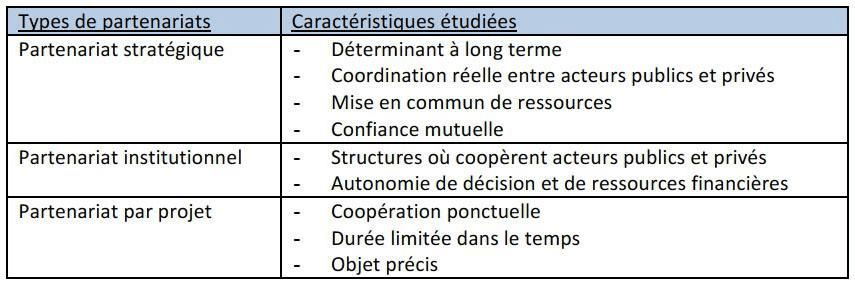
(Svensson et al. 2005, pp. 32–37)
Alongside these three types of governance, Jaccard et al. (2016, p. 90) identify two major management models. The first is the community model, in which services are decentralized. Each actor specializes in their own service, and there is no dominant power. The second is the corporate model. Services are integrated (in a corporate-style structure), and a profit-driven approach is emphasized.
Two Models of Strategic Adaptation to Climate Change
Climate change is forcing mid-mountain resorts to adopt adaptation strategies. According to Simonet (2016, p. 2) and Anouk (2019, p. 3), there are two main adaptation models. The first, “adjustment,” aims to sustain the winter sports industry economically by ensuring a supply of snow in the region. This model aims to rebalance infrastructure and development needs to compensate for insufficient snowfall. The second model, “transformational,” focuses on diversifying the region’s offerings in response to climate change. This model aims to redefine the region’s tourism strategies, with snow-related activities no longer being the top priority.
A region shaped by economic factors
Economic considerations are at the heart of political decision-making. This is especially true when the sector in question is a key driver of the region’s economy. Looking back at the origins of ski resorts, it becomes clear that they were created and developed based on a purely economic model. The objective was clear: to capitalize on alpine skiing through mass tourism: “The creation of winter sports and mountaineering resorts was part of a logic of mass consumption” (Debarbieux, 1995, p. 68).
Today, this model is proving all the more fragile as we are seeing a growing trend of fewer operating days at ski resorts throughout France, which is impacting their profitability. The economies of mid-mountain resorts remain heavily dependent on winter activities even today. We can see this in the case of the Métabief Mont d’Or resort, which generates more than three-quarters of its revenue during the winter season (Buin, 2021).
Nevertheless, the alpine skiing industry remains highly profitable when conditions permit (sufficient snow cover). This explains the challenges ski resorts face today:
- To continue with a business model that works very well, generating short-term profits, without knowing what the long-term future holds;
- Initiate a transition and a shift in the economic model now, to ensure a long-term future.
This is the central challenge facing mid-mountain ski resorts today, and political decisions are at the heart of the decision-making process. It is these decisions that will determine and dictate the strategies for addressing climate change, ensuring the long-term sustainability of the resort and its surrounding area.
The notion of territory is very important. According to Zimmermann (1998), the concept of territorial anchoring refers to a “localized collective learning process aimed at generating resources.” Indeed, “processes of territorial anchoring require, as a necessary condition for success, that local actors develop collective strategies that ensure their economic, social, and institutional survival ” (Cañada & Muchnik, 2011, p. 4). This territorial anchoring directly concerns the resort’s governance, since its impact—particularly its economic impact—is not measured at the resort level, but rather, of course, on its territory, its environment, and its stakeholders.
The objective of our analysis is to link the governance structure, types of partnerships, and management model of our two mid-mountain resorts in the Jura region to one of the adaptation strategies. The concepts of territory and economy will form the basis of this analysis.
Methodology
Our scientific approach is based on the collection of qualitative data. We conducted four semi-structured interviews—two in person and two by phone—each lasting an average of 45 minutes.
These interviews were conducted using an interview guide that addressed various topics: a general introduction to the resort and the interviewee, the region and its local roots, governance, and key issues. The scope of our study is limited to the Jura Mountains region, specifically the resorts of Métabief Mont d’Or (25) and Les Rousses (39).
We were able to interview the directors of each resort: the director of the Mont d’Or Joint Authority (SMMO Director) and the marketing director of the Société Anonyme d’Économie Mixte (SAEM) of the Les Rousses Resort Management Company (Sogestar Director). We also interviewed two representatives from the intermunicipal communities: the president of the Lacs et Montagnes du Haut-Doubs Intermunicipal Community (Elu. CCLMHD), which oversees the Métabief Mont d’Or resort, and the president of the Les Rousses Intermunicipal Community (Elu. CCSR).
Furthermore, our approach has been enriched and complemented by our participation in forums for reflection, dialogue, and consultation. In fact, we participated via videoconference in a European symposium on the impact of climate change on ski resorts (March 16 and 17, 2021, in Métabief Mont d’Or) and in a conference on mountain tourism in transition (October 4, 2021), moderated by the Director of the SMMO (who was interviewed). The information gathered consists of qualitative data obtained through expert interviews on the subject.
Our research methodology, which involves conducting interviews at both stations, clearly incorporates a comparative approach. Indeed, the goal is to compare these two stations in order to identify similarities and/or differences related to our research topic. The decision to interview a staff member in the same position at each of the two stations supports this comparative approach.
Nuanced Territorial Ties
Two resorts with different economic stakes
The economic challenges facing the two resorts under study are different. First of all, the resort of Les Rousses is much less dependent on skiing than Métabief Mont d’Or. Les Rousses generates 70% of its revenue in the winter: “I think SAEM must have revenue of 6.5 million euros. Roughly 4.5 million euros in the winter and 2 million in the summer” ( CCSR official). Meanwhile, the Métabief Mont d’Or resort generates 86% of its revenue in the winter: “On average, the resort runs a surplus of 3,300,000 euros in the winter and 500,000 euros in the summer ” (SMMO Director). This shows that in the event of a significant decrease in snowfall, Les Rousses has “non-snow” revenue four times greater than that of Métabief Mont d’Or. This is why Métabief Mont d’Or, which lags behind in its “non-snow” activities, must develop a new business model.
In addition to generating half as much economic revenue as Les Rousses, Métabief Mont d’Or is burdened by a debt of 15 million euros (SMMO Management). Les Rousses, on the other hand, has no debt. The resort can afford to continue offering skiing and extend the ski season. Significant investments are being made in new infrastructure, such as next-generation snow cannons and the creation of new snow reserves. The economic picture—as reflected in the revenue generated by “non-snow” activities and the debt levels of the two resorts—shows that Métabief Mont d’Or lags significantly behind Les Rousses economically.
Speeding up decision-making depends on regional roots
The resort of Les Rousses, due to its less exposed areas and its higher elevation—100 to 150 meters—has enjoyed a respite of about ten years in terms of snowfall. This allows it to continue reaping the economic benefits of snow-related activities for a few more years—benefits that are of immense importance to ski resorts, according to the director of the SMMO (Métabief Mont d’Or). TheCLIMSNOW2 studies conducted by the two resorts confirm the statements made by the director of the Syndicat Mixte du Mont d’Or. The Métabief Mont d’Or resort faces greater climate vulnerability than Les Rousses due to its geographic location.
Furthermore, the tourism sector is central to the strategies of the Rousses region. The political importance attached to this sector demonstrates the region’s interest in and economic dependence on it. Its regional roots run deeper than those of Métabief Mont d’Or. In fact, winter tourism development is one of the three key priorities for the Jura resort area:“As for priorities, historically we’ve had three major ones: agriculture (food crops, market gardening, forestry, wood panel production), artisanal skills (stone carving, wood furniture), and the development of winter sports, which began in the middle of the century ” (CCSR elected official).
This regional roots are reflected in greater economic benefits for Les Rousses: “There’s a rule that says for every 1 euro spent on the ski lifts, there are 5 or 7 euros in economic benefits for the region” (CCSR Elected Official). Meanwhile, Métabief Mont d’Or has a weaker multiplier effect: “We have a leverage effect of 1 to 4, which isn’t very high compared to other resorts” ( SMMO Director). The economic priorities for the Doubs resort’s region rely more on: “ agricultural activities, the timber industry, and cross-border trade—and precisely because we don’t rely on the tourism sector.”
(CCLMHD Elected Official). The tourism sector is a secondary priority for the region.
Finally, Switzerland, which borders both resorts, plays a contrasting role in the dynamics of the two regions. The Les Rousses resort has partnered with the Swiss ski area through the construction of a new chairlift costing 12,000,000 €. This new lift began operating in December 2020. It now provides a connection between the two ski areas: “The creation of a new ski area called Jura sur Léman—a new Franco-Swiss ski area—opens up significant opportunities for collaboration with our Swiss neighbors” (Sogestar Director). This is an opportunity for Les Rousses, which is seeking to attract new customers, increase visitor numbers, and maintain its performance despite climate change. This is not the case 50 km away, in Métabief Mont d’Or, where Switzerland is described as a “magnet for visitors,” according to the director of the SMMO. The conversion of tourist lodging into cross-border accommodations is concrete evidence of this trend in the region. Switzerland is perceived as a threat to Métabief Mont d’Or, whereas Les Rousses views it as an opportunity.
It is evident that the Métabief Mont d’Or resort has a fragile and vulnerable local foundation due to its debts, its dependence on snow, its altitude, and the threat posed by Switzerland. This trend is accelerating as a result of global warming. The resort is therefore compelled to change its business model if it wishes to continue generating economic spillover effects in its local area—which, as Debardieux (1995) notes, is the foundation of winter sports resorts. For its part, with its strong local roots, the resort of Les Rousses is less dependent on external factors and generates significant economic benefits, thanks to a new opportunity with Switzerland that allows it to maintain its current business model in the face of global warming.
The well-established business model of the Les Rousses resort stems from its strong regional assets, in accordance with Zimmermann’s (1998) concept of regional anchoring, as compared to the Métabief Mont d’Or resort.
Different Governance Structures and Management Approaches
The Métabief Mont d’Or ski area and resort are managed by a joint public-private entity, meaning they are under direct public management. The resort operates under a public management model in accordance with the three models described by Goncalves (2013). The type of actor in this governance model is public.
Although the SMMO is a public governance body, the strategy is to include all of the resort’s stakeholders. The input and perspectives of local businesses (equipment rental companies, restaurants, lodging providers, travel agencies, etc.) are important, according to the SMMO director: “The tourism office and the collaboration with local businesses for tourism development are a weak point for us, and we must address this in the short term over the next fifteen years as part of our transition project.” Indeed, the resort aims to cooperate with private stakeholders in the short term with an eye toward the long term, in order to build mutual trust between public and private actors. This approach aligns with the concept of strategic partnership as defined by Svensson et al. (2005).
Finally, according to the two models of governance for mountain tourist resorts discussed by Jaccard et al. (2016), the governance of Métabief Mont d’Or is similar to the community model. Indeed, all stakeholders in the region are independent and experts in their respective fields, and no single dominant authority oversees the adaptation process.
Conversely, the Les Rousses ski area is managed by a Société Anonyme d’Économie Mixte (SAEM)—also known as Sogestar—through indirect, or mixed, management. Two other organizations are involved in the resort’s management: the Communauté de Communes de la Station des Rousses (CCSR) and the Syndicat Mixte de Développement Touristique (SMDT). The resort operates under a mixed management model based on the three models described by Goncalves (2013). Private and public stakeholders are organized around various entities.
According to Svensson et al. (2005), the station is part of the institutional partnership. Indeed, “Stakeholders demonstrate their cooperation within a shared organization. […] In this case, the partnership requires a certain degree of decision-making autonomy and financial resources at its disposal in order to become
"effective" (Svensson et al., 2005, p. 34). The Rousses resort is a perfect example of this type of partnership, in which the public and private sectors come together under a single umbrella organization, SAEM. This entity is responsible for the resort's development.
In addition, at the helm of governance, we find the public sector—represented by the Rousses Community of Municipalities—and the private sector—represented by banks and ski schools. : “In our structure, we have private companies that are shareholders of SOGESTAR, since SOGESTAR is 85% owned by the community of municipalities, but the remaining 15% is held by banks and two ski schools” (SOGESTAR Director). The private sector plays a very prominent role in the governance of this resort.
Sogestar manages the ski area under a 6-year resort contract. Every 6 years, the community of municipalities meets to decide whether to extend or terminate the contract. This contract-based governance model imposes a performance obligation on the operators for the duration of the term. Les Rousses can be likened to the corporate model (ibid). Indeed, Sogestar’s operations are profit-driven, as the entity managing the ski area is partly privately owned. The shareholders expect a return on their investment.
In summary, the Les Rousses resort operates under a mixed management model, whereas Métabief Mont d’Or operates under a public management model (Goncalves, 2013). The second difference lies in the partnership between private and public stakeholders: in Les Rousses, public and private stakeholders are united under a single structure, whereas in Métabief Mont d’Or, they cooperate in parallel. Finally, the third difference is the resort’s economic model. One must generate profit from its ski area because it is accountable due to its mixed-management status (Les Rousses), whereas the other acts in the interest of the economy of its entire territory (Métabief Mont d’Or).
Different Strategies: Transformational Adaptation for Métabief Mont d’Or vs. Adjustment for Les Rousses
Since 2019, the Métabief Mont d’Or resort has been implementing a climate transition strategy: “Since January 1, 2019, the joint authority has been responsible for […] coordinating an engineering center dedicated to climate transition” (SMMO Director). The Métabief Mont d’Or resort is part of a transformational adaptation strategy, as described by Simonet (2016), to adapt to climate change. These policy directions are part of a roughly 15-year investment plan with short-, medium-, and long-term objectives: “In the short term […] build the four-season toboggan run and foster cooperation within the region. In the medium term (5–10 years), the goal is to invest in the region […]. In the long term—over 15 years—the goal is to dismantle the ski lifts, with the exception of the Morond chairlift” (SMMO Director). It is evident that the transformational strategy is being implemented over time.
In contrast, the Les Rousses resort is pursuing a strategy of diversification and sustaining winter sports activities. The development of infrastructure, such as the construction of the new “Des Jouvenceaux” chairlift and the creation of snow storage areas, are examples of this. We can thus link Simonet’s (2016) adaptation and adjustment strategy to the Les Rousses resort in the face of climate change. Indeed, the adjustment strategy is characterized by a rebalancing of the infrastructure already in place. Policy directions are part of a short- and medium-term strategy: “Today, given current trends—and we’re well-positioned to see this—it’s difficult to predict developments beyond six years. Even having a six-year outlook is already quite good. ” (Sogestar Director). The six-year period corresponds to the term of a station contract between the CCSR and the SAEM. It is evident that the adjustment strategy is being implemented in the short term.
The strategy depends on the resort's governance and context
The public governance model of the Métabief Mont d’Or resort appears well-suited to implementing a transformational strategy. The director of the Syndicat Mixte du Mont d’Or emphasizes that the ability to effect change over time, through (public) governance, is a crucial advantage of the direct management model: “When we talk about climate transition, we need to look beyond 10 years. I advocate
"The model that governs this. It’s the best model for change management. […] When I talk with other managers in France, this is confirmed. The management approach determines the capacity for change." These remarks are supported by the characteristics of the strategic partnership described by Svensson et al. (2005). Long-term transition projects are conducive to success, particularly through public governance. Furthermore, a transition project such as this must involve all local stakeholders, hence the need for cooperation with local socio-professional groups. This is one of the objectives of the “community model” (Jaccard et al., 2016). The strength lies in each stakeholder’s expertise in their respective fields, which will enable the transformation of the region at all levels. The public sector is there to support each stakeholder in the transformation process. This transformation must take place across the entire region. According to the director of the SMMO, this is one of the top priorities: “The focus is not on the ski area itself, but rather on the surrounding region in order to develop non-snow-based offerings.”
The regional and economic context also plays a role in the adaptation strategy. Our analysis shows that Métabief Mont d’Or, given its fragile economy and vulnerability (as outlined in section 3.2) to global warming, is moving very quickly toward diversifying its economic base. This has led to a transformational strategy currently being implemented across the region.
Conversely, the mixed governance model at Les Rousses ski resort appears conducive to developing an adjustment strategy. Indeed, strategies are planned for the short and medium term. The development plan supports this management model under a 6-year contract for the ski area. The mixed management model allows for investment in the ski area while continuing to benefit from snow-related activities through the mixed management structure (SAEM).
Short-term development is supported by institutional partnerships (Svensson et al., 2005). Indeed, mixed governance is characterized by autonomy in decision-making and economic value. This allows for the development of specific projects, such as the construction of a new chairlift. The mixed governance model applies solely to the ski area.
The local context and climate pose an economic challenge for the resort: “Today, it’s true here and throughout the Alps, the economic model driven by snow is very profitable, and no one has found a solution to replace it. ” ( Sogestar Director). They wish to continue operating the ski resort for as long as possible, since the activity is very successful in this region, which is consistent with the mixed management of the ski area. This is the objective of a governance model based on a corporate structure (ibid).
Based on our analysis, we can link, on the one hand, the public management model and the strategic partnership to a transformational strategy and, on the other hand, the mixed management model and the institutional partnership to an adjustment strategy. The time horizon (short- and long-term) is a distinguishing factor between the two strategies discussed by Simonet (2016) and links the two management models of the two stations used as examples. The second factor distinguishing the two strategies is the scope of the strategy’s geographic coverage. Public governance extends its strategy to the entire territory, whereas mixed governance focuses on its ski area. The third factor is the role of the private sector in decision-making and its cooperation with the governing body.
Conclusion
Given its deep roots in the local community and the fact that the ski area is particularly vulnerable to climate change, Métabief Mont d’Or must change its current strategy if it hopes to continue supporting the local economy and its stakeholders in about fifteen years. We have seen that its direct management model is a real asset for its long-term transition strategy.
For its part, the resort of Les Rousses, which is enjoying a “breather,” is continuing its “four-season” strategy, with a strong focus on the winter season as part of an approach of adaptation and adjustment, according to Simonet (2006). It has the capacity to capitalize on this for longer than Métabief Mont d’Or and has a genuine economic interest in continuing to operate its ski area by continuously improving its infrastructure.
Direct governance appears to be conducive to the development of a transformational adaptation strategy, while hybrid governance appears to be conducive to an adjustment-based adaptation strategy for a ski resort.
Both resorts have successfully adapted to the challenges posed by their climatic conditions. However, it seems necessary to develop a new approach to tourism engineering—one that incorporates intrinsic land-use solutions—to ensure the sustainability and even the economic development of mid-mountain resorts. Indeed, today it is winter tourism products that sustain these ski resorts.
Let’s take the example of the Ventron resort in the Vosges. This resort had to close its ski area due to a lack of snow in 2020. Today, the resort has managed to bounce back and has been revitalized by investors in the luxury hospitality sector. The goal is to continue to sustain the local economy and create attractions beyond those tied to “white gold.”
Looking ahead, what solutions—in terms of tourism, cultural, sports, or recreational activities—will generate as much economic impact as skiing, now that alpine activities have come to a halt?
Bibliography
Anouk, B. (2019). Climate Change Adaptation in Winter Sports Resorts in the French and Swiss Alps: What Role for Public Authorities? Adaptation and Tourism, 227–234.
Buin, M. (2021). The Challenges of Transition for Mid-Mountain Resorts in the Face of Global Warming: The Case of the Jura Mountains, as Illustrated by the Resorts of Les Rousses and Métabief Mont d’Or, Unpublished Master’s Thesis , Faculty of Sports Sciences and Physical Education, University of Montpellier I.
Cañada, J. S., & Muchnik, J. (2011). Introduction: Local Anchoring and Territorial Identity of Local Agri-Food Systems. Économie rurale. Agricultures, alimentations, territoires, 322, 4–10.
Debarbieux, B. (1995). Tourism and the Mountains, Paris , Economica. Défarge, P.M. (2011). Introduction. Governance, 5–8.
François et al. (2019). Adaptation Challenges and Best Practices for the Vercors Region. Adaptation Stories, 28, 62–69.
Goncalves, O. (2013). Private or Public Management: Which Governance System Leads to Which Level of Performance? Public Administration and Management, 40–57.
Jaccard, É. et al. (2016). The Governance of Mountain Resorts and Their Sports and Tourism Policies: The
Lessons from the Villars-sur-Ollon Case. Public Administration and Management, 87–105. Kandel, R. (2010). Introduction. Que sais-je ?, 5–12.
Lemercier, C. et al. (2015). Integrating Qualitative and Quantitative Approaches: A Case for Reasoned Hybridization.
Becoming a Researcher: Writing a Thesis in the Social Sciences, 125–143.
Métral, P.-A. (2019). The Hidden Side of Winter Sports: Abandoned Ski Resorts. The blog of the Grenoble Anti-Tourism Office, (accessed October 25, 2020).
Richard, H. (2018). Global Warming: What Impact Will It Have on Franche-Comté? Besançon – Environment, article
Published in *L'Est Républicain* on June 3, 2018 (accessed October 21, 2020)
Simonet, G. (2016). From Adjustment to Transformation: Toward a Boom in Adaptation? Sustainable Development and Territories, 1–7.
Svensson, B., et al. (2005). A governance perspective on destination development: exploring partnerships, clusters, and innovation systems. *Tourism Review*, 60, 32–37.
Zimmermann, J.B. (1998). Nomadism and Territorial Roots: Methodological Proposals for the Analysis of Relationships
firmes-territoires. Journal of Regional and Urban Economics, 98-2, 211–230.
1AccessedOctober 13, 2021: http://www.meteofrance.fr/climat-passe-et-futur/le- global-warming-observed-worldwide-and-in-france
2 Climate Study on Snow Reliability (https://www.climsnow.com/)