Walking Tours: An Experience Designed to Cope with Our Fast-Paced Society
Hiking is gaining new enthusiasts every year. The simplicity of walking, the connection to nature, exploring places accessible only on foot, and the reputation of certain trails—these are all factors that contribute to its popularity. Beyond the physical exertion, the experience of hiking offers a sense of freedom. However, does hiking allow one to break free from social constraints? In this study, we sought to examine this experience and explore hikers’ feelings. To this end, we conducted participant observation, as well as two semi-structured on-site interviews and four post-hike interviews. The adventure of hiking symbolizes more than just physical exertion and travel from one destination to another. It is a journey that leads to self-discovery, the discovery of others, and the discovery of the world around us.
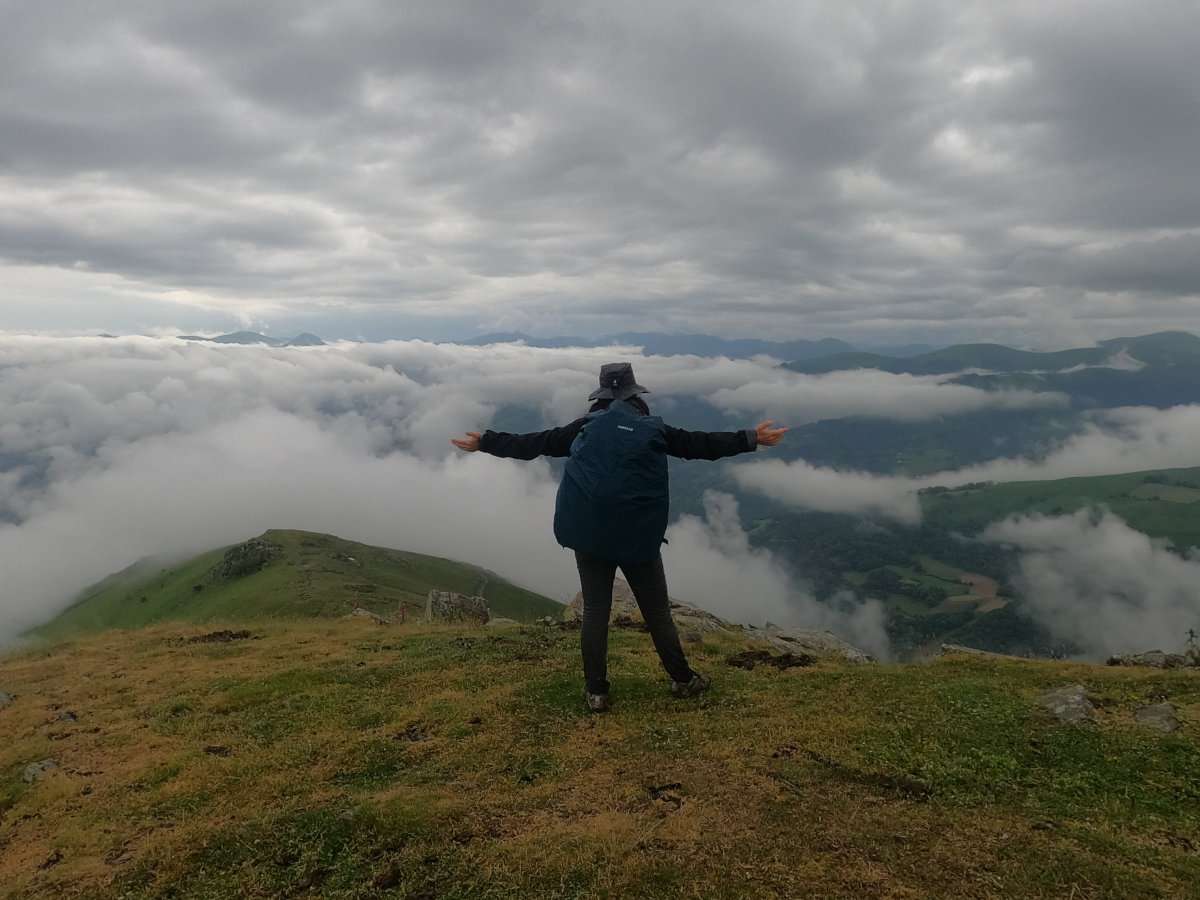
The fifth and final day of our backpacking trip through the Basque Pyrenees, in rainy and foggy weather, with the goal of reaching Saint-Jean-Pied-de-Port. We were climbing our final peak; once we reached the top, we felt as if we were in paradise, suspended between two layers of clouds, enjoying a return to the simplicity of nature. We left at the end of our trip with our minds filled with memories of an unforgettable adventure…” (participant observation, June 2021).
In recent years, we have seen an unprecedented surge in interest in hiking. This is undoubtedly linked to health and environmental factors, but also to a societal phenomenon: the compression of time and our “controlled temporalities” (Gramaccia, 2005). Indeed, in our societies, we no longer take the time to observe what is happening around us; we are constantly pressed for time. Walking helps counter this phenomenon; it requires the walker to be present—they have time for themselves and for the world around them. So, in the face of this ever-more-fast-paced society, hiking allows us to rediscover the time that is available to us.
The French Hiking Federation (FFRp) defines backpacking as a form of hiking that lasts more than three days, with overnight stays in different locations. Furthermore, it is through this organization that the Grandes Randonnées (GR) trails are established. These trails “show that the pleasure of hiking consists of simple, natural, and human elements” (Siroux, 1968, p. 6). Indeed, many philosophers use hiking as a means of reflection. Thus, walking is “an opportunity to reflect on oneself, to engage in introspection, and to analyze our deeds and actions ” (Pavie, 2014, p. 10). Beyond this physical activity, hiking is linked to a symbolic dimension and is “practiced by people seeking to return to simpler ways of life, often associated with a rediscovery of the self” (Barna, 2020, p. 2). The goal of backpacking is not simply to complete a stage or a GR trail; it is a daily challenge in the face of personal and societal problems. In this way, it allows one to “break free from the superficiality of society and material objects” (Corneloup, 2008, p. 16). Long-distance hikers are seeking a completely different experience, viewed as an escape, a source of renewal, “a journey toward the self” (Jullien, 1999, p. 101).
A Search for Experience
Sociology of Experience
It is evident that hikers’ accounts and various studies show that long-distance hiking leads to introspection and transforms the hiker. But this social experience, as lived by hikers, is also constructed: “the experience cannot be separated from the social categories of its narrative” (Dubet, 1994, p. 103). In 1994, François Dubet defined the sociology of experience as “defining experience as a combination of logics of action” (Dubet, 1994, p. 91). It is inherent to human nature to create one’s own experiences; reflecting on these experiences requires subjectivity on the part of the actors and presupposes a certain degree of reflexivity—an awareness of their own experiences. The actors themselves question their practices; we observe a desire to be the agents of their own lives. Social experience thus “studies representations, emotions, behaviors, and the ways in which actors account for them” (Dubet, 1994, p. 256). Dubet specifies that we must take into account the freedom expressed by individuals, which is evident in the hikers’ accounts, where they express it very concretely as follows: “I feel free” (Jullien, 1999, p. 19). But this notion also remains a social dimension within these experiences. Hiking involves more than just a body in motion. Hikers’ reflections involve introspection on their own practices and ways of being while on a hiking trip, as well as on their relationship with others, with the world, and with the space around them. The hiking trail will have an impact on how the experience is felt and lived.
The Trail Experience
Some trails have a symbolic dimension, such as the Way of St. James. This trail has a very strong religious dimension, where hikers are referred to as pilgrims. The return of travelers on this path evokes a transition in life between the pre-hike and post-hike phases. This is evident in Zapponi’s work on Santiago de Compostela, where “the Way of St. James is experienced as a place of return to one’s essential self, the ‘true self’” (Zapponi, 2010, p. 77). The pilgrims’ experience on the trail transforms the hikers. The mountains also provide a mystical setting. They draw us in with their mysterious and wild nature, largely untouched by humans, which allows for a certain closeness to nature: “hiking in the mountains is an experiential journey” (Andreux, 2008, p. 163). This leads hikers to develop a distinct culture and imagination, as well as a genuine “mountain spirit” (Barna, 2020, p. 9). In choosing the trail, we will draw on an initial personal experience on the GR 10 in the Basque Pyrenees. Furthermore, Barna’s study on the perceptions and practices of long-distance hikers in the high Pyrenees demonstrates that “hiking in the Pyrenees can be explained by the search for a different meaning in life—one that is closer to nature and more orderly” (Barna, 2020, p. 11). This combination of factors therefore justifies our choice of the GR 10 as the site for our field study—a 922-km trail that runs along the Pyrenees from the Atlantic Ocean to the Mediterranean Sea. It is a true adventure, where hikers find themselves immersed in the heart of nature within these Pyrenean mountains.
A Return to a Simpler Life?
When hiking, the hiker sets out with only the bare essentials in their backpack, which leads them to make use of natural resources—particularly when it comes to replenishing water from springs. Furthermore, some hikers prefer to camp for the sense of freedom it offers, the desire to be self-sufficient, the tranquility, or even the “search for a connection with nature ” (Barna, 2020, p. 7). The simplicity of these actions allows one to “break free from the superficiality of a materialistic society” (Corneloup, Berthelot, 2008, p. 16) and to “escape the consumerist world” (Barna, Rayssac, 2017, p. 237). Carrying a backpack limits the amount one can bring and requires making choices. This has an impact: “the experience of the essential and of living with only the few objects indispensable to the pilgrim’s life is described as transformative” (Zapponi, 2010, p. 79). Setting out on a walking pilgrimage transforms walkers after the experience. It allows for an escape from society, as can be seen on the Camino de Santiago, and challenges one’s relationship with oneself, with others, and with the world.
One might wonder to what extent the experience of hiking leads the hiker to reflect on themselves and to confront a hyper-modern society. One might assume that despite the desire to detach oneself from society and the evocation of a sense of freedom, the experience of wandering remains socially constructed. This experience is itself linked to a social imperative, the underlying forces of which must be understood through the analysis of accounts of these experiences.
Methodology
Choice of Methods
To address this issue, we conducted a qualitative study using a total of two methodologies. First, we conducted semi-structured interviews with hikers who had completed part or all of the GR10; “the interview-based survey thus allows for the qualitative collection of firsthand data” (Samlak, 2020, p. 38). Second, we conducted on-site interviews over four days in the Pyrénées-Orientales. Comparing these two types of interviews will allow us to observe whether this relationship with oneself, the world, and others occurs during the hike, or whether the reflection observed in the theoretical framework occurs instead after the experience.
To develop a robust interview framework, we drew on prior participant observation conducted during a five-day hike along the section of the GR 10 trail through the Basque Mountains. In addition, the semi-structured interview will be supplemented by the explicitation interview technique. This methodological approach encourages respondents to provide “the most detailed description possible of their actual experiences” (Gouju, Vermesch, Bouthier, 2003, p. 63). Thus, the essence of this method lies in the verbalization of the respondents’ actions. In this case, the objective is to have the respondents reflect on their experiences as street workers and to explore their lived experiences.
With regard to the post-GR respondents, we opted for snowball sampling; we will draw on the network established through the 2021 survey. As for the interviews, we chose to hike the GR 10 from the Pyrénées-Orientales toward Arles-sur-Tech. This choice stems from the fact that the vast majority of hikers traverse the trail from west to east. We therefore hiked in the opposite direction to increase the likelihood of encounters. We will thus rely on convenience sampling. The selection of participants therefore does not represent all types of hikers (ages, socioeconomic categories, etc.) that can be found on the GR. In the Barna study, we can see that the profiles of hikers are mixed in terms of gender, with the majority ranging from under 30 to 50 years old (80%). Furthermore—and this is an important factor—the majority of backpacking hikers belong to a higher socioeconomic class or are students. We did not aim for exhaustiveness, as we were interested only in qualitative data. The interviews lasted between 15 minutes and 1 hour and 14 minutes.
Survey Respondents

Life Experiences
A Different Relationship with Others
It is evident from the accounts of the hikers interviewed that encounters play a significant role in their experience. Their stories are punctuated by moments of sharing and mutual support among hikers; these encounters are “intergenerational—there was no age difference on the GR […] you might not be so young anymore, but we all move at our own pace, set up camp, and chat—we’re all equal” (Emmanuelle). Another respondent mentioned that backpacking is a way for him to “rediscover what it means to be human” (Mark). Indeed, a sense of trust develops among hikers who walk and camp together. However, in everyday life, it is frowned upon to
We don’t trust strangers; we tend to be suspicious, and we address people older than us formally. Memories associated with hiking are shaped by anecdotes and encounters: “Collective experiences of hiking and guided mountain treks are very enriching” (Andreux, 20098, p. 160).
Groups of hikers form as they meet along the way, and some of these encounters profoundly change the hiking experience. One of the women interviewed found herself hiking the GR 10 alone after her friend dropped out, but that’s how she was able to experience wonderful moments of sharing and mutual support with other solo hikers. In particular, she recounts nights when her tent was leaking: “Water was pouring down on me. There were guys sleeping with me so I wouldn’t get cold” (Laurine).
But these shared experiences also happen with mountain hut caretakers or locals. These moments have shaped Christian’s experience: “We had some truly fantastic moments with people—people from the towns […] they’re very down-to-earth folks” (Christian). There are also moments of celebration at the mountain huts that add to these memories along the GR: “We ran into Olivier, a 55-year-old hut owner who insisted on treating us to the first beer, then the second, then the third…” (Simon)—an experience that also happened to two other interviewees. The experience of backpacking wouldn’t be the same without these encounters. “We have a compelling need to share, to love, to compare, to laugh […] to communicate with all our senses.” (Jullien, 1999, p. 103). Hikers thus step outside their everyday context and take the time to interact; they are open to encounters and to sharing.
A Rediscovery of Nature and Everyday Life
The experience of hiking is shaped by various elements, such as one’s relationship with nature, where hikers rediscover a sense of closeness. Indeed, in our increasingly urbanized society, people have become distanced from nature. This need is mentioned in particular by Mark, who lived in Paris for part of his life and wanted to rediscover nature and connect with it. In this context, hikers are immersed in nature; they disconnect: “Out there on foot, in the mountains—and especially on the GR10—we really disconnect; we’re out in the wilderness” (Emmanuelle). This very strong connection with nature, this closeness—as Christian mentions in the Pyrenees—is part of the experience itself. The GR 10 trail has a direct impact on hikers: “Nature and the elements have generated within me a powerful inner strength that focuses my entire being on an extraordinary desire to live” (Jullien, 1999, p. 70). It also allows hikers to experience unique, simple moments that shape the journey: “Swimming in the river, washing in the river, and all that—so the three of us were naked, swimming and washing, and we were laughing our heads off. We’d done our laundry beforehand, and, well, it was actually a super simple thing” (Emmanuelle). For the hikers, the Pyrenees weren’t a destination they specifically sought out for their travels; rather, it was a natural extension of their life journeys. This contrasts with the choice to hike the GR 20, which is directly linked to its reputation and scenery. But ultimately, what stands out about the Pyrenees is the great variety of wildlife along the route—a point that comes up in the interviews with five respondents. The Pyrenees thus offer a respite from urban civilization. Simon expresses his wonder at the landscapes and sunsets. But this feeling is also fostered by the presence of animals roaming freely on the trails, as observed during participant observation. These findings reveal how the respondents perceive their relationship to the environment in which they find themselves. This aligns with the work of Barna, who notes a difference in hiking practices “due to the difference in elevation compared to the Alps, which may account for a more contemplative approach to backpacking in the Pyrenees” (Barna, 2020, p. 10). The Pyrenean mountains thus influence hikers’ experiences and the way they describe their backpacking journeys.
This experience has an impact on returning to daily life, “a new goal, which is to make time” (Mark). It has led to a realization: “In my sedentary daily life, I tend to forget that, for me, taking that time is actually very important” (Emmanuelle), and it also influences professional life. Among the six hikers surveyed, three were considering a career change, and another chose to work only part-time. This relationship with time spent alone in nature influences moments of introspection during the journey. However, it’s clear that expressions of introspection and perspective are stronger among solo hikers. These are less prominent in Christian’s account of his trek with friends.
The Subjectivity of Backpackers
The slow pace of walking leads them to take their time—to take time for themselves. This is something that is sometimes lost in today’s society: “Wandering implies a willingness to embrace time, where duration and slowness combine in varying ways” (Boutroy, 2008, p. 115). This is what enriches this subjective experience: “Yeah, when you’re all alone, you have time to think; you do everything on your own, and I find that really enjoyable” (Simon). For Zoé, the goal of engaging in self-reflection was her reason for setting out in the first place: “to take stock, but in a setting completely different from usual—and above all, without any obligations” (Zoé). Hiking allows for “that connection where, well, your body and mind are kind of on the same wavelength” (Zoé). Indeed, as we have seen in the theoretical framework, walking is championed by philosophers as a tool for self-reflection.
But this subjectivity, linked to the hiker’s physical posture, is inextricably tied to the physical experience hikers go through. Physical exertion and concentration allow one to fully experience the journey: “I really feel more connected to the present moment in those moments […] I’m in tune with the moment. I control my breathing; I observe nature” (Emmanuelle). Hiking leads the hiker to confront their thoughts alone.
Hikers view long-distance hikes as “a life experience” (Mark) that lead them to develop a personal perspective on their journey, expressed through the various emotions and sensations that wash over them. This is reflected in Simon’s account: “It really puts me at peace with myself,” “It’s just a sense of fulfillment—it’s great” (Simon). Emmanuelle also says, “Honestly, I don’t know—something happens in my body and mind that makes me love it and gives me this sense of fulfillment. ” (Emmanuelle). Both mention this sense of fulfillment, and we also find other positive adjectives such as “I really felt pure happiness,” “a sense of freedom” (Emmanuelle), or even a sense of calm for Mark. Andreux echoes the words of David Le Breton in his book *In Praise of Walking*. Indeed, he states that “wandering, walking over several days, fosters a different perception of the world and of oneself” (Andreux, 2008, p. 160).
This leads them to reflect, or even to engage in introspection. This is what Emmanuelle refers to when she talks about the meditative aspect of her hike and how it helps her step back to get to know herself better: “And actually, especially during the hike, I found that I had some ‘aha’ moments—I think there were quite a few… well, yeah, yeah, I had a realization about certain things that concerned me” (Emmanuelle). Without this turn inward—which was more widely observed in the post-GR interviews and among hikers who set out alone—one can’t help but question the experience.
Social Norms in the Face of a Society in Flux
Dubet’s three logics of action reveal how experiences are socially constructed: “We act in accordance with our integration and socialization […] we are individuals who strive to ‘fulfill’ ourselves and to ‘live’ as the masters of our own actions” (Dubet, 2008, p. 8). Dubet identifies three logics of action. The first stems from the system of integration—specifically, one’s various affiliations, particularly culture and values.
In light of this, it’s clear that even before the backpacking trip, the interviewees were drawn to adventure and hiking; they all share this adventurous spirit. This is reflected in their relationship with nature, particularly in terms of a sense of wonder: “All the animals, the incredible sunsets. Everything—the whole trip is unforgettable” (Simon). Similarly, this perspective encompasses the “them/us” dynamic among the participants, which connects to the significant memories tied to encounters with others during the backpacking trip, including moments of celebration and mutual support among the hikers. They unconsciously share this culture of sharing and kindness toward one another, stemming from the education they received about hiking, as well as their sensitivity to the protection of flora and fauna. Furthermore, “human beings have an innate tendency, embedded in their genes, to seek connections with nature” (Cosquer, 2022, p. 14).
The second framework encompasses the competitive system, which reflects the hiker’s motivations and the goals they pursue. During the interviews, we asked about the reasons for setting out on the GR 10. Some mentioned a need to reconnect with nature, a desire to take stock of their lives, or to experience and share an adventure with friends—or on their own… While the initial goals vary, they all share this desire to complete the trail and return to the Pyrenean mountains: “My goal is to cross the Pyrenees—the entire route” (Christian). Similarly, this aligns with the qualitative data examined earlier regarding the goal of setting out on an adventure: “I’ve always had a thirst for adventure and all that. And also to prove things to myself.” This desire allows hikers to reconcile the exploration of new territories with this sense of freedom; hiking “is an experience of freedom, an inexhaustible source of observations and daydreams” (Le Breton, 2001, p. 12). But this competitive dynamic is less pronounced in the experience of hiking. Indeed, the typical rivalries between individual and collective interests are not observed here. Hikers are more open to others and to sharing.
Finally, the last framework relates to subjectivity and encompasses the cultural system. It allows us to observe how the individual defines themselves within society. In light of this, we identify the elements that reflect how hikers distinguish between their way of being while on a backpacking trip and in their daily lives. This time spent on the trail is truly valued as a time to disconnect from daily life, a time of peace and tranquility: “These are really the moments when I feel my best, most in harmony with myself; I’m smiling from morning to night” (Simon). This subjective perspective is complemented by empirical data on the rediscovery of time and nature: “Setting out on a backpacking trip means creating distance” (Andreux, 2008, p. 163) from what is socially imposed upon them.
Taken together, these perspectives reveal, within the social experience of backpacking, an aspect that stands in contrast to our fast-paced society, where we are always in a hurry. Here, hiking allows for a return to a sense of time, freeing the mind to give free rein to thoughts and reflections. Also evident is this logic of sharing with others, which is very prominent in hikers’ accounts. These experiences are enriched by moments of sharing among strangers, yet they are deeply meaningful. A kind of camaraderie forms among itinerant hikers, who set out with divergent interests but share the same ultimate goal. However, even though the participants speak of this need for detachment from society, it is clear that this experience remains socially constructed. It stands in contrast to the imperative of individual fulfillment, where “each person is called upon to assert their subjectivity and uniqueness” (Delory-Momberger, 2010, p. 3). Indeed, despite this escape from society, the experience of long-distance hiking is the result of a social construction. It is linked precisely to this subjectivity, this desire to be the agent of one’s own life, and to “the expression of the quest for the self” (Zapponi, 2020, p. 75). This echoes Cosquer’s research: “If contact with nature is beneficial to us, it is perhaps because, through establishing this connection, we perceive different ways of being in the world” (Cosquer, 2022, p. 14).
Walking to Rediscover Yourself
This research as a whole has allowed us to understand the expectations and behaviors of long-distance hikers, to gain a better understanding of what motivates them in their activities, and to identify the elements that make for a fulfilling experience. We can thus see the importance of long-distance trails and GRs, which are more than just paths that structure the landscape: they have a symbolic dimension that plays out throughout the hikers’ journey. This research may be particularly useful in demonstrating the role of the FFRP, which has been significant since the 1970s.
Hiking allows you to discover new places, but it is more than just a physical challenge or a sporting feat. It is an experience that enables the hiker to build their sense of self, to take control of their own life, and to create their own experiences. It also highlights the importance of connecting with nature, as well as the notion of taking time for oneself—a challenge in our fast-paced society—representing “a universal need for identity renewal” (Zaponi, 2010, p. 83). Travel agencies that market treks must take these factors—which represent a break from everyday life—into account. To market this type of trip, agencies and tour operators must be able to offer their clients a human adventure, where encounters, shared experiences, and closeness to nature are at the heart of the trip.
Throughout this research phase, we focused on what walking trips offer. Throughout our lives, we experiment, we experience, and we walk. Numerous studies have been conducted on hiking, which draw conclusions about these benefits in particular. But walking trips are an experience that leaves a lasting impression on the hiker. We can see, then, that the central element in accounts describing long-distance hiking is the encounters—the unexpected interactions with fellow hikers or with locals. These are the highlights of the experience, the moments that resonate in memories of the journey. Openness to others is a very prominent characteristic of long-distance hiking. Second, we have seen that long-distance hiking leads to self-discovery and an understanding of one’s own capabilities. Thus, long-distance hiking prompts the hiker to engage in self-reflection—particularly regarding their self-concept and daily life—which helps explain the career changes that often follow the hiking experience. What emerges is the notion of reclaiming the time we’ve lost in our everyday lives. But taking time—in a natural environment—is part of the experience; it’s a source of renewal in which the hiker finds themselves immersed in the heart of nature. This has an impact on their feelings and perceptions of backpacking.
We have seen that the experience of backpacking is socially constructed by the society in which we live. It is the social construction of the idea of self-actualization that leads the hiker, through backpacking, to assert their identity and thus experience this sense of freedom. However, it defies the logic of competition based on the rivalry between individual and collective interests. What takes precedence, rather, is this reconnection with others—a departure from everyday life—where the hiker opens up to others without fear. In contrast to highly urbanized daily life, nature is seen as a place of renewal and fosters a completely different relationship between the hiker and their inner reflections. One might then ask whether the experience of hiking—through encounters with fellow hikers in nature—allows one to break free from social determinism and foster this sense of freedom?
Bibliography
Andreux, C., 2008.—“Guided Wandering: A Training Resource for ‘Eco-Wandering’” in Berthelot, L., and Corneloup, J. (eds.), *Itinérance, du Tour au détours*, Du Fournel, L’Argentière La Bessée, pp. 155–167
Barna, R. C. (2020). Hikers in the High Pyrenees: What Perceptions Shape Which Practices? Journal of Alpine Research | Revue de géographie alpine, 108, 3, Article 108, 3. https://doi.org/10.4000/rga.7402
Berthelot, L., and Corneloup, J. (eds.), 2008.— *Itinérance, du Tour au détours*, Du Fournel, L’Argentière La Bessée.
Boutroy, E., 2008.—“An Ethnologist’s Wanderings: Some Candid Notes on an Ambiguous Object” in Berthelot, L., and Corneloup, J. (eds.), *Itinérance, du Tour au détours*, Du Fournel, L’Argentière-La Bessée, pp. 111–120
Cosquer, A. (2022). Why Does Nature Make Us Feel Good? Rhizome, 82, 13–14. https://doi.org/10.3917/rhiz.082.0013
Delory-Momberger, C., 2010. “The Role of Narrative,” *L’orientation scolaire et professionnelle*, 39/1: http://journals.openedition.org/osp/2479
Dubet, F. (2014). Sociology of Experience. The Color of Ideas.
Gouju, J., Vermersch, P., & Bouthier, D. (2003). Objectification of athletic actions through explanatory interviews. A case study. *Staps*(No. 62), 59–73. https://doi-org.ezpum.scdi-montpellier.fr/10.3917/sta.062.0059
Gramaccia, G. (2005). Toward a Society of Schedules: A Shift in Temporalities. *Communication & Organisation*, 26, 258–260.
https://doi.org/10.4000/communicationorganisation.3303
Jullien, F., 1999 – *La Grande Traversée des Pyrénées*, Du Fournel.
Le Breton, D. (2001). “Side Roads: In Praise of Walking.” Quaderni, 44(1), 5–16. https://doi.org/10.3406/quad.2001.1478
Pavie, X. (2014). The Body as the Subject of Spiritual Exercises. Sociétés, 125, 69–79. https://doi.org/10.3917/soc.125.0069
Samlak, N. (2020). Qualitative and Quantitative Approaches in Field Research: Observation, Interviews, and Questionnaires. Linguistic Journal and Intercultural Frameworks, 1.
Siroux, R. (1968). Long-distance hiking trails. Revue Forestière Française, 10, 670. https://doi.org/10.4267/2042/20208
Zapponi, E. (2010). The Pilgrimage to Santiago de Compostela. Archives of the Social Sciences of Religion, 149, 73–87. https://doi.org/10.4000/assr.21855